Alligator Gar
The alligator gar is the largest fish in most of the waters it swims, a true freshwater giant that can exceed 8 feet in length and weigh over 300 pounds.
🗓️ Last reviewed: June 2026
Overview
The alligator gar is the largest fish in most of the waters it swims, a true freshwater giant that can exceed 8 feet in length and weigh over 300 pounds. It is the apex predator of the slow Southern rivers and reservoirs it inhabits, an armored relic that has survived essentially unchanged for tens of millions of years. For decades it was persecuted as a destructive nuisance and shot, netted, and poisoned out of many waters. That campaign nearly erased it from parts of its range. Today the story has flipped: the alligator gar is recognized as a magnificent native gamefish, a trophy on par with anything in North American freshwater, and managed carefully where it still thrives.
For anglers, the alligator gar offers something nothing else can - the chance to hook and battle a fish longer and heavier than themselves in inland waters. It is a specialized, patient, and physically demanding pursuit, and one of the most thrilling big-fish adventures available without going to sea.
Identification & Appearance
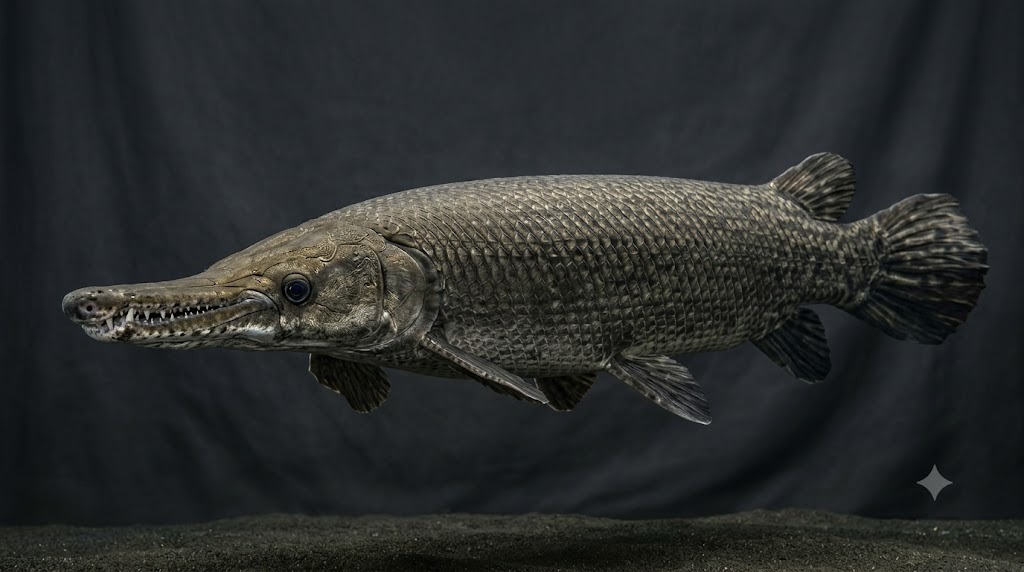
The alligator gar is unmistakable once you see one. The body is massive, elongated, and cylindrical, encased in interlocking diamond-shaped ganoid scales that form near-impenetrable armor - early settlers reportedly used gar hide for protective covering and the scales as arrowheads. Coloration is olive-brown to gray-green on the back, fading to a yellowish or white belly.
The head is broad and the snout is the key identifier: short, wide, and alligator-like, far broader than the slender beak of a longnose gar. The upper jaw carries two rows of large teeth - a distinctive feature that separates it from other gar species. The dorsal and anal fins sit far back near the powerful tail. Juveniles have a prominent stripe. Sheer size is itself an identifier; any gar over 6 feet in inland US water is almost certainly an alligator gar.
Range & Habitat (US waters)
The alligator gar is a fish of the South and lower Midwest. Its stronghold is the lower Mississippi River basin and the Gulf Coast drainages, with the strongest populations in Texas, Louisiana, Mississippi, Alabama, Arkansas, and parts of Oklahoma. It also occurs in the Florida panhandle and historically ranged farther up the Mississippi system, where restoration efforts are now underway.
It favors large, slow rivers, their backwaters and oxbows, big reservoirs, bayous, and brackish coastal estuaries - alligator gar tolerate salt and are sometimes caught in coastal bays. It prefers deep, slow pools with abundant baitfish and gravitates to warm water. Like all gars it breathes air and handles low-oxygen, warm conditions with ease, often surfacing to roll and gulp.
Behavior & Feeding
The alligator gar is a patient, ambush-oriented apex predator. Despite its fearsome look it is generally a lethargic, slow-moving fish that hangs in deep pools and backwaters, conserving energy and feeding opportunistically. Its diet is dominated by fish - gizzard shad, buffalo, carp, and other rough fish make up the bulk - and large adults also take waterfowl, turtles, small mammals, and carrion. Its broad, double-toothed jaw lets it grab and crush larger prey than slender gars can handle.
Alligator gar feed most actively in warm water. They spawn in spring and early summer when rising water floods vegetation; the females are remarkably fecund, scattering huge numbers of eggs over flooded grass. The eggs, like all gar roe, are toxic. Gar grow slowly and live a very long time - fish over 50 years old have been documented - which makes mature trophies a precious, slowly-replaced resource.
Best Seasons & Times to Catch
Late spring through early fall is the prime window, with the hottest months - June through September - generally the most productive as gar feed actively and roll frequently at the surface. Spring, around the spawn, concentrates fish in flooded backwaters. In the cooler months gar become sluggish and hold deep, and bites slow dramatically; winter is the off-season across most of the range.
Within a day, warm, calm, stable weather is best. Many anglers fish for alligator gar around the clock, but low-light periods - dawn, dusk, and night - often produce well, while hot afternoons are good for spotting rolling fish and presenting baits to them. Stable, settled high-pressure conditions beat the slowdown that follows a cold front.
Where to Find Them - Reading the Water
Focus on big, slow water. The classic alligator gar spot is a deep, slow river pool, an oxbow lake, or a reservoir flat adjacent to deep water, with current breaks and an abundant population of shad and other rough fish to feed on. Backwaters, river bends with deep outside holes, and the slack water below dams all concentrate gar.
Watch the surface on warm days - alligator gar roll heavily to gulp air, and a big roll tells you a big fish is present and gives you a target zone. Look for areas where baitfish school, since the gar will be nearby. In brackish reaches, estuary channels and bayou junctions hold fish. Local knowledge matters enormously with this species; established gar holes are often known to local anglers and guides, and the fish use them year after year.
Tackle & Rigs
Alligator gar fishing demands heavy, big-game tackle - this is closer to shark fishing than panfishing. A heavy or extra-heavy rod, 7 to 8 feet, with a backbone to move a huge fish, paired with a strong conventional or large baitcasting reel with a smooth, powerful drag and ample line capacity. Spool with 65 to 100 lb braided line or heavy mono.
The terminal rig must survive that armored, tooth-lined mouth. Use a long, heavy steel or multi-strand wire leader - 1 to 3 feet - because no monofilament survives a gar's teeth. Modern alligator gar fishing has largely moved to large circle hooks, often 8/0 to 12/0, which pin in the corner of the jaw and dramatically improve survival for released fish. A heavy fish-finder or sliding sinker rig presents a big bait near the bottom. Bring a long gaff-free landing plan - heavy gloves, a tail rope or sling, and help - because landing a fish this size is a serious operation. Many anglers fish from boats or stout bank setups with rod holders.
Best Baits & Lures
Alligator gar are bait fish. The overwhelming standard is large fresh cut bait - a sizable chunk or half of a gizzard shad, common carp, mullet, buffalo, or other oily rough fish. Big gar want a big meal, so do not undersize the bait. Fresh, bloody, oily cut bait appeals strongly to their keen sense of smell, and a whole or half-sized baitfish on a circle hook is the classic presentation.
Live bait also works where legal and practical - a large live shad or sucker. Some anglers use the rope-lure principle for smaller gar, but for genuine trophies, cut bait on a circle hook dominates. Lures are largely impractical for adult alligator gar; their bony mouths and lethargic nature make hook-and-line lure fishing unreliable. The takeaway is simple: big, fresh, smelly cut bait, fished on the bottom or suspended near it, in a known gar hole.
Techniques - How to Fish for It
Alligator gar fishing is a patient waiting game punctuated by an extraordinary fight. Anchor or position over a deep pool or near rolling fish, cast a large cut bait on a circle-hook rig to the bottom or suspend it under a heavy float, set the rod in a holder with the drag set but not locked, and wait. A taking gar will often move off slowly with the bait - this is the critical moment. Resist setting the hook. Let the gar carry the bait, turn it, and swallow or fully mouth it; with a circle hook, you then simply tighten the line steadily and let the rod load. A premature, hard hookset usually pulls the bait out of that bony mouth.
Once hooked, the fight is a marathon. Big alligator gar make powerful runs, surge, roll, and occasionally come fully out of the water in a spectacular thrashing leap. Keep steady, heavy pressure, let the drag work, and be prepared for a long battle. Land the fish carefully in shallow water or boatside, control the head and tail, support its body, take quick photos, and release it - most serious gar anglers release every trophy, as these old giants are irreplaceable.
Common Mistakes
The number one mistake is setting the hook too soon - give the gar time. The second is undersized or worn-out tackle that fails on a 100-plus-pound fish; this is big-game fishing and the gear must match. Skipping the wire leader guarantees a cut-off. Using bait that is too small for a trophy fish reduces big bites. Many anglers also handle these fish poorly - a huge gar must be supported, kept calm, and released quickly; dragging it onto hot rocks or holding it vertically by the jaw harms it. Finally, never eat the roe - gar eggs are toxic - and always check local regulations, as alligator gar are protected or limited in many states.
Size, Records & Eating Quality
The alligator gar is a true giant. Common adults run 4 to 6 feet and 30 to 100 pounds; trophies exceed 7 feet and 150 to 200 pounds. The all-tackle world record stands at 279 pounds, taken in Texas, while a fish caught in a Mississippi net weighed 327 pounds. Any alligator gar over 6 feet is the catch of a lifetime.
The flesh is firm, white, and considered good table fare in the South, and gar is genuinely valued food in parts of Louisiana and Texas, where it appears as fried gar balls, boulettes, and grilled fillets. Cleaning requires heavy shears or tin snips to cut the armored hide. However, because large alligator gar are old, slow-growing, and ecologically important, most anglers and biologists encourage releasing big fish; if you keep one for the table, a smaller fish is the better choice. The roe is poisonous and must always be discarded.
Pros & Cons (as a target species)
Pros: the chance to catch a freshwater fish bigger and heavier than yourself; a powerful, long, sometimes airborne fight; a true apex trophy with deep mystique; relatively uncrowded fishing; a native species whose pursuit, done as catch-and-release, supports conservation and reframes a once-persecuted fish as a prized gamefish.
Cons: requires expensive heavy tackle and often a boat or guide; a slow waiting game with long stretches of no action; a physically demanding, sometimes dangerous fish to land; toxic roe and an armored body that complicate cleaning; tightly regulated or protected in many states, so you must know the law; slow-growing populations that demand careful, conservation-minded handling.
Best Suited For
The alligator gar suits the trophy hunter - the angler chasing the single biggest freshwater fish they will ever touch. It rewards patient anglers comfortable with long waits for a huge payoff, those willing to invest in heavy tackle or hire a knowledgeable guide, and physically capable anglers prepared to handle and safely release an enormous fish. It is ideal for conservation-minded sportsmen who appreciate a recovering native species. It is not for anglers who want frequent bites, light tackle fun, or a quick fish dinner.
FAQ
How big do alligator gar really get? They are the largest fish in most of their range. Adults of 4 to 6 feet and up to 100 pounds are common, trophies exceed 7 feet and 150-plus pounds, and the rod-and-reel world record is 279 pounds, with a netted specimen recorded at 327 pounds.
Are alligator gar dangerous to people? No. Despite their size and teeth, alligator gar are not aggressive toward humans and there is no record of an unprovoked attack on a swimmer. The danger to anglers comes from handling a huge, thrashing, toothy fish at the boat - that requires care, gloves, and help. The toxic eggs are dangerous only if eaten.
Why shouldn't I set the hook right away? A gar's mouth is hard and bony. If you set too soon, you pull the bait out before the hook finds purchase. Let the gar carry, turn, and mouth the bait, then tighten steadily - circle hooks will slide into the jaw corner on their own.
Can you eat alligator gar? Yes, the firm white flesh is good and valued in the South, but the eggs are toxic and must be discarded. Because large gar are old and slow-growing, releasing trophies and keeping only smaller fish (where legal) is the responsible approach.
Do I need a guide to catch one? Not strictly, but a guide dramatically shortens the learning curve. Established gar holes, the right heavy tackle, proper rigging, and safe handling all benefit from local expertise, and many anglers book a guide for their first alligator gar.