Redfish
The redfish - also called red drum, channel bass, or simply "red" - is arguably the most beloved inshore gamefish on the Gulf and South Atlantic coasts.
🗓️ Last reviewed: June 2026
Overview
The redfish - also called red drum, channel bass, or simply "red" - is arguably the most beloved inshore gamefish on the Gulf and South Atlantic coasts. It pulls hard, eats aggressively, tolerates a huge range of conditions, and tastes excellent on the table. From skinny grass flats only a foot deep to deep coastal passes and even nearshore wrecks, redfish are accessible to waders, kayakers, and boaters alike. Their willingness to chase a fly, a topwater plug, or a chunk of cut bait makes them a perfect target for anglers of every skill level. Add the trademark black tail spot and a personality that can range from spooky to suicidally aggressive, and it's easy to see why redfish anchor a billion-dollar inshore fishery.
Identification & Appearance
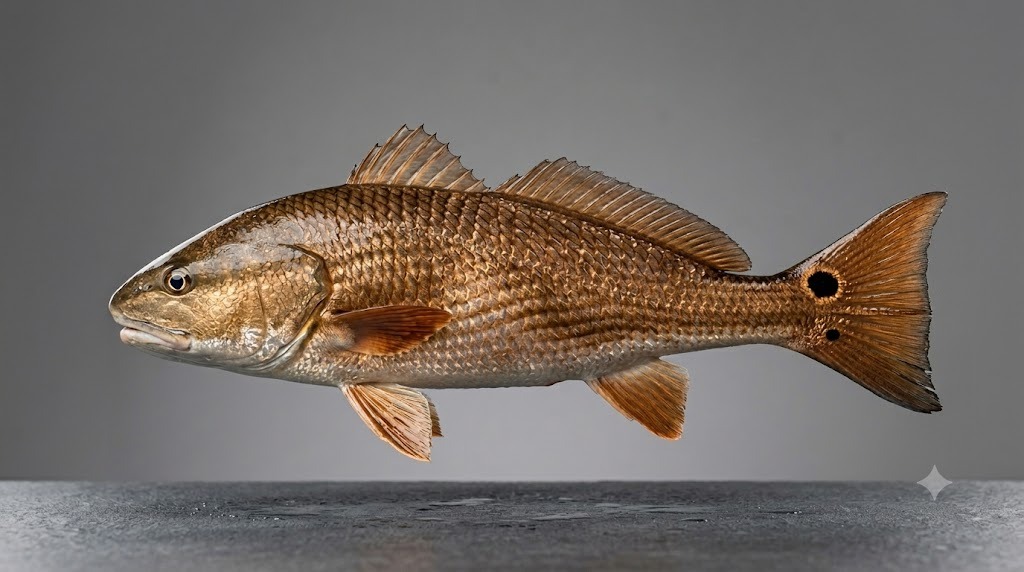
Redfish are a deep, coppery bronze to reddish-gold on the back and flanks, fading to a white or pale belly. The body is robust and slightly elongated, with a blunt, slightly downturned snout - a clue to their bottom-feeding habits. Their most reliable identifying mark is one (or more) black "ocellated" spots near the base of the tail; this eyespot is thought to confuse predators into striking the tail instead of the head. Most fish carry a single spot, but multi-spotted reds are common and prized as photo trophies. They lack the barbels of black drum, lack the canine teeth of seatrout, and have no spots scattered across the body. Juveniles in the marsh tend to be lighter and more silvery, while old "bull" reds in open water turn a darker, almost mahogany hue.
Range & Habitat (US waters - inshore / offshore)
Redfish range from the Mid-Atlantic - Virginia and the Carolinas - down around Florida and across the entire Gulf of Mexico to Texas and the Mexican border. The heart of the fishery is the Gulf: Louisiana's vast marsh, the Texas bays, the Florida Big Bend, and the Mosquito Lagoon area of central Florida.
Inshore, redfish use grass flats, oyster bars, marsh drains, mangrove shorelines, sandy potholes, and dock structure. They thrive in brackish water and will run far up into the freshwater reaches of coastal rivers. Offshore (really nearshore), large mature bulls school up in coastal passes, along beaches, and around nearshore wrecks and jetties, especially during the fall spawn. A single fish may spend its juvenile years in a marsh creek and its adulthood patrolling beachfronts.
Behavior & Feeding
Redfish are opportunistic bottom-and-ambush feeders. Their downturned mouth is built for rooting crabs, shrimp, and small fish off the bottom - when they tip down to feed in shallow water, their tail breaks the surface, the famous "tailing" behavior that sight-fishermen live for. They also crush baitfish higher in the column and will blow up on a topwater with shocking violence. Reds often travel in loose schools, and in clear water you can watch a whole school push a wake across a flat. They feed by a mix of sight, smell, and the lateral line, which means they hunt well in muddy water where seatrout struggle. Tide drives everything: moving water positions bait and switches the fish on.
Best Seasons & Times to Catch
Redfish can be caught year-round across most of their range, but fall is prime time. From September through November, bull reds gather to spawn near passes and beaches, and slot-sized fish gorge in the marsh ahead of winter. Spring is excellent for tailing fish on warming flats. Summer fishing is strong early and late in the day - beat the heat by fishing the first and last two hours of light. Winter concentrates fish in deeper marsh holes and on dark mud bottoms that warm in the sun; clear, cold-water flats can offer the best sight-fishing of the year. As a rule: fish moving tides, fish low light, and in winter fish the warmest part of the afternoon.
Where to Find Them - Reading the Water
Look for "redfish water" - sandy potholes inside grass flats, the edges of oyster bars, points where a marsh drain dumps into a larger basin, and shorelines with a defined edge. On a falling tide, fish stack at the mouths of drains to ambush bait flushed out of the grass. On a rising tide, they push up onto flooded flats and into the grass itself to tail for crabs. Watch for nervous bait, mud "blows" where a fish kicked off the bottom, pushes and wakes, and of course tailing and crawling backs in skinny water. Birds working bait, slicks (the oily sheen of feeding fish), and color changes where clean meets dirty water are all worth a cast.
Tackle & Rigs
For slot-sized reds (roughly 18-27 inches), a 7- to 7.5-foot medium or medium-heavy spinning rod paired with a 3000-4000 size reel is ideal. Spool with 10-20 lb braid and add a 20-30 lb fluorocarbon leader of 18-24 inches - the leader resists abrasion from oyster shell and gives a stealthier presentation.
Productive rigs include the classic Carolina (fish-finder) rig with a 1/2-1 oz egg sinder for cut or live bait on the bottom; a popping cork with a shrimp or soft plastic suspended 18-36 inches below; and a simple jighead (1/8-1/4 oz) for soft plastics. For bull reds in passes and surf, step up to a 7.5-8 foot heavy rod, a 5000-6000 reel, 30-50 lb braid, and a 40-60 lb leader with a 2-4 oz weight and a circle hook.
Best Baits & Lures
Live bait is hard to beat: live shrimp, finger mullet, menhaden (pogies), and small blue crabs (a top bait for big reds). Cut bait - chunks of mullet, menhaden, or crab - works extremely well because reds hunt by scent, and it shines in muddy water.
Among artificials, soft plastic paddletails and shrimp imitations on a jighead are the everyday workhorse; gold and copper spoons are a redfish classic that no box should be without; and topwater walking plugs draw heart-stopping strikes early and late. Suspending twitchbaits and weedless soft plastics for working over grass round out the kit. Natural, baitfish, and gold/copper colors produce in clear water; dark colors and chartreuse excel when the water is stained.
Techniques - How to Fish for It
Sight-fishing is the purest method: pole or wade quietly across a flat, spot a tailing or cruising fish, and lead it by several feet so the lure or fly settles in its path. Let it sit, then give a small twitch as the fish closes. For blind-casting, fan-cast potholes and oyster edges with a soft plastic, hopping it slowly along the bottom. The popping cork is deadly - cast it out, let it settle, then sharply "pop" the cork to imitate feeding sounds, drawing reds from a distance. With cut bait, anchor up-current of structure and let the scent trail do the work, keeping a semi-tight line and letting circle hooks find the corner of the jaw. When a red eats, resist the urge to set hard - a steady sweep is enough.
Common Mistakes
The biggest error is moving too fast and too loud in shallow water; redfish feel hull slap and footsteps. Casting directly on top of a fish - instead of leading it - sends it bolting. Anglers also tend to overwork lures; a slow, deliberate retrieve outfishes a frantic one. Fishing the wrong tide stage is a quiet killer: slack water often shuts the bite down completely. With circle hooks, swinging hard to "set" the hook actually pulls the bait out of the fish's mouth - let the rod load. Finally, many anglers ignore stained water, when in fact reds feed confidently there if you switch to scent and noise.
Size, Records & Eating Quality
A typical inshore "slot" red runs 18-27 inches and 4-8 pounds. Bull reds commonly reach 30-45 inches and 15-35 pounds, and the largest exceed 50 pounds. The IGFA all-tackle world record is a 94-pound, 2-ounce fish caught off Avon, North Carolina, in 1984. Redfish are excellent eating - slot-sized fish have firm, mild, slightly sweet white fillets, famous as the base of blackened redfish. Large bulls are coarser and best released; most states protect them with slot limits precisely because big females are the breeding stock. Always check current state regulations, as slot and bag limits vary and change.
Pros & Cons (as a target species)
Pros: Hard-fighting and dogged; available to shore, kayak, and boat anglers; tolerant of muddy and brackish water; readily eats bait, lures, and flies; excellent table fare within the slot; catchable year-round. Cons: Can be spooky in skinny clear water; bull reds require heavier gear and are catch-and-release in most areas; bite is highly tide-dependent; sensitive to fishing pressure on popular flats.
Best Suited For
Redfish are an outstanding species for beginners and families - they're forgiving, hard-pulling, and reachable from a bank or kayak. They also satisfy advanced sight-fishermen and fly anglers chasing tailing fish on a pristine flat. In short, redfish reward everyone from a kid with a shrimp under a cork to an expert poling a skiff at dawn.
FAQ
Is redfish good to eat? Yes - slot-sized redfish are among the best inshore table fish, with firm, mild white meat. Larger bull reds are coarse and should be released.
What's the difference between a redfish and a black drum? Black drum have chin barbels, vertical body bars (when young), and lack the tail spot. Redfish are coppery, have no barbels, and carry the signature black spot near the tail.
Do I need a boat to catch redfish? No. Redfish are caught by waders, surfcasters, and bank anglers around marshes, jetties, docks, and beaches. A kayak dramatically expands your range.
Why is my redfish's tail sticking out of the water? That's "tailing" - the fish is feeding head-down on the bottom for crabs and shrimp, and its tail breaks the surface. It's a prime sight-fishing opportunity.
What size hook for redfish? A 2/0 to 4/0 circle hook covers most slot-fish bait work; step up to 6/0-8/0 circle hooks for bull reds with crab or large cut bait.