Largemouth Bass
The largemouth bass is the most popular freshwater game fish in the United States.
🗓️ Last reviewed: June 2026
Overview
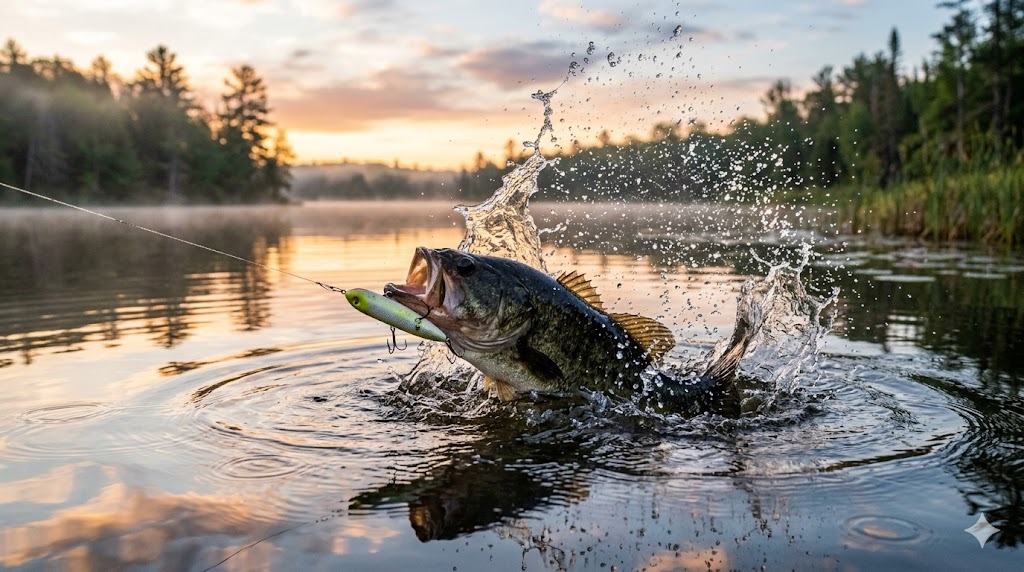
The largemouth bass is the most popular freshwater game fish in the United States. It is the species that built the modern bass-fishing industry, anchors a national tournament circuit, and drives the design of countless rods, reels, and lures. For millions of anglers, "going fishing" simply means going after largemouth. They are aggressive, widely distributed, hard-fighting, and willing to strike a huge range of presentations, which makes them an ideal target for beginners and a lifelong pursuit for experts. A largemouth that explodes on a topwater frog in the shallows is one of the most memorable strikes in all of fishing.
Identification & Appearance
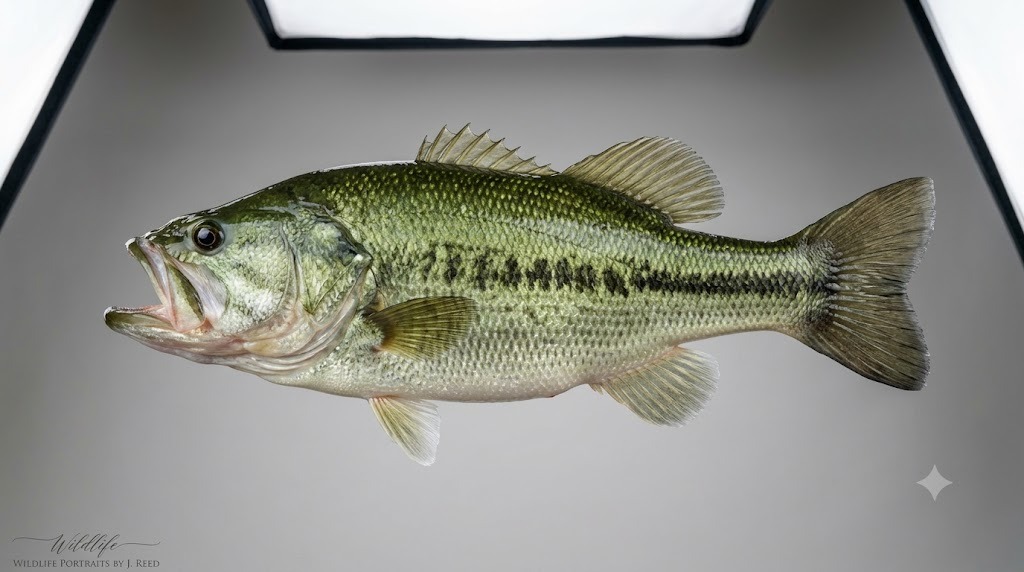
The largemouth is a member of the sunfish family despite its predatory bulk. It has an olive-green to dark-green back, a lighter green or yellow-green flank, and a creamy white belly. The defining field mark is a dark, ragged horizontal stripe running along the lateral line from the gill plate to the tail. The two best ways to separate it from the similar smallmouth bass: first, the upper jaw (maxilla) of a largemouth extends well past the rear edge of the eye; second, the spiny front dorsal fin and the soft rear dorsal fin are nearly separated by a deep notch. Largemouth are also typically greener and lack the vertical bars and reddish eye of the smallmouth.
Range & Habitat (US waters)
Largemouth bass are found in all 48 contiguous states and have been widely stocked far beyond their native southeastern range. They thrive in warm, slow-moving or still water: natural lakes, man-made reservoirs, farm ponds, oxbows, swamps, and the sluggish backwaters of rivers. They favor water with abundant cover such as weed beds, lily pads, flooded timber, brush, docks, and laydowns. Southern strains, including the Florida-strain largemouth, grow largest in the warm waters of Florida, Texas, and California. They tolerate water that is too warm and low in oxygen for trout, but they slow dramatically once water drops into the 40s.
Behavior & Feeding
Largemouth are ambush predators. Rather than chasing prey across open water, they tuck into cover and wait, then accelerate explosively to engulf anything that fits in their oversized mouth. They feed on shad, bluegill and other panfish, crayfish, frogs, worms, large insects, small snakes, and even ducklings and rodents. Feeding activity is strongly tied to water temperature; the bite peaks when water sits in the 65-80 degree range. Light levels matter too - low-light periods and overcast skies push fish to roam and feed more boldly, while bright midday sun drives them tight to shade.
Best Seasons & Times to Catch
Spring is the marquee season. As water warms through the 50s and 60s, bass move shallow to spawn and feed heavily before and after the spawn (the pre-spawn and post-spawn windows are prime). Summer fishing is strong early and late in the day, with fish holding deep or in heavy shade during the heat. Fall brings another excellent stretch as cooling water triggers heavy feeding on shad. Winter is the toughest season, but slow presentations in deeper water still produce. On a daily basis, dawn and dusk are reliably the best times, and a stable or slightly falling barometer often improves the bite.
Where to Find Them - Reading the Water
Look for cover and an edge. Largemouth relate to weed lines, the edges of lily-pad fields, points, drop-offs, creek channels, submerged brush piles, boat docks, and any laydown tree. In spring, search shallow, protected coves with dark bottoms that warm fastest. In summer, target shade and deeper structure - main-lake points, humps, and the deep edge of vegetation. In fall, follow baitfish into the backs of creeks and pockets. A good rule: find the cover, find the edge between two types of habitat, and find the baitfish, and you will find bass.
Tackle & Rigs
A medium-heavy 7-foot baitcasting rod paired with a baitcasting reel is the all-around standard, spooled with 12-17 lb monofilament or fluorocarbon, or 30-50 lb braid for heavy cover. A medium spinning outfit with 8-10 lb line is excellent for finesse presentations and for newer anglers. Core rigs every largemouth angler should know: the Texas rig (a worm or creature bait rigged weedless with a bullet weight) for cover; the Carolina rig for dragging deep structure; the wacky rig (a stick worm hooked in the middle) for a slow, fluttering fall; the drop-shot for pressured or deep fish; and the jig-and-trailer for big bites around heavy cover.
Best Baits & Lures
Few fish eat as wide a menu as the largemouth. Top producers include soft-plastic worms and creature baits, jigs with craw trailers, spinnerbaits, squarebill and deep-diving crankbaits, lipless crankbaits, swimbaits, and a full topwater arsenal of hollow-body frogs, poppers, walking baits, and buzzbaits. For live bait, nightcrawlers, large shiners, and crayfish are deadly. Match color to water clarity - natural greens and browns in clear water, brighter chartreuse and white in stained water, and dark profiles for night fishing.
Techniques - How to Fish for It
The defining skill is presenting a lure to cover without snagging. Pitch and flip soft plastics and jigs tight to docks, laydowns, and pad edges, letting the bait fall on a semi-slack line and watching for any tick or line jump. Slow-roll spinnerbaits along weed lines. Burn lipless crankbaits over submerged grass and rip them free of the vegetation to trigger reaction strikes. Walk a topwater across calm flats at dawn. When fish are tough, downsize to a drop-shot or wacky rig and fish slowly. The largemouth's signature is the hard hookset - when you feel weight, reel down and drive the hook home with a firm sweep.
Common Mistakes
The most common error is fishing too fast and skipping cover. Largemouth often hold tight to a single piece of structure, and a bait must come within inches. Other frequent mistakes: setting the hook too early on a soft-plastic bite before the fish has the bait; using line too light for the cover and getting broken off; ignoring water temperature and seasonal movements; making noise and casting shadows in shallow water; and dull hooks that fail to penetrate on a sweeping hookset.
Size, Records & Eating Quality
A 12-15 inch largemouth is a common catch; a fish over 5 pounds is a real trophy in most of the country, and a 10-pounder is the fish of a lifetime in northern states. The all-tackle world record is a tie at 22 pounds 4 ounces - George Perry's 1932 Georgia fish and Manabu Kurita's 2009 catch from Japan's Lake Biwa. Largemouth are edible, with mild white flesh, but most are released; bass fishing in the US is overwhelmingly catch-and-release, which keeps quality fisheries thriving.
Pros & Cons (as a target species)
Pros: available almost everywhere, willing to hit a huge variety of lures, hard fighting with spectacular jumps, supports endless tackle variety and skill development, and excellent for catch-and-release. Cons: heavily pressured fisheries can be tough, big fish require real skill and patience, the bite shuts down in cold water, and crowded popular lakes can feel like a competition.
Best Suited For
Largemouth bass suit nearly everyone. They are the perfect species for a beginner to catch a first fish on a worm, yet deep enough to occupy a lifelong specialist. They reward anglers who enjoy active casting, lure fishing, problem-solving, and reading water. They are ideal for pond hoppers, kayak anglers, and tournament competitors alike.
FAQ
What is the best all-around lure for largemouth bass? A soft-plastic worm on a Texas rig is the single most reliable choice. It is weedless, can be fished anywhere, works in every season, and consistently catches both numbers and size.
What water temperature is best for largemouth fishing? The 65-80 degree range produces the most active feeding. The spring pre-spawn, when water climbs through the upper 50s and 60s, is widely considered the best window for a big fish.
Do I need a boat to catch largemouth bass? No. Farm ponds, lake shorelines, and accessible banks all hold good largemouth. Many trophy fish are caught from shore, and a small pond is one of the best places for a beginner to learn.
Why won't bass bite in the middle of a sunny day? Bright sun pushes largemouth tight to shade and cover. Fish docks, overhanging trees, and the thickest weeds, slow down, and put the bait right on top of them.
Are largemouth bass good to eat? They are edible with mild flesh, but the strong conservation culture in US bass fishing means most anglers release them, especially larger fish that fuel the fishery.