Blue Catfish
The blue catfish is the giant of North American catfish - the largest member of the catfish family on the continent and the species responsible for most of the freshwater monsters that test 50 and 100-pound tackle.
🗓️ Last reviewed: June 2026
Overview
The blue catfish is the giant of North American catfish - the largest member of the catfish family on the continent and the species responsible for most of the freshwater monsters that test 50 and 100-pound tackle. Powerful, abundant in big rivers and reservoirs, and a willing biter, the blue cat has built a passionate following among anglers who love to set out heavy rods, watch the tip slam down, and lean into a fish that can weigh more than a child. Blues are also outstanding eating when taken in the right size range. For the angler chasing a true freshwater heavyweight without leaving the river, the blue catfish is the prize.
Identification & Appearance
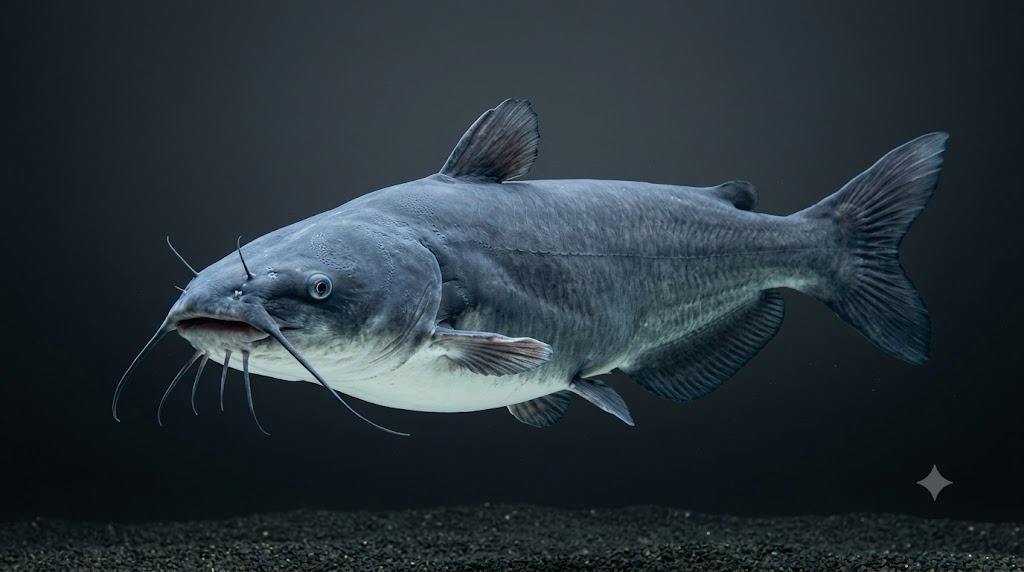
The blue catfish has a smooth, scaleless body that is slate-blue to silvery-gray on the back, fading to a clean white belly, with no dark spots. The single most reliable identification feature is the anal fin: a blue catfish's anal fin is long, straight-edged, and squared off, with 30 to 35 rays - distinctly different from the rounded, shorter anal fin of the similar channel catfish. Blues have a deeply forked tail, a slightly humped back ahead of the dorsal fin in large fish, four pairs of barbels ("whiskers") around the mouth, and the sharp pectoral and dorsal spines common to catfish. Big blues develop a broad, blocky head and an enormous girth.
Range & Habitat (US waters)
Blue catfish are native to the Mississippi, Missouri, and Ohio River basins and the major rivers of the Gulf Coast and Rio Grande systems. Through stocking and natural spread, they now thrive in large reservoirs and rivers across much of the South, the lower Midwest, and the Mid-Atlantic - where introduced populations in the Chesapeake Bay tributaries have boomed dramatically. Blues favor big water: large rivers, their tailraces, and major reservoirs with current, deep holes, and abundant forage. They tolerate a range of conditions, including slightly brackish water, and roam widely. They concentrate around deep channels, holes, and current breaks where bait collects.
Behavior & Feeding
Blue catfish are powerful, opportunistic predators and scavengers that feed largely by scent and by sensing vibration, but they are far more predatory than their bottom-feeder reputation suggests. They actively hunt live and dying fish - shad, skipjack herring, and other baitfish are dietary staples - and will also take crayfish, mussels, and cut bait readily. Blues use current to their advantage, holding in or near it and ambushing food that drifts past. They roam in loose groups and cover ground in search of forage. They feed actively in cold water, which is why winter can be a top season, and they bite around the clock.
Best Seasons & Times to Catch
Blue catfish bite year-round, and they are famously a strong cold-water fishery - winter is prime time for trophy blues, which feed heavily even in frigid conditions when concentrated in deep holes. Spring is excellent as fish move and gorge in advance of spawning. Summer offers fast action with numbers of fish, especially at night and in tailraces. Fall sees blues feeding hard as water cools. Time of day matters less than for many species - blues bite day and night - though night fishing in summer is comfortable and productive. The constant is current and bait: when the water moves and shad are present, blues feed.
Where to Find Them - Reading the Water
Blue catfish relate to depth, current, and structure. In rivers, focus on deep holes, the outside bends of channels, the bases of drop-offs, holes below sandbars, and current seams where fast water meets slow. Dam tailraces are blue cat magnets, concentrating both current and stunned baitfish. In reservoirs, target the old river channel, deep flats adjacent to channels, humps, and points - especially where shad concentrate. Wind-blown and current-swept areas push bait and attract feeding fish. Use electronics to locate bait and the larger arches of catfish nearby, then position to put baits in the strike zone with the right amount of current.
Tackle & Rigs
Trophy blue catfishing demands heavy gear. Use a stout 7 to 8 foot catfish rod with a strong backbone, paired with a high-capacity baitcasting or large spinning reel with a powerful, smooth drag and a clicker. Spool with 30 to 80 pound monofilament or braid, scaled to the size of fish expected. The standard rig is a Carolina-style slip-sinker rig - an egg or no-roll sinker above a swivel, a leader of 12 to 24 inches, and a strong circle hook from 5/0 to 10/0. The three-way rig is excellent in current, holding bait near bottom while allowing it to wave naturally. Sturdy rod holders are essential, since blues hit hard enough to pull a rod overboard.
Best Baits & Lures
Blue catfish are caught almost entirely on natural bait - fresh and oily is the rule. Fresh-cut shad and skipjack herring are the top baits nationwide; the fresher and bloodier, the better. Live shad and other baitfish produce well, especially for the largest, most predatory blues. Cut bait from other species, gizzard shad chunks, and whole small baitfish all work. Blues feed by scent, so freshness trumps everything - bait that has been frozen and thawed repeatedly loses much of its appeal. Prepared "dough" and "stink" baits are more of a channel-cat tactic; for blues, think fresh fish, presented big.
Techniques - How to Fish for It
Two approaches dominate. Anchoring or "spot-locking" over a known deep hole or channel edge, then fanning out a spread of rods with cut bait on slip-sinker rigs, is the classic method - let the scent draw fish in and wait for the rod to load. Drift fishing covers water efficiently: present baits along the bottom or just above it while the boat moves with the wind or current, often using drift rigs and weights that bump structure. In tailraces, fish current seams and eddies. Whatever the method, use circle hooks and let the fish hook itself - don't swing; let the rod load and lift steadily into the fish.
Common Mistakes
The biggest mistake is using stale, freezer-burned bait - blues hunt by scent, and fresh, bloody cut bait dramatically outperforms old bait. Tackle that's too light is another, costing anglers big fish and prolonging fights that exhaust the catfish. Setting the hook hard on a circle hook pulls it free; let the rod load instead. Many anglers fish dead, featureless water rather than current breaks, holes, and bait-rich structure. Inadequate rod holders lose rods to hard-hitting fish. And poor handling of giant blues, including improper support of the body, can injure trophy fish meant for release.
Size, Records & Eating Quality
Blue catfish grow enormous. Fish of 5 to 20 pounds are common table fish; 30 to 50-pounders are realistic trophies on many waters; and giants over 80 and 100 pounds are caught every year on premier rivers and reservoirs. The all-tackle world record blue catfish weighed 143 pounds, taken from Kerr Reservoir (Buggs Island Lake) on the Virginia-North Carolina line in 2011. As table fare, blue catfish are excellent in the smaller size ranges - firm, white, mild fillets ideal for frying. Most anglers practice selective harvest, keeping eater-sized fish and releasing the large, slow-growing trophy females.
Pros & Cons (as a target species)
Pros: blues offer a genuine shot at a freshwater fish over 50 or even 100 pounds, they fight with raw power, they bite year-round including in cold water, and they are widely distributed in big rivers and reservoirs. Eater-sized fish are excellent table fare. Cons: trophy fishing requires heavy, sometimes expensive gear and stout rod holders; the best fishing is on big water that often requires a boat; bait management (sourcing and keeping fresh shad) is a chore; and the waiting game of anchored catfishing is not for everyone.
Best Suited For
Blue catfish suit anglers who want size and power and don't mind a patient, gear-intensive style of fishing. They are ideal for boaters working big rivers and reservoirs, for night fishermen, and for anyone who enjoys setting a spread of rods and waiting for a heavyweight. Tailrace areas also offer bank-fishing access. Smaller blues make blue catfish a great family and meat-fishing option too. For the angler dreaming of a triple-digit freshwater fish, no other species offers a better realistic chance.
FAQ
How do I tell a blue catfish from a channel catfish? Look at the anal fin. A blue catfish has a long, straight-edged anal fin with 30 to 35 rays, while a channel catfish's anal fin is shorter and rounded. Blue cats also lack the dark spots that smaller channel cats often show, and they have a slate-blue, clean-bodied appearance.
What is the best bait for blue catfish? Fresh-cut shad and skipjack herring are the top baits - the fresher and bloodier, the better, since blues hunt by scent. Live baitfish also produce well for the largest predatory blues. Avoid stale, repeatedly frozen bait.
When is the best time to catch trophy blue catfish? Winter is famously prime for big blues - they feed heavily in cold water and concentrate in deep holes. Spring and fall are also excellent. Blues bite both day and night year-round, so timing is more about season and current than time of day.
How big do blue catfish get? Very big. Trophy fish of 30 to 50 pounds are realistic on good water, fish over 80 and 100 pounds are caught annually on premier rivers and reservoirs, and the world record weighed 143 pounds.
Are blue catfish good to eat? Yes - eater-sized blue cats of roughly 5 to 20 pounds have firm, white, mild fillets that are excellent fried. Most anglers keep these smaller fish and release the large trophy fish, which are old, slow-growing breeders.