Bluegill
The bluegill is the quintessential American panfish - the fish that launches more fishing careers than any other species.
🗓️ Last reviewed: June 2026
Overview
The bluegill is the quintessential American panfish - the fish that launches more fishing careers than any other species. Small, abundant, scrappy, willing, and delicious, the bluegill is the perfect first catch for a child with a cane pole and a worm, yet it remains a favorite of seasoned anglers who appreciate its hard fight on light tackle and its place at the top of the freshwater menu. Bluegill live in nearly every pond, lake, and slow river in the country, and a good spot can produce dozens of fish in an afternoon. They are the heart of family fishing in the US.
Identification & Appearance
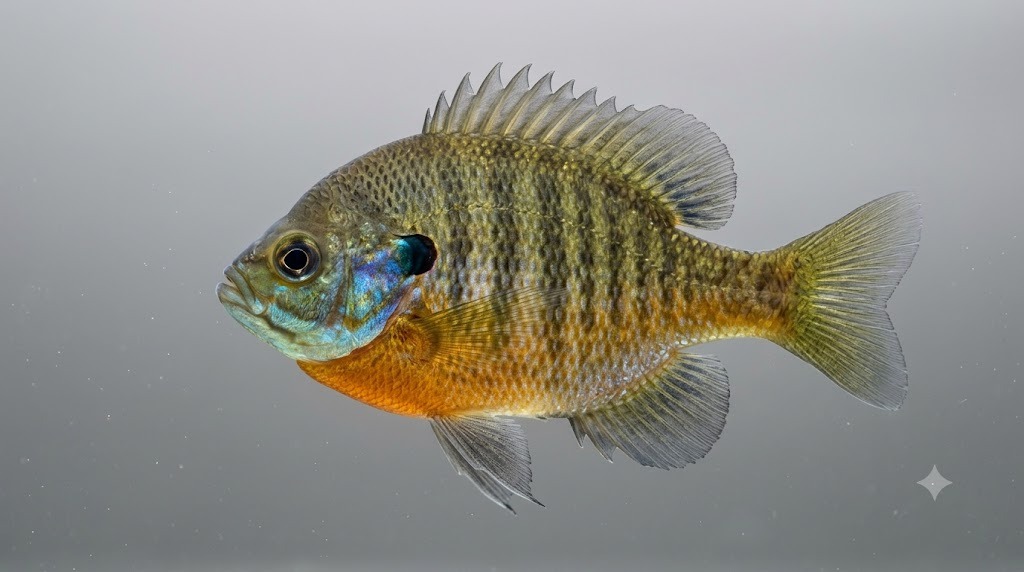
The bluegill is a deep, laterally compressed, almost dinner-plate-shaped sunfish. Its body is olive to bluish on the back, fading to a yellow, orange, or coppery breast, often with faint vertical bars along the sides. Two features identify it reliably: a solid black flap, or "ear," at the rear edge of the gill cover with no light margin, and a dark blotch at the rear base of the soft dorsal fin. The face and lower gill cover often show an iridescent blue, which gives the fish its name. Spawning males are spectacularly colored, with a deep orange breast and intense blue on the head.
Range & Habitat (US waters)
Native to much of the central and eastern US, the bluegill has been introduced nearly everywhere and now thrives across all 48 contiguous states. It is the most widespread panfish in America. Bluegill favor warm, calm, weedy water: farm ponds, natural lakes, reservoir backwaters, slow streams, and sloughs. They relate strongly to cover such as weed beds, brush, docks, fallen trees, and bulrushes. They tolerate a wide range of conditions and are often the most abundant fish in any small pond, which is exactly why they are so accessible.
Behavior & Feeding
Bluegill are visual feeders with small mouths, built to nip rather than gulp. Their diet centers on aquatic and terrestrial insects, insect larvae, tiny crustaceans, snails, zooplankton, small minnows, and fish eggs. They feed throughout the day but are most active in low light. Bluegill are social and travel in loose schools, so where you catch one, you usually catch many. In late spring and early summer they fan out distinctive circular spawning beds in shallow water, often in colonies, and become extremely aggressive defending those nests.
Best Seasons & Times to Catch
Late spring and early summer are the peak - the spawn concentrates fish in shallow, visible beds and makes them aggressive and easy to locate. Summer fishing remains strong, with fish often pulling slightly deeper to weed edges during the heat and biting best morning and evening. Fall offers steady action as bluegill feed up for winter. Bluegill also remain a top ice-fishing target through winter in northern states. On a daily basis, dawn and the last hours of light are most productive, though bluegill will bite all day in shaded, cooler conditions.
Where to Find Them - Reading the Water
Look shallow and look at cover. In spring, scan calm, shallow flats for the cluster of light circular spawning beds, often on firm sand or gravel near vegetation. Through summer and fall, target weed bed edges, brush piles, dock pilings, fallen trees, and the shade they create. Bluegill rarely stray far from cover and structure. In clear water you can often sight-fish them; in stained water, fish methodically along any visible cover. The biggest bluegill, the prized "bull" or "dinner-plate" fish, often hold a little deeper and tighter to cover than the smaller, more eager fish.
Tackle & Rigs
Light gear is the point. An ultralight or light spinning rod, 5 to 6.5 feet, with a small reel and 2-6 lb monofilament is ideal, and a simple cane pole or telescopic pole works wonderfully for kids and close-in fishing. The classic rig is a small bobber set 1-3 feet above a small split shot and a size 6 to 10 long-shank hook baited with a piece of worm. A tiny jig under a float is equally effective. Fly anglers use a 3 to 5 weight rod with small poppers and wet flies.
Best Baits & Lures
Live bait is hard to beat for bluegill: a piece of nightcrawler, red wigglers, crickets, grasshoppers, mealworms, and waxworms all produce. Keep the bait small to match the bluegill's small mouth. Effective artificials include tiny jigs (1/64 to 1/32 ounce) in plain colors or with soft-plastic or tinsel bodies, small spinners, micro soft plastics, and small foam-bodied poppers and sponge spiders for fly and float fishing. Tip a small jig with a waxworm for the best of both worlds.
Techniques - How to Fish for It
Bluegill fishing is simple and forgiving, which is its charm. The most common method is a baited hook beneath a small float, cast near cover and watched for the telltale dip and run of the bobber. Set the hook with a gentle lift - bluegill mouths are small. For more active fishing, cast a tiny jig past cover and retrieve it slowly with light twitches, or fish it under a float and shake it in place. During the spawn, drop a bait directly into visible beds for instant action. Small poppers worked slowly on the surface at dusk produce exciting strikes.
Common Mistakes
The biggest mistake is using bait and hooks that are too large for the bluegill's small mouth, which leads to endless missed bites. Anglers also fish too fast and too far from cover, set the hook too hard and tear free, and overlook how shallow and cover-oriented bluegill are. Many anglers keep every small fish and harvest the big bull bluegill that matter most for the fishery - selectively releasing the largest fish keeps a pond producing quality panfish.
Size, Records & Eating Quality
Most bluegill run a modest 4-8 inches; a fish of 9 inches or better is excellent, and a true "bull" bluegill over 10 inches or a pound is a genuine trophy. The all-tackle world record is 4 pounds 12 ounces, caught by T. S. Hudson from Ketona Lake, Alabama, in 1950 - a record that has stood for over seven decades. Bluegill are outstanding eating, with sweet, flaky, mild white flesh, and a stringer of them makes one of the best freshwater fish fries available.
Pros & Cons (as a target species)
Pros: incredibly abundant and available almost everywhere, easy to catch and forgiving of mistakes, the perfect species for kids and beginners, hard fighting for their size on light tackle, and excellent table fare. Cons: most fish are small, big bull bluegill can be surprisingly tricky to target, light tackle is needed to make them sporting, and overharvest can stunt a pond's panfish population.
Best Suited For
Bluegill are the ideal species for beginners, children, and families - there is no better fish for a first catch. They also suit anglers who enjoy relaxed, productive fishing, anyone who wants fish for the table, ice anglers, and fly anglers looking for fast surface action on small poppers. They are the perfect way to spend an easy afternoon on the water.
FAQ
What is the best bait for bluegill? A small piece of nightcrawler or a whole red wiggler under a bobber is the classic and most reliable choice. Crickets, mealworms, and waxworms are also excellent. Keep the bait small to match their tiny mouth.
Why do I keep missing bluegill bites? Your hook and bait are probably too big. Bluegill nibble with small mouths - switch to a size 8 or 10 hook and a small piece of bait, and set the hook with a gentle lift rather than a hard jerk.
When is the best time to catch bluegill? Late spring and early summer during the spawn, when fish concentrate in visible shallow beds and feed aggressively. Dawn and dusk are the best times on any given day.
Are bluegill good to eat? Yes, excellent. They have sweet, flaky, mild white flesh and are a favorite for a fish fry. A stringer of bluegill is one of the best meals freshwater fishing offers.
Where should I look for bluegill in a pond? Near cover in shallow water - weed beds, brush, docks, and fallen trees. In spring, look for the cluster of light circular spawning beds on shallow flats.