Bowfin
The bowfin is one of the most ancient fish swimming in North American waters, the lone surviving member of an order that dates back more than 150 million years.
🗓️ Last reviewed: June 2026
Overview
The bowfin is one of the most ancient fish swimming in North American waters, the lone surviving member of an order that dates back more than 150 million years. Anglers know it by a long list of regional nicknames - mudfish, dogfish, grinnel, cypress trout, blackfish - and for decades it was dismissed as a trash fish that ruined a good day of bass fishing. That reputation is fading fast. The bowfin is a brutally hard-fighting, ambush-feeding predator that hits lures with violence, runs like a freight train, and grows large enough to genuinely test your tackle. For anglers willing to look past tradition, it is one of the best pound-for-pound fights in freshwater.
A bowfin is built like a torpedo with attitude. It has a primitive air-breathing swim bladder that lets it gulp atmospheric oxygen, so it thrives in warm, stagnant, low-oxygen swamps and backwaters where bass and pike would suffocate. That makes it a target you can chase in conditions that shut down everything else.
Identification & Appearance
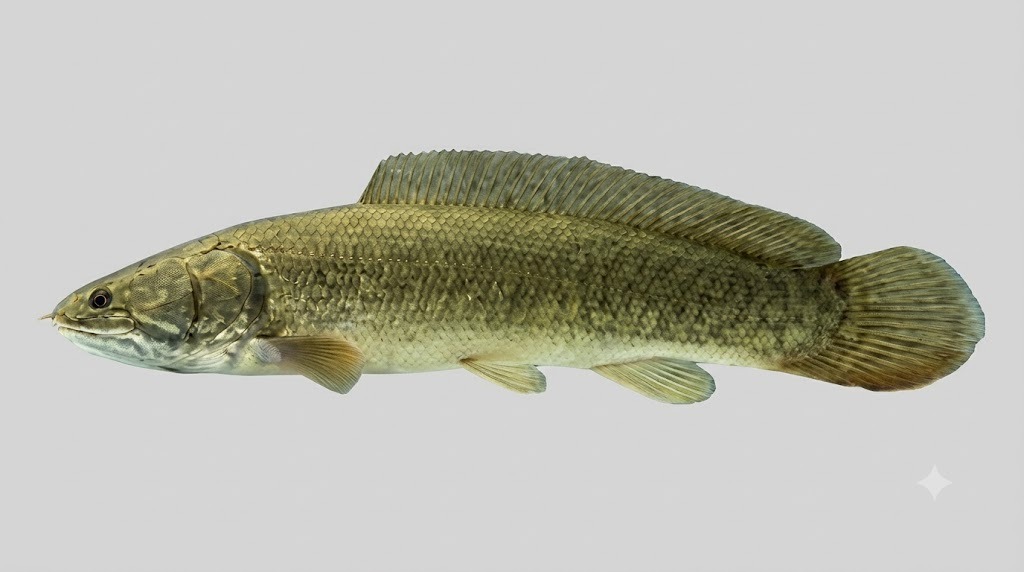
The bowfin has an unmistakable, archaic look. The body is cylindrical and heavily built, olive to brown-green on the back fading to a pale cream belly, often with mottled or marbled patterning along the flanks. The single most diagnostic feature is the long dorsal fin, which runs more than half the length of the back in a continuous, undulating wave. The head is bony and rounded, the mouth wide and full of small sharp teeth, and a distinctive bony plate (the gular plate) sits underneath the lower jaw between the gills.
Mature males, and juveniles of both sexes, carry a striking black eyespot - a dark ocellus ringed in orange or yellow - at the upper base of the tail. In breeding males the lower fins turn a vivid emerald green. Females usually lack the bright tail spot or show only a faint, unringed version. Do not confuse a bowfin with a snakehead: the bowfin has a short anal fin, the snakehead has a very long one, and the snakehead lacks the bowfin's gular plate.
Range & Habitat (US waters)
Bowfin are native across the eastern and central United States, from the Great Lakes drainage south through the Mississippi River basin to the Gulf Coast, and along the Atlantic slope from the Carolinas through Florida. They are common in the lower Mississippi Valley, the Florida swamps, the Texas and Louisiana bayous, and the slow rivers of the Southeast and Midwest.
They favor warm, weedy, slow-moving or still water: oxbow lakes, cypress swamps, marsh backwaters, vegetated bays of larger lakes, sloughs, and the sluggish stretches of rivers. Heavy vegetation, submerged timber, and soft mucky bottoms are classic bowfin cover. Because they breathe air, they tolerate water that is warm, murky, and oxygen-poor, so they often hold in the exact backwater pockets other gamefish abandon in midsummer.
Behavior & Feeding
The bowfin is a pure ambush predator. It hangs motionless in cover - under a log, inside a weed edge, beside a stump - and explodes on anything that moves within range. It is an opportunistic, indiscriminate feeder, taking fish, crayfish, frogs, large insects, and the occasional small bird or snake. Its eyesight is decent but it relies heavily on lateral-line vibration and a strong sense of smell, which is why both cut bait and noisy lures work so well.
Bowfin are most active in warm water and feed aggressively in the heat of summer when other species sulk. Males build and guard nests in spring, fanning out shallow depressions in vegetation, and they are notably protective parents - the young swarm in dense black schools guarded by the male. A bowfin hooked anywhere near a nest will fight with extra fury.
Best Seasons & Times to Catch
Late spring through early fall is prime time. Bowfin become increasingly active as water temperatures climb past 60°F and peak in the hot months of June through August, when their air-breathing advantage lets them feed hard while bass and pike go lethargic. Spring, just after the spawn, offers shots at aggressive, shallow, nest-guarding fish.
Within a day, low-light periods are most productive - early morning and the last hours before dark - but bowfin will feed all day in stained or vegetated water that breaks up the light. Warm, stable, even muggy weather is good bowfin weather. Cold fronts slow them down, and winter fishing in the northern part of their range is genuinely tough as they bury into deeper holes and become sluggish.
Where to Find Them - Reading the Water
Look for the nastiest, weediest, most overlooked water on the lake or river. The classic bowfin spot is a back-of-the-cove pocket choked with lily pads, hydrilla, or cattails, with a soft bottom and some scattered wood. Cypress knees, fallen timber, undercut banks, and the dark edges of weed mats all hold fish.
Watch the surface. Because bowfin gulp air, you will see them roll, swirl, or break the surface as they breathe - those rises are a dead giveaway to where fish are stacked. Backwater sloughs off main rivers, dead-end canals, marina basins, and the stagnant ends of oxbows are reliable. In summer, the warmer and more stagnant the water, the better. If a spot looks too thick and gross to bother with, that is exactly where the bowfin live.
Tackle & Rigs
Bowfin demand stout tackle. They are heavy, powerful, and they live in cover that you must drag them out of, and their bony, tooth-lined mouths chew up light line. A medium-heavy to heavy baitcasting rod, 7 to 7.5 feet, paired with a strong reel and 40 to 65 lb braided line is the right starting point. Add a 12 to 20 inch heavy fluorocarbon or wire-equivalent leader - at minimum a long, abrasion-resistant fluoro leader - because their teeth and rough jaws will fray lighter line.
For bait fishing, a simple Carolina rig or fish-finder rig with a 2/0 to 5/0 wide-gap or circle hook is hard to beat. A float rig suspending cut bait just over the weeds works well in heavy cover. Use strong, sharp hooks; the bowfin's hard mouth resists penetration, so a chemically sharpened hook and a firm hookset matter. Bring long pliers or a hookout tool - you do not want fingers near that mouth.
Best Baits & Lures
Bowfin are not picky, which is part of their charm. For bait, cut fish (shad, sucker, bluegill where legal) is outstanding because of their keen sense of smell. Live bait - large minnows, shiners, small bluegill where legal - and crayfish all produce. Frozen or fresh, oily, smelly bait draws them in.
For lures, bowfin smash a wide range of presentations. Soft plastic swimbaits and creature baits rigged weedless work in the slop. Spinnerbaits and chatterbaits called past cover trigger reaction strikes. Topwater frogs fished over pads and mats produce explosive, heart-stopping blowups - one of the great reasons to target bowfin on purpose. Lipless crankbaits, large in-line spinners, and bladed jigs all draw hits. Anything noisy, flashy, or vibrating that you can work through or beside heavy vegetation is a candidate.
Techniques - How to Fish for It
Two approaches dominate. The first is patient bait soaking: anchor or position near visible cover, cast a cut-bait rig to the edge of weeds or wood, keep your line semi-tight, and wait. When a bowfin takes, let it move a moment to get the bait, then drive the hook hard. With circle hooks, simply tighten and let the rod load.
The second is run-and-gun lure fishing: cover water with weedless plastics, frogs, and bladed baits along weed edges and pockets, looking for that reaction strike. Slow your retrieve in cooler water, speed it up in summer heat.
Either way, the fight is the event. A hooked bowfin runs, rolls, thrashes, and uses its primitive body to wrap cover. Keep steady, heavy pressure and turn its head before it buries. Land it firmly, control the head, and use pliers to remove the hook - the teeth are no joke, and a thrashing bowfin coats everything in slime.
Common Mistakes
The biggest mistake is fishing too light. Anglers hook a bowfin on bass gear, get bullied into cover, and lose the fish and their lure. Match the tackle to the fight. The second mistake is a weak hookset; that bony mouth needs a hard, deliberate set. Third, anglers fish water that is too clean and open - bowfin live in the thick, ugly stuff. Fourth, many people simply do not target them at all, treating every bowfin as an accident. Finally, careless handling leads to bites and slime everywhere; use a proper grip and pliers, and protect both yourself and the fish.
Size, Records & Eating Quality
A typical bowfin runs 1.5 to 5 pounds, with good fish reaching 6 to 8 pounds and trophies exceeding 10. The all-tackle world record is just over 21 pounds, taken in South Carolina. Any bowfin over 8 pounds is a genuine prize and a serious test of tackle.
Eating quality is honestly modest. Bowfin flesh is soft and somewhat gelatinous, and it loses quality fast unless the fish is bled and iced immediately and cooked promptly. Some Southern anglers smoke it, make fish patties or fritters, or use it in highly seasoned dishes with success, but most catch-and-release the bowfin and value it purely as a sport fish. The roe, by contrast, is sometimes processed as a regional caviar substitute called "Cajun caviar."
Pros & Cons (as a target species)
Pros: an explosive, sustained, genuinely powerful fight; aggressive and willing to hit lures, including topwater; abundant and underfished, so spots are not crowded; available in hot weather and oxygen-poor water when nothing else bites; native, so targeting them carries no ecological downside.
Cons: poor table quality; bony, tooth-filled mouth that destroys light tackle and frays line; extremely slimy and messy to handle; lives in hot, buggy, hard-to-access swamp water; still suffers an unfair "trash fish" reputation that means few anglers will share the experience with you.
Best Suited For
Bowfin are ideal for anglers who care about the fight rather than the fillet - catch-and-release sport fishermen, kids and beginners who want guaranteed bent-rod action in summer, and experienced anglers looking for a new challenge with a fish that hits hard and never quits. They suit anyone fishing warm Southern or Midwestern backwaters who is tired of crowds, and anyone who enjoys topwater fishing the slop. They are not for anglers focused on a fish fry.
FAQ
Are bowfin and snakeheads the same fish? No, and the confusion has hurt the bowfin's reputation. Bowfin are native North American fish. Snakeheads are invasive Asian imports. The quickest tells: the bowfin has a short anal fin and a bony gular plate under the jaw; the snakehead has a long anal fin and no gular plate.
Are bowfin good to eat? Honestly, they are below average. The flesh is soft and best if bled, iced immediately, and cooked fresh in seasoned preparations or smoked. Most anglers release them and target them for sport.
Do bowfin really breathe air? Yes. They have a modified, lung-like swim bladder and regularly rise to gulp atmospheric oxygen, which lets them survive in warm, stagnant water that would kill most gamefish - and which gives you a visible clue to their location.
Will bowfin hurt my bass population? Bowfin are native and have coexisted with bass and other gamefish for millennia. They are part of a healthy ecosystem, not a threat to it. Killing bowfin "to protect the bass" is unnecessary.
What is the best single bait for bowfin? Fresh cut fish on a Carolina rig fished tight to heavy cover. Their strong sense of smell makes oily cut bait extremely effective, and the rig keeps it in the strike zone along weed edges.