Burbot
The burbot is the strange one.
🗓️ Last reviewed: June 2026

Overview
The burbot is the strange one. It is the only true cod that lives its entire life in fresh water, an oddly serpentine, mottled, whiskered fish that looks like a cross between an eel, a catfish, and a deep-sea creature. Anglers know it by a long list of names - ling, lawyer, eelpout, cusk, freshwater cod, mariah. For most of the year it is rarely seen, because the burbot is a cold-loving, deep-dwelling, nocturnal predator that hides in dark water. But in the dead of winter it does something remarkable: it spawns under the ice and feeds aggressively, and that is when ice anglers across the northern states pursue it with real enthusiasm.
The burbot is one of the great hidden treasures of cold-water fishing. It is a willing biter once located, it fights with a powerful eel-like twisting pull, it grows large, and - surprising many first-timers - it is genuinely excellent eating, so good it is sometimes called "poor man's lobster." For the angler who embraces hard-water fishing and the long northern night, the burbot is a uniquely rewarding target.
Identification & Appearance
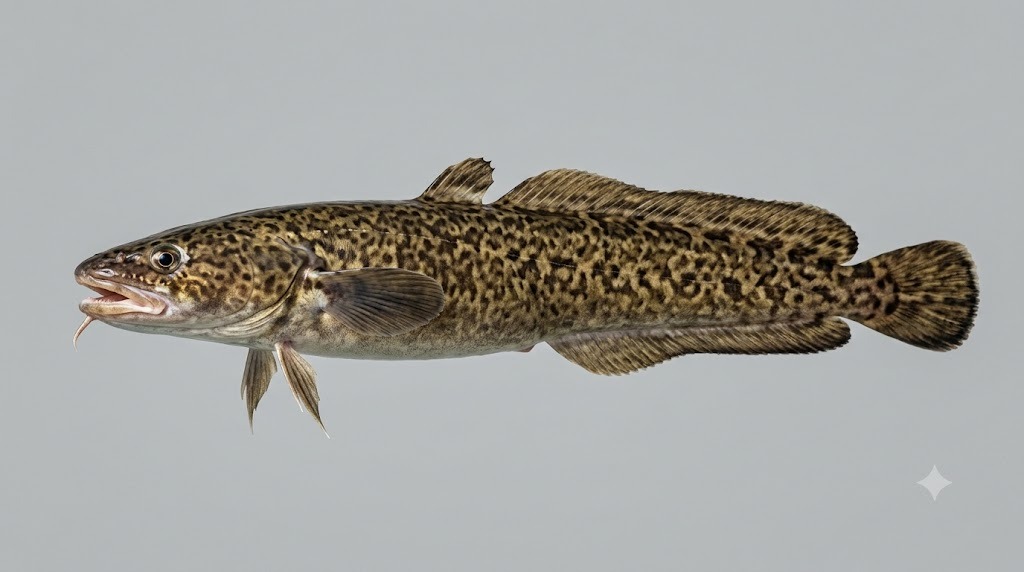
The burbot is unmistakable once you have seen one. The body is long and eel-like, rounded toward the front and laterally compressed toward the tail, with smooth skin embedded with tiny scales that gives it a slick, almost slimy feel. Coloration is a mottled, marbled pattern of dark brown, olive, and yellow over a paler background - excellent camouflage against a rocky or muddy bottom - fading to a pale belly.
The most diagnostic features are the fins and the chin. The burbot has a single long, low-slung barbel - a whisker - on the center of its chin, plus a smaller barbel near each nostril. Its dorsal fin is in two parts, the second very long, and the anal fin is also long, both running back to join near the rounded tail, giving the fish that continuous, eel-like profile. The head is broad and somewhat flattened with a wide mouth full of small teeth. There is no other freshwater fish it can easily be confused with.
Range & Habitat (US waters)
The burbot has a circumpolar, far-northern distribution, and in the United States it is a fish of the cold northern tier. It is found across the northern states from the Great Lakes region - where it is common in the deep, cold waters of the Great Lakes themselves and many connected lakes - through the upper Midwest, including Minnesota, Wisconsin, and the Dakotas, and across the northern Rocky Mountain and Western states, including Montana, Idaho, and parts of Wyoming, where it inhabits cold rivers and reservoirs. Alaska has abundant burbot populations.
Burbot require cold, well-oxygenated water and are usually a deep-water fish. They inhabit large, deep, cold lakes and reservoirs and cold rivers, relating to the bottom over rock, gravel, and rubble. They prefer cold temperatures year-round and retreat to deep, cold water in summer. In winter, however, they move shallower to feed and spawn, which is what makes them accessible to ice anglers. Notably, in part of the upper Colorado River system the burbot is an introduced, invasive species that anglers are encouraged to remove.
Behavior & Feeding
The burbot is a bottom-dwelling, primarily nocturnal predator and scavenger. By day it hides in dark cover - under rocks, in crevices, in deep shade - and as light fades it emerges to hunt and forage along the bottom. It locates food using its chin barbel and keen senses of smell and touch, well adapted to feeding in the dark and in deep, dim water.
Its diet is broad. Adult burbot are voracious fish-eaters, taking sculpins, ciscoes, perch, whitefish, small burbot, and other available species, and they also consume crayfish, fish eggs, aquatic insects, and carrion. They are opportunistic and will scavenge readily. The burbot's defining biological quirk is its winter spawning: while almost every other freshwater fish spawns in spring or summer, the burbot spawns in mid-winter, often right under the ice, gathering over rocky shallows in a writhing communal "spawning ball." This winter activity drives the famous cold-season feeding binge that ice anglers exploit.
Best Seasons & Times to Catch
Burbot fishing is, above all, a winter sport. The peak season is the heart of the ice-fishing year - roughly mid-winter, from January into March - when burbot move shallower to spawn and feed aggressively. This is when they are most concentrated, most active, and most catchable, and dedicated "eelpout" fishing is a celebrated northern tradition built around exactly this window. Late ice can be excellent.
Crucially, burbot are nocturnal, so the best fishing is after dark. While they can be caught during the day, the action typically picks up dramatically in the evening and continues through the night, and many burbot anglers fish well past sunset for the best results. In open water, summer burbot fishing is difficult because the fish are deep and lethargic in cold bottom water, though cold rivers can produce. Stable cold weather suits them; the burbot is a creature of the cold and dark.
Where to Find Them - Reading the Water
In winter, the burbot's location is tied to its spawning and feeding behavior. Look for rocky and gravelly structure in relatively shallow-to-moderate depths where burbot gather to spawn - rocky points, humps, reefs, rubble flats, and gravel shorelines are classic. The transition zones where these rocky areas meet deeper water are particularly productive, as burbot move up from the depths to feed and spawn and back down again.
Concentrate on the bottom; burbot are firmly bottom-oriented and your presentation must be on or just above the substrate. In summer and in rivers, target the deepest, coldest water available, again over rock and rubble, and fish near the bottom. Across all seasons the constants are cold water, a rocky or gravelly bottom, and bottom-contact presentation. In winter, finding the right rocky structure in the right depth, and fishing it after dark, is the recipe for burbot.
Tackle & Rigs
Most burbot fishing happens through the ice, and the tackle is the heavier end of ice-fishing gear. A medium to medium-heavy ice rod, 28 to 36 inches, with a solid backbone to handle a strong, twisting fish and to drive a hook home, paired with a reliable spinning reel and 10 to 20 lb line - braid or mono - covers most situations. Burbot are not leader-shy, but they live around abrasive rock, so abrasion resistance matters.
The terminal setup keeps bait and lures on the bottom. A simple bottom rig - a hook above a sinker, or a baited jigging spoon - is standard, with enough weight to stay anchored on the substrate. Glow-in-the-dark jigs and spoons are extremely popular and effective because burbot feed at night and in dim water; recharging a glow lure with a light noticeably improves bites. Many anglers fish two presentations: an active glow jigging spoon to attract fish with flash and noise, and a nearby tip-up or dead-stick with bait on the bottom. Strong hooks and a sturdy rod handle the burbot's powerful pull.
Best Baits & Lures
Burbot respond well to both bait and lures, and a combination is often best. For bait, cut fish and whole dead baitfish are top producers - pieces of cisco, smelt, sucker, or perch fished on the bottom - because the burbot's strong sense of smell makes scent-heavy bait very effective. Live minnows and pieces of nightcrawler also work. Fresh, oily, smelly bait fished on the bottom is a reliable burbot offering.
For lures, glow-in-the-dark jigging spoons and jigs are the signature burbot lures. The glow finish is genuinely important because burbot hunt in darkness; charge the lure regularly with a flashlight or UV light. Jigging spoons add flash, vibration, and noise that pull burbot in from a distance, and tipping the spoon's hook with a piece of cut bait combines attraction and scent. Brightly colored jigs, especially glowing chartreuse, white, and green, are favorites. Working a flashy lure to draw fish toward a nearby scented bait is a classic and deadly burbot one-two punch.
Techniques - How to Fish for It
The dominant technique is winter jigging through the ice, done after dark over rocky structure. Drill holes over the right depth and structure, drop a glow jigging spoon or jig to the bottom, and work it with an aggressive jigging cadence: lift and snap the lure off the bottom, let it flutter back down, and pause - burbot often hit on the pause or as the lure settles. The lure should regularly tick the bottom, stirring substrate and ringing the burbot's bottom-feeding instincts. Recharge the glow frequently.
A highly effective approach is to fish two lines: one active glow lure to attract and excite fish, and a second dead-stick rod or tip-up nearby with cut bait resting on the bottom for fish drawn in but wanting an easy scented meal. When a burbot takes, set the hook firmly and prepare for a distinctive fight - the burbot pulls hard and twists, often wrapping itself around the line in a powerful, eel-like spiral. Land it, control the slick body, and unhook carefully. Where burbot are native, enjoy a fine meal within the limits; where they are invasive, such as in parts of the upper Colorado system, anglers are asked to harvest and not return them.
Common Mistakes
The most common mistake is fishing for burbot during the day - they are nocturnal, and anglers who quit at sunset miss the best action; commit to fishing after dark. Another is not keeping the presentation on the bottom, since burbot are strictly bottom feeders. Failing to use or recharge glow lures sacrifices a real advantage in the dark. Many anglers fish the wrong water, targeting open mud flats instead of the rocky structure burbot favor. Underestimating the fight and using flimsy tackle leads to lost fish. Some anglers also wrongly assume burbot are not worth eating and waste an excellent fillet, while others, unaware of regulations, release invasive burbot where they should be removed. Know the local rules.
Size, Records & Eating Quality
Burbot are a respectably large fish. A typical burbot runs 1 to 4 pounds, good fish reach 5 to 8 pounds, and trophies exceed 10 pounds with the largest topping 15 to 18 pounds. The all-tackle world record is around 25 pounds 2 ounces, taken in Manitoba, Canada; in US waters a burbot in the high single digits or low teens is an excellent catch. They are long, strong, and surprisingly heavy for their slim build.
Eating quality is the burbot's delightful secret. The flesh is white, firm, dense, and mild-to-sweet, and it is genuinely excellent - so good that burbot is widely nicknamed "poor man's lobster" because, poached in butter, it has a sweet, lobster-like quality. It fries, bakes, and chowders beautifully. The liver is also large and was historically prized. First-time burbot anglers are routinely amazed at how well this odd-looking fish eats. Where burbot are native, a meal within legal limits is one of the rewards of the sport; where they are invasive, harvesting them for the table serves conservation too.
Pros & Cons (as a target species)
Pros: outstanding eating, the famous "poor man's lobster"; a willing, aggressive biter once located; a strong, distinctive twisting fight; grows large enough for genuine trophies; a unique winter quarry that gives ice anglers an exciting reason to fish after dark; abundant in cold northern waters and often underfished.
Cons: a cold-water, largely winter and nighttime fishery, which means fishing in harsh conditions at uncomfortable hours; difficult to catch in summer when fish are deep and lethargic; an odd, very slimy fish that some find off-putting to handle; requires finding specific rocky structure; invasive in a few systems, where it must be removed rather than released.
Best Suited For
The burbot is ideal for ice-fishing enthusiasts and cold-weather anglers who do not mind fishing the long northern night for a strong, fine-eating fish. It suits anglers in the Great Lakes region, the upper Midwest, the northern Rockies, and Alaska who want a productive winter target beyond panfish and walleye. It is excellent for those who value a fish for the table, since burbot eating quality is exceptional. It appeals to anglers who enjoy something unusual and underfished. It is not well suited to those who dislike cold, night fishing, or handling slick fish, or to anglers focused on warm-season open-water sport.
FAQ
Is a burbot really a cod? Yes. The burbot is a true member of the cod family and the only one that lives its entire life in fresh water. Its firm white flesh and many of its habits reflect that cod heritage.
Why do people fish for burbot at night and in winter? Burbot are nocturnal, so they feed most actively after dark, and they spawn in mid-winter, moving shallow and feeding aggressively under the ice. That combination makes after-dark winter ice fishing by far the most productive way to catch them.
Are burbot good to eat? Excellent. The white, firm, mild-to-sweet flesh is so good that burbot is nicknamed "poor man's lobster," and poached in butter it genuinely has a lobster-like sweetness. Many first-time burbot anglers are surprised by how well this odd-looking fish eats.
Why use glow lures for burbot? Burbot hunt in darkness and dim deep water, relying heavily on senses other than bright-light vision. Glow-in-the-dark jigs and spoons are visible to fish in the dark and consistently draw more bites - just remember to recharge the glow regularly with a light.
Should I release a burbot? It depends on where you are. Where burbot are native, release or keep within legal limits as you choose. But in waters where burbot are invasive, such as parts of the upper Colorado River system, anglers are asked to harvest them and not return them to the water. Always check local regulations.