Longnose Gar
The longnose gar looks like something that swam straight out of the Cretaceous, and in a sense it did - gars are an ancient lineage that has changed remarkably little in tens of millions of years.
🗓️ Last reviewed: June 2026
Overview
The longnose gar looks like something that swam straight out of the Cretaceous, and in a sense it did - gars are an ancient lineage that has changed remarkably little in tens of millions of years. With a slender, armor-plated body, a needle-shaped snout lined with teeth, and the habit of basking lazily near the surface on warm afternoons, the longnose gar is one of the most distinctive fish in North American freshwater. For a long time it was treated as a pest. Today a growing crowd of anglers has discovered that gar fishing is a genuine, addictive specialty: sight casting to visible fish, watching them stalk a bait, and hanging on through wild, twisting, head-shaking, often airborne fights.
The longnose gar is the most widespread of the gar family and the most accessible target for anglers who want to try something completely different. It is abundant, willing to bite in summer heat when other fish quit, and large enough to demand respect.
Identification & Appearance
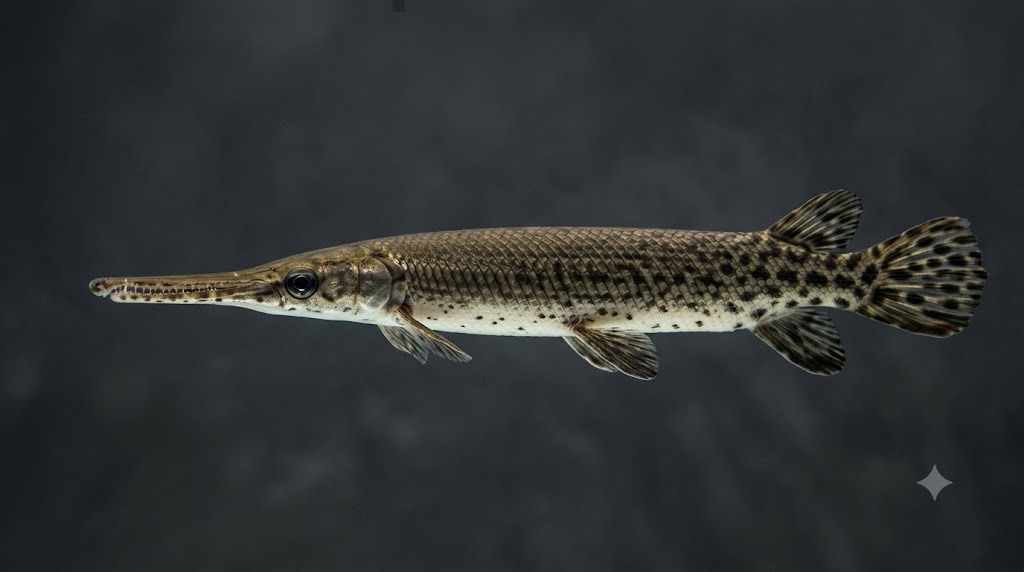
The longnose gar is instantly recognizable. Its body is long, cylindrical, and torpedo-shaped, sheathed in hard, diamond-shaped ganoid scales that feel like enamel armor. Coloration is olive-brown to greenish on the back, fading to a white belly, often with dark spots scattered along the body and on the fins, especially in younger fish and in clear water.
The defining feature is the snout: extremely long, narrow, and beak-like, at least twice the length of the rest of the head, lined with rows of fine, sharp teeth. This long, slender bill is what separates the longnose from its relatives - the shortnose, spotted, and alligator gars all have proportionally shorter, broader snouts. The dorsal and anal fins are set far back near the tail, giving the gar that explosive, lunging burst of acceleration. Like all gars, it has a vascularized swim bladder it can use as a primitive lung.
Range & Habitat (US waters)
Longnose gar range broadly across the eastern and central United States, from the Great Lakes and St. Lawrence drainage south through the entire Mississippi River basin to the Gulf, and along the Atlantic and Gulf coastal rivers from the mid-Atlantic states through Florida and Texas. They are abundant in large rivers and reservoirs throughout the South and Midwest.
They prefer slow-moving and still waters: the pools and backwaters of large rivers, reservoirs, oxbow lakes, sluggish creeks, and brackish coastal estuaries - gars tolerate some salinity. They favor warm water and gravitate toward calm, sun-warmed surface areas, weed edges, current seams, and the slack water below dams and around bridge pilings. Because they can breathe air, they handle warm, low-oxygen conditions easily.
Behavior & Feeding
The longnose gar is a stealthy, surface-oriented ambush predator. It hangs nearly motionless, often just under the surface, then accelerates with a sudden sideways slash of that toothed snout to snag prey. Its diet is dominated by fish - shad, minnows, sunfish, small rough fish - and it will also take crayfish and large insects. The slender bill is a precision tool: the gar grabs prey crosswise, then manipulates and swallows it headfirst.
Gars are most active and most visible in warm weather, often seen basking and rolling at the surface to gulp air on hot afternoons. They feed throughout the day but tend to be most aggressive in low light and during warm, stable conditions. They spawn in spring in shallow, weedy water; the eggs are notably toxic to predators, a quirk that protects the next generation.
Best Seasons & Times to Catch
Summer is gar season. From late spring through early fall, when water temperatures climb into the 70s and 80s, longnose gar are active, surface-oriented, and highly catchable. The hottest months - June, July, and August - are prime, exactly when bass and walleye fishing slows down. Spring offers good fishing around the spawn as fish move shallow.
Within a day, late morning through afternoon is often best because gars rise to bask and feed in the warming surface water, making them easy to spot for sight fishing. Calm, sunny, stable weather is ideal - flat water lets you see cruising and basking gar. Fishing drops off sharply in cold water; in winter, gars become sluggish and bury into deeper, slower holes.
Where to Find Them - Reading the Water
Use your eyes. Longnose gar are one of the few fish you can reliably hunt by sight. Scan calm surface water on warm days for gars basking, slowly finning, or rolling to gulp air - that telltale roll is a clear target. Look in slow river pools, backwater eddies, the slack water beside current, reservoir coves, and around structure like bridge pilings, fallen timber, and weed edges.
Current seams below dams and at creek mouths concentrate baitfish and therefore gar. In reservoirs, points, flats adjacent to deep water, and the back ends of warm coves all hold fish. Brackish estuary mouths can be excellent. The general rule: warm, calm, slow water with baitfish and some structure. When you see a gar, you have found your spot - cast to it directly.
Tackle & Rigs
The challenge with gar is their bony, tooth-filled mouth, which is almost impossible to set a conventional hook into. Two tackle approaches solve this. The first is the rope lure: a frayed bundle of nylon rope with no hook at all. When a gar bites, its many fine teeth tangle hopelessly in the rope fibers, and you simply hold steady and bring the fish in, then work it free. This is the cleanest, most hookless method and is easy on the fish.
The second approach uses bait on a wire or heavy fluorocarbon leader - gar teeth will cut mono - with a small, very sharp treble or a specialized gar hook, and a long, deliberate delay before setting to let the gar fully mouth and turn the bait. For tackle, a medium-heavy to heavy rod, a sturdy reel, and 30 to 50 lb braid handle the fight and the abrasive scales. Always run a steel or heavy fluoro leader of 12 inches or more.
Best Baits & Lures
For bait fishing, cut bait and live baitfish are the standards. A chunk of fresh shad, a live shiner, or a small sucker fished under a float in the strike zone draws gar reliably. Their good sense of smell makes oily cut bait effective.
The most famous "lure" is not a lure at all - it is the rope lure, a hookless bundle of unraveled nylon rope, sometimes white or chartreuse, that tangles their teeth. Beyond that, gars will chase fast-moving lures: in-line spinners, spoons, lipless crankbaits, and topwater plugs all draw strikes, though hookups on conventional lures are notoriously poor because of that hard mouth. Many anglers use a flashy lure to attract and excite the gar, then present a rope lure or baited rig once the fish is interested. Bright colors and steady, visible movement near the surface trigger their predatory chase.
Techniques - How to Fish for It
Sight fishing is the heart of gar angling. Spot a basking or cruising gar, position quietly, and cast a rope lure or baited float a few feet ahead of and across its path. Retrieve the rope slowly with a gentle twitch so it looks like a struggling baitfish. The gar will turn, track it, and slash at it. Resist the urge to set - there is no hook. Just keep the line tight, let the teeth tangle, and steadily reel and lift the fish to the boat or bank.
With baited rigs, the key is patience. When a gar takes the bait, give it a long, slow count - often 20 to 30 seconds or more - before tightening, so it has time to turn the bait and let the small hooks find purchase in the soft corners of the mouth. Expect a wild fight: gars run, twist, shake their heads violently, and frequently leap clear of the water. Use long pliers and a glove or towel to control the head when landing - those teeth are sharp and the fish thrashes hard.
Common Mistakes
The most common error is fishing for gar with normal hooks and a normal hookset, then losing fish after fish to that bony mouth - switch to a rope lure or learn the long delay. Setting the hook too soon on a baited rig is the classic baited-rig mistake. Anglers also use mono straight to the bait and get cut off; always run a leader. Many people ignore the visual clues and blind-cast instead of hunting basking fish. Finally, careless handling of the toothed jaw leads to nasty cuts - control the head and use tools. And never eat the eggs; gar roe is toxic.
Size, Records & Eating Quality
Longnose gar commonly run 2 to 4 feet and 3 to 10 pounds, with good fish reaching 4 to 5 feet and trophies topping 20 to 30 pounds. The all-tackle world record is around 50 pounds. Any longnose gar over 4 feet is a memorable catch.
Eating quality surprises people. The flesh is firm, white, and mild - genuinely good when cleaned correctly - but the fish is armored in tough ganoid scales that require tin snips or heavy shears to open. Gar is a regional delicacy in parts of the South, often fried in balls or patties or grilled. One critical warning: the eggs (roe) of all gars are poisonous to humans and other animals and must never be eaten. Handle the flesh, discard the roe.
Pros & Cons (as a target species)
Pros: a unique, visual style of fishing - sight casting to a fish you can watch stalk your bait; wild, acrobatic, leaping fights; abundant and underfished, with little competition on the water; reliably active in hot summer weather; the hookless rope lure makes for a low-injury, conservation-friendly method; surprisingly decent eating.
Cons: extremely difficult to hook with conventional gear; bony, tooth-lined mouth that cuts line and fingers; armored body that is laborious to clean; toxic eggs that demand careful handling; still saddled with an undeserved "trash fish" reputation.
Best Suited For
Longnose gar are perfect for anglers who want a novel, visual challenge - sight fishermen, fly and light-tackle hobbyists, and anyone bored with conventional bass fishing. They suit summer anglers who fish big rivers and reservoirs and want action when the heat shuts everything else down. They are great for adventurous anglers willing to learn the rope-lure technique, and for those who appreciate ancient, oddball species. They are less suited to anglers who want easy hookups or who refuse to fish without a hook.
FAQ
Why are gar so hard to hook? Their long, hard, bony beak gives a conventional hook almost nothing to bite into. The solution is either a hookless rope lure that tangles their teeth, or a baited rig with a very long delay before setting so small hooks can find the softer corners of the mouth.
What is a rope lure and how does it work? A rope lure is a hookless bundle of unraveled nylon rope. When a gar bites, its many fine, recurved teeth tangle in the fibers and cannot pull free. You simply keep the line tight and reel the fish in, then untangle it for release - no hook injury at all.
Can you eat longnose gar? Yes. The flesh is firm, white, and mild, and it is a Southern delicacy when cleaned properly with heavy shears to cut the armored scales. But the eggs are toxic to humans and animals and must never be eaten.
Are gar dangerous to people or other fish? Gars are not a danger to swimmers - they are not aggressive toward people. They are predators of small fish, but as native species they are a natural part of the ecosystem and do not threaten healthy gamefish populations.
When is the best time to catch longnose gar? Hot summer days. From June through August, on calm sunny afternoons, gar rise to bask and feed near the surface, making them easy to spot and target by sight.