Muskellunge
The muskellunge - "musky" to the anglers obsessed with it - is famously called "the fish of 10,000 casts." It is the largest member of the pike family in North America and the apex predator of the cool northern lakes and rivers it haunts.
🗓️ Last reviewed: June 2026
Overview
The muskellunge - "musky" to the anglers obsessed with it - is famously called "the fish of 10,000 casts." It is the largest member of the pike family in North America and the apex predator of the cool northern lakes and rivers it haunts. Musky fishing is a pursuit of patience and persistence: long hours, heavy gear, and the constant tension of knowing that one explosive strike can erupt at any moment, often right at the side of the boat. For the dedicated, that single boatside blowup from a 4-foot fish is worth every fishless hour. The musky is not a numbers fish; it is a trophy fish, a lifelong obsession, and an apex predator that demands respect.
Identification & Appearance
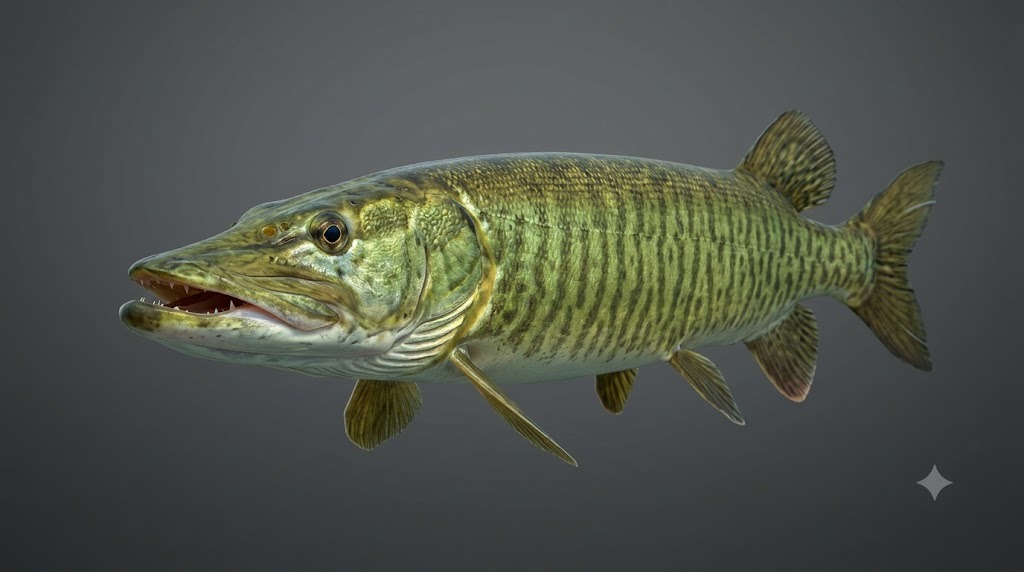
The muskellunge is long, sleek, and built like a missile, with a broad, duck-billed snout full of needle-sharp teeth. Coloration is variable but typically a light greenish, brownish, or silvery body marked with darker vertical bars, spots, or a vague reticulated pattern - and in some "clear" individuals, almost no pattern at all. The key field marks that separate a musky from its cousin the northern pike: muskies have light bodies with dark markings (pike are the reverse - dark bodies with light spots), and the underside of a musky's lower jaw has six or more sensory pores per side (pike have five or fewer). The tail is more sharply pointed than a pike's. Adult muskies routinely exceed 40 inches.
Range & Habitat (US waters)
Muskellunge are native to the Great Lakes basin, the upper Mississippi drainage, and the Ohio River system. They are a signature species of Wisconsin, Minnesota, and Michigan, with strong fisheries in northern lakes and large rivers. Stocking programs have extended musky fishing into New York, Pennsylvania, the southern Appalachians (including renowned river fisheries in West Virginia, Tennessee, and the Carolinas), and elsewhere. They favor cool, clear-to-stained lakes and rivers with abundant weed growth, rock structure, and a healthy forage base. River-dwelling muskies relate to current breaks and deep pools. They need cool water and good oxygen, and tolerate warmth poorly.
Behavior & Feeding
Muskies are ambush predators of the highest order - patient, solitary, and territorial. They hold near weed edges, rock bars, timber, and structure, waiting to dart out and inhale prey with a single violent rush. Their diet is dominated by fish - suckers, ciscoes, perch, panfish, and smaller gamefish - but a big musky will also take ducklings, muskrats, and frogs. They are notorious "followers," trailing a lure all the way to the boat without committing, which is why the figure-eight at boatside is a core musky technique. Feeding windows are often short and tied to weather, moon, and light, making timing critical.
Best Seasons & Times to Catch
Musky season generally opens in late spring or early summer in the northern states. Early season can be excellent as fish feed in warming shallows. Summer offers consistent action with the right approach, including night fishing on some waters. But fall is the legendary trophy season - as water cools, big female muskies feed heavily to build energy reserves, and the largest fish of the year come from late September through ice-up, often on large live suckers or oversized lures. Low-light periods, weather changes, and the much-debated "moon phases" all influence feeding windows. Persistence across conditions is the only reliable strategy.
Where to Find Them - Reading the Water
Muskies relate to structure and edges. Classic spots include deep weed edges, rock bars and humps, points, sharp drop-offs, and the deep tips of mid-lake structure. Newly developed or healthy green weeds are magnets. In rivers, look for current seams, eddies behind boulders or wing dams, and deep holes adjacent to faster water. As seasons progress, muskies move - shallow weed flats in summer, deeper rock and the open-water haunts of ciscoes in fall. Forage location is key: where the baitfish concentrate, big muskies set up nearby. Cover water and target the highest-percentage edges and breaks.
Tackle & Rigs
Musky fishing requires heavy, purpose-built gear. Use a stout 8 to 9 foot musky rod rated for casting heavy lures, paired with a strong, high-capacity baitcasting reel. Spool with 65 to 100 pound braided line. A heavy fluorocarbon or, more reliably, a wire or titanium leader of 80 to 130 pound test is mandatory - a musky's teeth will slice through anything less in an instant. Hooks must be sharp and strong; many anglers upgrade factory trebles. Long-nosed pliers, heavy hook cutters, a large rubber landing net or cradle, and a jaw spreader are essential safety tools for both the angler and the fish.
Best Baits & Lures
Musky lures are oversized by any other standard. Big bucktails - large spinners with flashing blades - are the workhorse search bait. Massive soft-plastic and rubber swimbaits, jerkbaits, glide baits, crankbaits, and topwater lures (prop baits and walkers) all produce, each suited to different moods and conditions. Lure size commonly runs 6 to 12 inches and can go larger. Live bait, especially large suckers fished on a quick-strike rig, is a deadly fall tactic for trophy fish. The general rule of musky fishing - "big baits catch big fish" - holds true more here than for almost any other freshwater species.
Techniques - How to Fish for It
Casting is the heart of musky fishing: fire big baits to weed edges, rock structure, and breaks, and retrieve with speed and erratic action to trigger reaction strikes. The critical habit is the boatside figure-eight - at the end of every retrieve, plunge the rod tip into the water and sweep the lure in a wide, smooth figure-eight pattern, because muskies famously strike right at the boat. Trolling large crankbaits covers vast water and locates active fish. In fall, drifting or anchoring with big live suckers on quick-strike rigs targets the biggest fish. Above all, fish every cast like it's the one.
Common Mistakes
The classic mistake is skipping the figure-eight - countless muskies are lost because the angler reels the lure straight to the boat and quits. Using leaders that are too light costs anglers the fish of a lifetime to bite-offs. Underpowered tackle leads to poor hooksets in a bony mouth and prolonged, harmful fights. Many anglers also throw lures that are too small. Poor fish-handling - long air exposure, no proper release tools, fishing in dangerously warm water - kills these slow-growing apex predators. And quitting too early: musky fishing rewards the angler who keeps casting.
Size, Records & Eating Quality
Muskies are giants. A "legal" musky in many states is 40 inches or more, a 50-incher is the milestone of a lifetime, and the rare 55-plus-inch fish is a true giant. The all-tackle world record stands at around 67 pounds 8 ounces, a hotly debated mark from Wisconsin's Chippewa Flowage in 1949. As for eating, muskies are technically edible with white flesh, but they are almost universally released. They are slow-growing, relatively low in numbers, and far too valuable as a trophy and as breeding stock to keep. Catch-and-release is the deeply ingrained ethic of the musky community.
Pros & Cons (as a target species)
Pros: muskies are the ultimate freshwater trophy, with a single 50-inch fish capable of defining an angler's season or career. The strikes are heart-stopping, the figure-eight makes boatside hits routine, and the pursuit builds genuine skill. Cons: they are genuinely difficult - the "10,000 casts" reputation is earned, and fishless days are normal. The gear is heavy and expensive, the technique is demanding, and the physical effort of casting big baits all day is real. They are not a fish you keep, so it's a pure trophy pursuit.
Best Suited For
Muskellunge are for dedicated, patient, goal-oriented anglers who measure success in inches, not numbers. They suit the angler willing to invest in heavy gear, commit long hours, and chase one giant fish. The pursuit demands physical stamina and mental persistence. It is not a beginner's fish and not a meal-fishing pursuit. But for the angler who wants the biggest, most challenging freshwater predator in North America, nothing else compares.
FAQ
Why is the musky called the "fish of 10,000 casts"? Because muskies are scarce, solitary, and notoriously selective, anglers can cast for many hours - even days - between strikes. The phrase captures the patience and persistence the pursuit demands, and why a single trophy is so deeply rewarding.
What's the difference between a muskellunge and a northern pike? The simplest tell is the coloring: muskies have light bodies with dark markings, while pike have dark bodies with light spots. Muskies also have six or more pores under each side of the lower jaw (pike have five or fewer) and a more sharply pointed tail.
What is the figure-eight and why does it matter? At the end of every retrieve, you sweep the lure in a wide figure-eight pattern boatside with the rod tip in the water. Muskies are famous followers that often strike right at the boat - the figure-eight converts those followers into hooked fish.
Do I really need a wire leader? Yes. A musky's teeth will instantly slice through standard line and even heavy mono. A wire, titanium, or very heavy fluorocarbon leader of 80 to 130 pound test is mandatory to avoid bite-offs and losing the fish of a lifetime.
Should I keep a muskellunge? Almost never. Muskies are slow-growing apex predators with relatively low populations, and the angling community strongly embraces catch-and-release. Use proper handling tools, minimize air exposure, and revive the fish carefully before release.