Peacock Bass
The peacock bass is, despite its name, not a bass at all - it is a large, brilliantly colored cichlid native to the Amazon basin of South America.
🗓️ Last reviewed: June 2026
Overview
The peacock bass is, despite its name, not a bass at all - it is a large, brilliantly colored cichlid native to the Amazon basin of South America. But it has become a genuine part of American freshwater fishing thanks to a remarkable success story: in the 1980s, fisheries managers introduced peacock bass into the warm canals and lakes of southeastern Florida to control nuisance non-native fish. The introduction worked, and today the butterfly peacock bass thrives in South Florida, giving United States anglers a chance to catch a tropical exotic gamefish without leaving the country.
For anglers, the peacock bass is a thrill. It is stunningly beautiful - gold and green with bold black bars and a distinctive eyespot on the tail - it is fiercely aggressive, it strikes lures with shocking violence, and it fights with relentless, drag-screaming power. It is best known to US anglers as the butterfly peacock bass, the species suited to Florida's climate, and it has turned ordinary urban canals into a destination fishery. The peacock bass is proof that an introduced species, carefully chosen, can become a treasured and ecologically useful gamefish.
Identification & Appearance
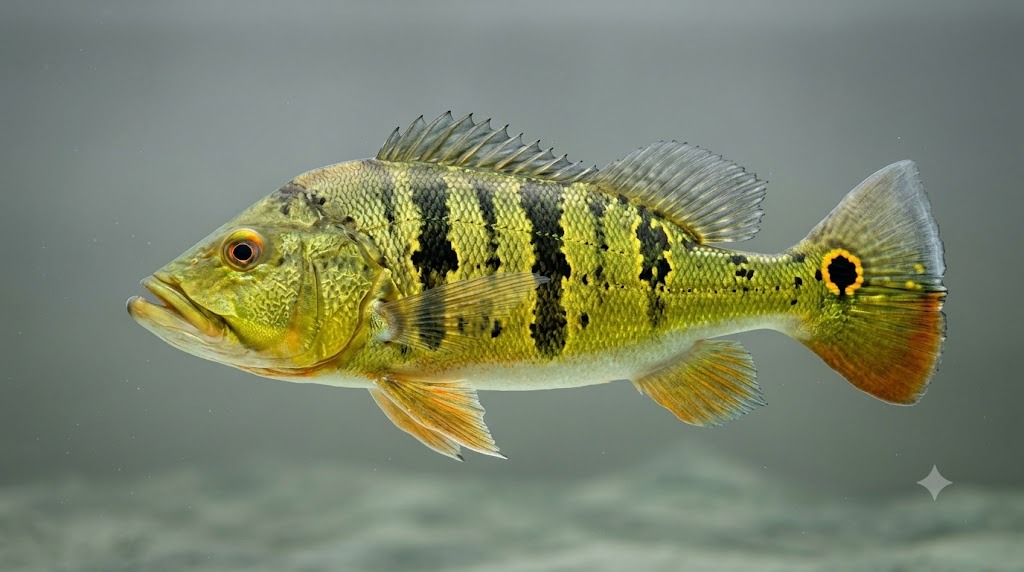
The peacock bass is a showpiece. The body is robust and elongated, somewhat bass-like in profile, and vividly colored - generally golden-green to olive with a yellow-gold belly, often flushed with orange on the lower body and fins. The most striking markings are three bold dark vertical bars along the flanks (the butterfly peacock bass typically shows these as distinct bars or blotches) and, most diagnostic of all, a prominent black "eyespot" - a dark ocellus ringed in iridescent gold or blue-white - at the base of the tail.
That eyespot is the source of the name: it resembles the eye-shaped marking on a peacock's tail feathers. Breeding adults, especially males, develop intensified colors and a pronounced nuchal hump on the forehead. The fins are large and the mouth is wide, befitting an aggressive predator. As a cichlid, it has a single nostril on each side of the head, unlike the true bass. The combination of brilliant gold-green color, dark bars, and that ringed tail eyespot makes the peacock bass unmistakable.
Range & Habitat (US waters)
In the United States, peacock bass are found in one place: South Florida. The butterfly peacock bass was deliberately introduced into the freshwater canal systems, lakes, and ponds of the Miami metropolitan area and surrounding southeastern Florida - Miami-Dade and Broward counties and nearby areas. There it has established a self-sustaining, popular fishery. Peacock bass cannot survive cold water, so cold winters strictly limit their range, confining them to the warm southern tip of the state; they have not spread northward, which is by design.
Within South Florida they thrive in the extensive network of urban and suburban canals, drainage systems, rock-pit lakes, and ponds. They favor warm, clear-to-lightly-stained water and relate to structure: canal edges, bridge and culvert pilings, rock and concrete edges, fallen timber, dock structure, and current breaks. They like warm water and become sluggish and inactive when temperatures drop, which both limits their range and shapes when anglers fish for them.
Behavior & Feeding
The peacock bass is an extremely aggressive, sight-hunting predator. It is a daytime, warm-water hunter that pursues prey actively and strikes with explosive ferocity - the violence of a peacock bass strike is famous and is a large part of the appeal. Its diet is dominated by fish; in Florida it feeds heavily on smaller non-native fish, which is precisely why it was introduced, and it readily takes shad, shiners, and other forage. It will also take large insects and small prey when young.
Peacock bass are visual hunters that feed best in good light and warm conditions - the opposite of many native gamefish, which makes for a refreshing midday fishery. They are highly territorial, especially when guarding nests; like other cichlids, peacock bass are devoted parents that build and defend nests and protectively guard their schooling fry. A nest-guarding peacock bass will savagely attack anything that approaches. They are intolerant of cold, becoming lethargic and ceasing to feed in cool water, and prolonged cold can kill them.
Best Seasons & Times to Catch
Because peacock bass are tropical and depend on warmth, the prime season is the warm part of the year. In South Florida, fishing is good from roughly spring through fall, with the warm months delivering the most aggressive feeding. Spring and early summer, the spawning period, can be outstanding - peacock bass move shallow, become intensely territorial, and attack lures with abandon as they guard nests and fry. Winter is the slow season; cool spells shut the fish down, and a hard cold snap can be tough.
Unlike most freshwater fishing, the peacock bass bite is best in the middle of the day. These are sight-hunting, warmth-loving fish, so the prime hours are the warm, bright part of the day - late morning through afternoon - when the sun is up and the water is warmest. This makes peacock bass fishing convenient and family-friendly: you can sleep in, fish the warm midday, and still have the best action. Sunny, warm, stable weather is ideal.
Where to Find Them - Reading the Water
In South Florida's canal-and-lake fishery, reading the water means finding structure, current breaks, and warm, sunlit areas. Peacock bass relate strongly to hard structure: bridge and culvert pilings, rock and concrete canal edges, seawalls, dock pilings, fallen trees, and any object that breaks current or provides ambush cover. Canal intersections, bends, and the areas around culverts and water-control structures, where current and forage concentrate, are reliable.
Look for the warmest, best-lit water, especially in cooler conditions when peacock bass seek out warmth. Shallow shoreline cover holds fish, particularly in spring when they move up to spawn. Because peacock bass are sight hunters in often-clear water, you can frequently spot them - cruising fish, fish holding on structure, or guarded schools of fry tended by aggressive parents. A visible school of fry is a sign that protective adults are right there. The general approach is to fish hard structure and current breaks in warm, sunlit canal and lake water.
Tackle & Rigs
Peacock bass fight hard and often hold near structure they will try to break you off on, so the tackle is sturdy - a step up from typical largemouth bass gear. A medium-heavy spinning or baitcasting rod, around 6.5 to 7.5 feet, with a fast action for casting lures and driving hooks, paired with a quality reel with a strong, smooth drag, is the standard. Spool with 15 to 30 lb braided line, or comparable mono, with enough strength to turn a hard-charging fish away from pilings and timber.
A fluorocarbon leader of 20 to 40 lb, a foot or two long, adds abrasion resistance against rock and structure and is a sensible addition, especially with braided main line. Peacock bass do not have cutting teeth like a pike, but their habitat is full of abrasive edges. Terminal tackle is straightforward - strong, sharp hooks on lures and a simple free-line or light-weight rig for live bait. The emphasis is on a strong, balanced setup that can absorb violent strikes and stop powerful runs around cover.
Best Baits & Lures
Peacock bass are aggressive and respond superbly to lures, which is much of their appeal. Topwater lures are a favorite and produce explosive, heart-stopping strikes - walking baits, poppers, and prop baits draw savage surface attacks, especially in warm conditions. Crankbaits, jerkbaits, and lipless crankbaits that imitate fleeing baitfish trigger hard reaction strikes. Soft-plastic jerkbaits and swimbaits, and bucktail or feather jigs worked with quick darting motions, are all effective. Bright colors and erratic, fast retrieves that mimic a panicked baitfish bring out the peacock bass's aggression.
For consistency, especially with larger or pressured fish, live bait is extremely effective. A live shiner or other lively baitfish, free-lined or fished near structure, is the classic peacock bass producer and a favorite of guides. The general rule for lures is fast and erratic: peacock bass are reaction-strike hunters that key on movement and flash, so a quickly worked, darting, flashy lure usually outproduces a slow presentation.
Techniques - How to Fish for It
The defining technique for peacock bass is aggressive, fast-paced lure fishing. Make accurate casts to structure, current breaks, and shoreline cover, and work the lure quickly with erratic, darting action - sharp twitches, fast retrieves, abrupt direction changes - to trigger the reaction strike. With topwater, a steady walking cadence or sharp popping over likely cover draws explosive blowups. Cover water, target the structure, and keep the lure moving fast; a peacock bass that sees a fleeing target usually cannot resist it.
Sight fishing adds another dimension: in clear canal water you can spot individual peacock bass or schools of guarded fry, cast accurately to them, and watch the strike. Casting to a nest-guarding adult near a school of fry almost guarantees an aggressive response. With live bait, free-line a lively shiner near structure and hold on. When a peacock bass strikes, set the hook hard and immediately apply pressure to steer the fish away from pilings and timber, because it will run straight for cover. The fight is intense - strong runs, head-shakes, and jumps. Handle these beautiful fish carefully and release them to sustain the fishery.
Common Mistakes
A common mistake is working lures too slowly; peacock bass are reaction hunters and a fast, erratic retrieve draws far more strikes than a slow one. Another is fishing too light, then losing fish that bolt into structure - use sturdy tackle and apply pressure immediately. Fishing the wrong hours is a frequent error; unlike most freshwater fish, peacock bass bite best in the warm, bright middle of the day, so dawn-and-dusk habits work against you. Fishing in cold conditions, when peacock bass are shut down, is largely futile. Anglers also overlook structure and current breaks, casting to open water instead of the pilings, rocks, and timber where peacock bass ambush. Finally, careless handling of these beautiful fish hurts a fishery built on a deliberate, balanced introduction.
Size, Records & Eating Quality
The butterfly peacock bass in Florida is a moderate-sized but powerful gamefish. A typical fish runs 1 to 3 pounds, a good one reaches 4 to 6 pounds, and a true Florida trophy approaches or tops 8 to 9 pounds. The Florida state-record butterfly peacock bass is around 9 pounds. (In their native South America, other, larger peacock bass species grow far bigger, exceeding 20 pounds, but those are not the fish established in US waters.) Pound for pound, the peacock bass fights as hard as almost anything its size in fresh water.
Eating quality is good - the flesh is white, firm, and mild - but in Florida the peacock bass is overwhelmingly valued and managed as a catch-and-release sport fish. It supports a popular, economically important recreational fishery, and regulations limit harvest, with strict bag limits and protections on larger fish. Most anglers release every peacock bass, both because the regulations encourage it and because the fish is worth far more swimming, providing repeated sport and helping control nuisance non-native species. Check and follow Florida's specific regulations.
Pros & Cons (as a target species)
Pros: a brilliantly beautiful, exotic tropical gamefish available within the United States; explosive, savage strikes, especially on topwater; a hard, powerful, drag-pulling fight; an aggressive, willing biter that hits lures readily; a convenient midday fishery in accessible South Florida canals and lakes; an ecologically useful introduced species that helps control nuisance non-native fish.
Cons: extremely limited US range - only South Florida - so most anglers must travel; intolerant of cold, with a poor winter season and a vulnerability to cold snaps; structure-loving fish that break off careless anglers; not a table fish, managed for catch-and-release; smaller in Florida than the giant peacock bass of South America.
Best Suited For
The peacock bass is ideal for anglers who want an exotic, hard-fighting, beautiful gamefish without an international trip - a tropical experience reachable in South Florida. It suits aggressive lure fishermen who love fast retrieves and explosive topwater strikes, sight-fishing enthusiasts, and visitors to the Miami area looking for a memorable fishery. Its warm-midday bite makes it convenient and family-friendly, and it is excellent for anglers who appreciate a catch-and-release sport fish. It is not for those seeking a fish for the table, anglers far from South Florida unwilling to travel, or those fishing in the cold season.
FAQ
Is a peacock bass actually a bass? No. Despite the name, the peacock bass is a cichlid, native to the Amazon basin of South America and related to other cichlids, not to North American black bass. The "bass" name comes from its bass-like shape and predatory, gamefish behavior.
How did peacock bass end up in the United States? They were deliberately introduced. In the 1980s, Florida fisheries managers stocked butterfly peacock bass into South Florida's canals and lakes to control nuisance non-native fish. The introduction succeeded, creating a popular self-sustaining fishery that has not spread because the fish cannot survive cold winters.
Where can I catch peacock bass in the US? Only in South Florida - the canal systems, lakes, and ponds of the Miami metropolitan area and surrounding southeastern counties. Cold intolerance keeps them confined to the warm southern tip of the state.
When is the best time of day to fish for peacock bass? Unusually for freshwater fishing, the middle of the day. Peacock bass are warmth-loving sight hunters, so the warm, bright hours from late morning through afternoon produce the best action - you do not need a dawn start.
Should I keep peacock bass to eat? Generally no. While the flesh is good, peacock bass in Florida are managed as a catch-and-release sport fishery with strict regulations and protections, and they are far more valuable alive - providing repeated sport and controlling nuisance fish. Release them and follow Florida's specific rules.