Pumpkinseed Sunfish
The pumpkinseed is one of the most beautiful fish in North American fresh water - a small, jewel-toned panfish that lights up like a stained-glass window when held in the sun.
🗓️ Last reviewed: June 2026
Overview
The pumpkinseed is one of the most beautiful fish in North American fresh water - a small, jewel-toned panfish that lights up like a stained-glass window when held in the sun. Named for its rounded, seed-shaped body, the pumpkinseed is a fixture of northern ponds, lakes, and slow streams, and it is very likely the first fish many anglers ever caught. It is aggressive, abundant, easy to catch, and willing to bite almost anything, making it the ultimate kids' fish and a dependable source of light-tackle fun. Though it does not grow large, the pumpkinseed punches above its weight as a fighter, as table fare, and as an introduction to the joys of fishing.
Identification & Appearance
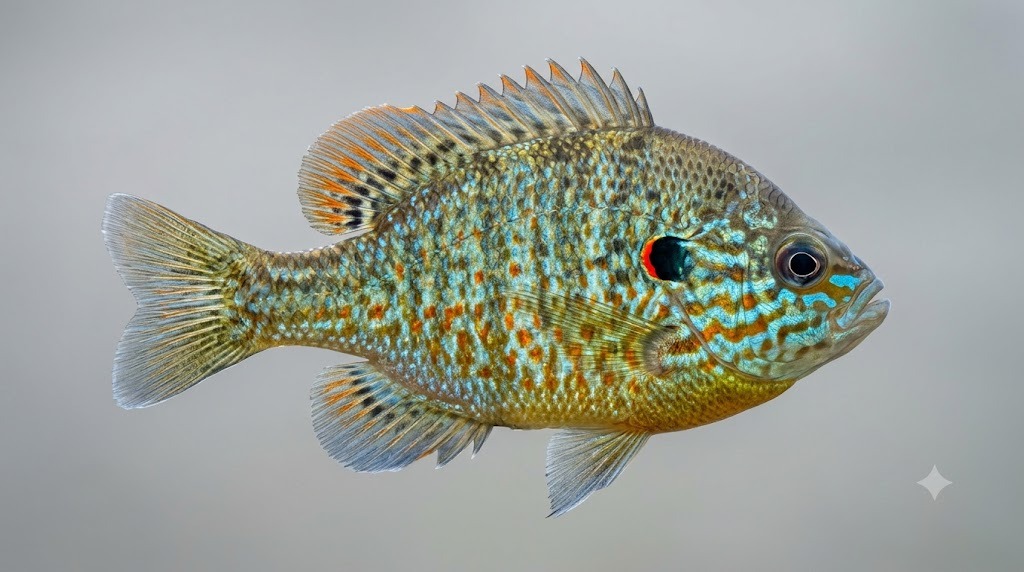
The pumpkinseed is unmistakable up close. Its deep, almost circular body glows with olive-green, orange, blue, and yellow, the flanks scattered with iridescent spots and the cheeks crossed by wavy electric-blue lines. The standout identification feature is the gill flap, or "ear": small, black, and crucially tipped with a bright crimson or scarlet spot - a half-moon of red that distinguishes the pumpkinseed from the similar bluegill, which has an all-dark ear. The pumpkinseed has a small mouth, long pointed pectoral fins, and faint vertical bars on the sides. The dorsal fin's soft rear portion may carry a small dark spot. Adults are typically 4 to 8 inches long.
Range & Habitat (US waters)
Pumpkinseeds are native to the northeastern and upper-midwestern United States and the Great Lakes region, from Maine and the Maritimes through the Mid-Atlantic, the Great Lakes states, and parts of the upper Mississippi drainage. They have been introduced more widely, including parts of the West. They favor cool to warm, clear, quiet water with abundant vegetation: ponds, the weedy margins of lakes, slow streams, marshes, and protected bays. They are shallow-water, near-shore fish, rarely far from cover, and tolerate cooler water better than many sunfish, which helps them thrive in northern climates.
Behavior & Feeding
Pumpkinseeds are bold, curious, and constantly feeding. They patrol shallow weedy margins picking off a wide variety of small prey: aquatic insects and their larvae, snails, small crustaceans, worms, tiny fish, and the occasional bit of vegetation. Like the redear, the pumpkinseed has well-developed throat teeth and readily eats snails, but it is far more aggressive and surface-oriented. They will rise to insects on top, snap at small lures, and crowd around any bait. Pumpkinseeds are highly social, often found in loose groups, and they spawn in colonies in late spring and early summer, with males fanning and guarding saucer-shaped nests in the shallows.
Best Seasons & Times to Catch
Pumpkinseeds can be caught all open-water season and through the ice, but late spring and early summer are the easiest and most productive - the spawn brings fish into the shallows in great numbers and they bite with abandon. Summer fishing remains excellent along weed edges, best in morning and evening when the sun is off the water. Fall offers steady action as fish feed up. In winter, pumpkinseeds are a reliable ice-fishing target in shallow weedy bays. Sunny, calm days are perfectly fine for these eager fish.
Where to Find Them - Reading the Water
Think shallow and weedy. Pumpkinseeds hold in 1 to 8 feet of water around aquatic vegetation, lily pads, submerged grass, fallen wood, docks, and rocky shorelines. They love the edges where weeds meet open water and the pockets within weed beds. In spring, look for their nests - clean, circular depressions fanned into sandy or gravelly bottom in the shallows, often in colonies. Around docks and any near-shore cover you will find pumpkinseeds. They rarely venture into deep open water, so almost any shoreline angler can reach them.
Tackle & Rigs
This is light-tackle and ultralight fishing at its simplest. A 5- to 6 1/2-foot ultralight or light spinning rod with 2- to 6-pound monofilament is ideal, and even a basic spincast combo works fine. A cane pole or telescopic pole is a classic, effective choice for working pocket water. The standard rig is a small bobber a foot or two above a #6 to #10 long-shank hook with a split shot or two. A tiny jig under a bobber is just as effective. Keep everything small to match the pumpkinseed's modest mouth.
Best Baits & Lures
Pumpkinseeds will eat almost anything small. Top live baits include garden worms, red wigglers, pieces of nightcrawler, crickets, mealworms, and wax worms. Even small bits of bread or corn can work in a pinch. Among artificials, tiny jigs (1/64 to 1/16 ounce) with marabou or soft-plastic bodies, micro spinners, small spoons, and tiny crankbaits all draw strikes. Fly anglers catch them readily on small poppers, foam beetles, ants, and wet flies. Bright colors help, but with a fish this willing, presentation matters more than exact color.
Techniques - How to Fish for It
Catching pumpkinseeds is wonderfully simple. Suspend a small baited hook or jig a foot or two under a bobber and cast it to weed edges, pads, and around docks; watch the float and set on the dip. With a pole, dap the bait into pockets in the vegetation. For artificials, cast tiny jigs or spinners along cover and retrieve slowly with small twitches. Fly anglers cast small poppers and beetles tight to the weeds and let pumpkinseeds attack on top. Move along the shoreline until you find a willing group, then enjoy steady action.
Common Mistakes
The main mistake is using gear that is too big - large hooks, heavy line, and oversized baits cost bites from this small-mouthed fish. Anglers sometimes fish too deep or too far from cover; pumpkinseeds live shallow and tight to the weeds. Setting the hook too hard with light line can break off or tear the small mouth. Some anglers also dismiss pumpkinseeds entirely, missing out on a perfect species for beginners and a fun light-tackle target. Finally, sitting in one unproductive spot rather than moving to find active fish wastes time.
Size, Records & Eating Quality
Pumpkinseeds are small - most run 4 to 7 inches, and an 8-incher is a notable fish. A true trophy approaches 9 to 10 inches. The all-tackle world record is 1 pound 6 ounces, caught in New York in 2016. Despite their size, pumpkinseeds are excellent eating: sweet, white, flaky panfish flesh, the same quality that makes a sunfish fry so good. The challenge is simply that it takes a number of fish to make a meal. Where populations are abundant - and they often are - a mess of pumpkinseeds is a fine, traditional shore-lunch.
Pros & Cons (as a target species)
Pros: stunningly colorful; extremely abundant and easy to catch; aggressive, willing biters that take almost any small bait or lure; accessible from any weedy shoreline; superb for kids and beginners; good eating and catchable year-round including through the ice. Cons: very small, so they are no trophy fish; bony and small for filleting, requiring many fish for a meal; can crowd out a bait meant for larger species; not a challenge for experienced anglers seeking a test.
Best Suited For
The pumpkinseed is the ideal first fish - perfect for children, beginners, and anyone who wants guaranteed, low-stress action on simple gear. It suits shore anglers, pond hoppers, and families looking for a fun afternoon, as well as ice anglers seeking dependable shallow-water bites. Light-tackle and fly anglers enjoy them as a colorful, willing target. They are less suited to anglers chasing size or a serious challenge, but as a fish that makes people fall in love with fishing, the pumpkinseed has few rivals.
FAQ
How do I tell a pumpkinseed from a bluegill? Look at the gill flap, or "ear." The pumpkinseed's ear has a bright crimson spot at the tip, while the bluegill's ear is solid dark. Pumpkinseeds are also more vividly multicolored with wavy blue cheek lines.
Are pumpkinseeds good to eat? Yes - they have sweet, white, flaky flesh just like other sunfish. The only drawback is their small size, so it takes a good number of fish to make a meal.
What is the best bait for pumpkinseed sunfish? Small live baits work best - garden worms, red wigglers, crickets, wax worms, and mealworms fished under a small bobber. Tiny jigs and spinners also catch them readily.
Where should I fish for pumpkinseeds? In shallow, weedy water near cover - around lily pads, submerged grass, docks, and rocky shorelines, usually in one to eight feet. They rarely move into deep open water.
Are pumpkinseeds a good fish for kids? They are one of the best. They are abundant, aggressive, easy to catch on simple gear, beautiful to look at, and found along almost any pond or lake shoreline.