Steelhead
Steelhead are the sea-run, or in the Great Lakes the lake-run, form of rainbow trout.
🗓️ Last reviewed: June 2026
Overview
Steelhead are the sea-run, or in the Great Lakes the lake-run, form of rainbow trout. They are the same species as resident rainbows but follow a migratory life history: they hatch in rivers, drop down to the ocean or a large lake to feed and grow, then return to freshwater to spawn. That ocean or big-water feeding turns a modest stream trout into a powerful, chrome-bright, hard-fighting fish that many anglers consider the ultimate freshwater quarry. Steelhead are prized for their dramatic runs, acrobatic jumps, and the cold, scenic rivers they swim. They are also famously difficult - a fish that rewards persistence, river knowledge, and patience. The pursuit has its own culture, with dedicated anglers logging long days for a single grab.
Identification & Appearance
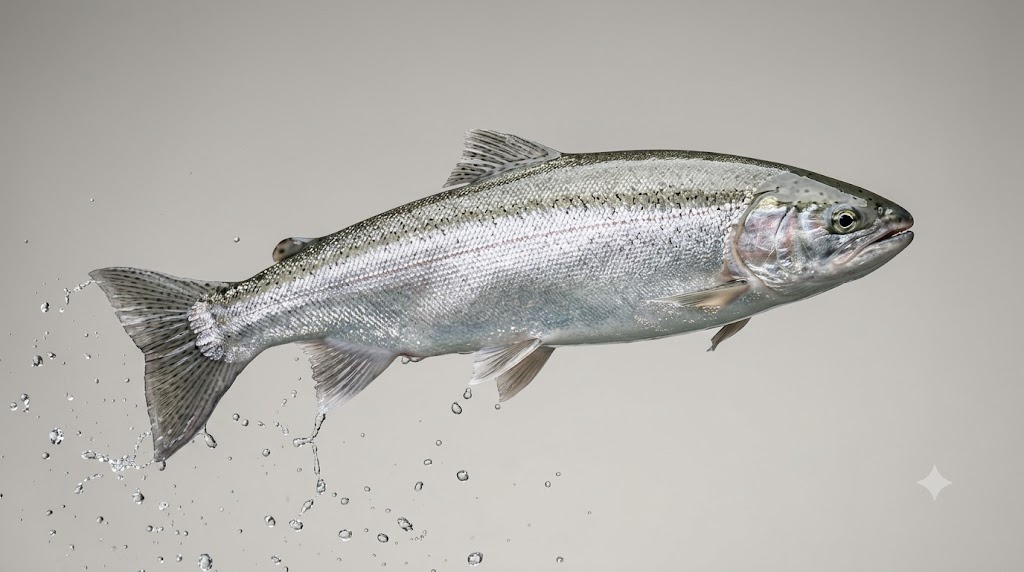
A fresh steelhead straight from salt or a lake is unmistakable: bright silver, almost mirror-chrome on the flanks, with a clean white belly and a dark blue-green back. As the fish holds in the river and approaches spawning, color returns - a rosy or crimson stripe down the lateral line, a darker olive back, and a pinkish gill plate. Small black spots cover the back, dorsal fin, and the square-edged tail; the spotting on the tail radiates outward. Steelhead have a relatively streamlined, athletic body compared to the deeper-bodied resident rainbows. The mouth extends to roughly under the eye. Spawning males develop a pronounced kype (hooked jaw). Size ranges widely - many rivers produce 5- to 12-pound fish, while West Coast and British Columbia systems give up genuine giants over 20 pounds.
Range & Habitat (US waters)
Native steelhead range along the Pacific coast from Southern California to Alaska, with the strongest fisheries in Washington, Oregon, Northern California, and Idaho's Snake River tributaries. They were also introduced to the Great Lakes, where they now thrive - Lake Michigan, Lake Erie, Lake Ontario, Lake Huron, and Lake Superior all have excellent runs that ascend tributary rivers in fall, winter, and spring. They need cold, clean, well-oxygenated rivers with gravel for spawning and a connection to large feeding water. In the river they hold in moderate-current runs, pool tailouts, and seams behind structure.
Behavior & Feeding
Returning steelhead are not feeding to survive in the river - they are driven by spawning - but they still strike out of aggression, territoriality, reflex, and residual feeding instinct. That is the key to catching them. They hold in predictable lies and will move a short distance to intercept a drifting egg, a swung fly, or a plug working through their zone. Cold water makes them lethargic and tight to the bottom; warmer flows make them more aggressive and willing to chase. Steelhead are sensitive to light, water clarity, and pressure, often biting best in low light and slightly colored "steelhead green" water.
Best Seasons & Times to Catch
Runs are split into summer-run and winter-run strains. Winter steelhead enter coastal rivers from late fall through early spring and are the classic target. Summer-run fish enter in spring and summer and hold over for months. In the Great Lakes, the heart of the fishery is fall through spring, with strong pushes after autumn rains and again during the spring spawn. The best fishing usually follows a rain event as rivers drop and clear from high, muddy flows into fishable green. Early morning and the first hour of light are prime, and overcast days extend the bite.
Where to Find Them - Reading the Water
Steelhead hold in "walking-pace" water - current you could comfortably walk beside, typically 3 to 6 feet deep. Focus on the head of a run where fast water meets a defined slot, the heart of the run along current seams, and the tailout where a pool shallows before the next riffle. Look for changes: a depth change, a color change, a boulder, a ledge, or a soft pocket beside heavy current. Fresh fish often rest at the bottoms of pools and travel through tailouts; holding fish settle into mid-run seams. Cover water - steelhead are spread thin, and finding the player is half the battle.
Tackle & Rigs
Float fishing is the most productive numbers approach: a 10- to 11-foot medium-action spinning or casting rod, a sliding float, a leader to a bait or jig, and split shot for depth control. Drift fishing uses a similar rod with a pencil-lead or slinky weight bouncing bottom. Plug fishing from a boat backs diving plugs down to holding fish. Fly anglers swing flies with two-handed spey rods (7- to 8-weight) or nymph with single-hand 7-weights and indicators. Mainlines run 10- to 15-pound mono or 30-pound braid; leaders are 6- to 12-pound fluorocarbon depending on clarity. Hooks should be sharp and stout - steelhead fight hard.
Best Baits & Lures
Cured salmon roe and spawn sacs are the classic, deadly bait. Soft beads in egg colors fished above a bare hook are now extremely popular and effective. Other top producers include yarn flies, pink worms and plastic worms, sand shrimp, and nightcrawlers. For hardware, inline spinners, spoons, and diving plugs in chrome, pink, blue pirate, and green-and-silver patterns shine. Steelhead jigs (1/8 to 1/4 ounce) under a float in pink, black, white, and purple are river staples. Fly patterns include egg patterns, stonefly and copper-John nymphs, and intruder-style swing flies.
Techniques - How to Fish for It
Float fishing: set the float so your bait ticks just off bottom, cast upstream, mend the line, and drift naturally through the slot, repeating with small adjustments to cover the lane. Drift fishing: cast quartering upstream and let the weight tap bottom as the rig swings down - set on any pause or pull. Plugging: anchor or hover above a run and let plugs work downstream into the fish. Swinging flies: cast across, mend, and let the fly sweep through the run on a tight line, taking a step downstream after each cast. Whatever the method, the goal is a dead-natural drift in the strike zone - and a fast, firm hookset.
Common Mistakes
The biggest error is fishing the wrong depth - your offering must be near the bottom where steelhead hold. Many anglers also fish too fast, racing through water instead of methodically covering every lane. Setting the hook too softly on subtle takes loses fish; so does horsing a hot steelhead instead of using rod angle and a smooth drag. Anglers ignore water conditions, fishing blown-out brown water or gin-clear low water rather than the productive green window. Finally, walking past good water to reach a "famous" hole wastes prime, unpressured lies.
Size, Records & Eating Quality
Great Lakes steelhead commonly run 5 to 12 pounds, with fish to the high teens. West Coast winter fish average 8 to 12 pounds, with 20-pound-plus trophies in Washington, Oregon, and especially British Columbia. The all-tackle world record rainbow/steelhead is over 48 pounds (a Lake Diefenbaker, Saskatchewan fish). Eating quality is good - firm, pink-orange flesh that is excellent grilled, smoked, or baked, best when fish are bright and fresh from big water. Many anglers practice catch-and-release on wild steelhead to protect fragile native runs, keeping only hatchery fish where regulations allow.
Pros & Cons (as a target species)
Pros: explosive fights, blistering runs, and spectacular jumps; beautiful, chrome-bright fish in stunning rivers; a true challenge that builds skill; strong fisheries in both coastal and Great Lakes regions. Cons: notoriously hard to catch, with long fishless stretches; weather- and flow-dependent; cold, wet, winter conditions; crowded popular rivers; conservation concerns mean restrictive regulations on many wild runs.
Best Suited For
Steelhead suit the dedicated, patient angler who enjoys process as much as result and is willing to brave cold rivers for a few elite grabs. They are ideal for anglers who love reading moving water, refining drift technique, and exploring scenic river country. They are less suited to anglers wanting fast, easy action or fair-weather comfort. Newcomers do best hiring a guide for a day to shortcut years of trial and error.
FAQ
Are steelhead and rainbow trout the same fish? Yes - they are the same species, Oncorhynchus mykiss. Steelhead are simply rainbows that migrate to the ocean or a large lake to feed, then return to rivers to spawn. The migratory life history makes them bigger and stronger.
Why are steelhead so hard to catch? They do not need to feed in the river, they are spread thinly, and they hold in specific lies. Success depends on finding the right water at the right depth in the right conditions and presenting a natural drift.
What is the best water condition for steelhead? A river dropping and clearing after rain into a green tint with about 1 to 3 feet of visibility is ideal. Blown-out muddy water and gin-clear low water are both tough.
Do I need a boat to catch steelhead? No. Most steelhead are caught by bank anglers wading and float or drift fishing. A boat helps cover water and back plugs, but plenty of trophy fish fall to walk-and-wade anglers.
What size line should I use? In stained water, 10- to 12-pound leaders are fine; in clear water, drop to 6- to 8-pound fluorocarbon for more bites. Use a stout, sharp hook regardless.