Tiger Muskie
The tiger muskie is the apex predator of many North American lakes - a striking, hard-hitting hybrid produced when a muskellunge crosses with a northern pike.
🗓️ Last reviewed: June 2026
Overview
The tiger muskie is the apex predator of many North American lakes - a striking, hard-hitting hybrid produced when a muskellunge crosses with a northern pike. It carries the best traits of both parents: the size potential and explosive strike of the muskie, the aggression and willingness of the pike, and a vigor that often makes it grow faster and feed harder than either. Add a body marked with bold, irregular tiger stripes, and you have one of the most exciting and visually arresting freshwater gamefish on the continent.
Tiger muskies occur naturally where pike and muskie ranges overlap, but most fish anglers catch are produced in hatcheries and stocked deliberately by fisheries agencies. Because the hybrid is functionally sterile, it cannot reproduce and overrun a fishery, which makes it a controlled, manageable trophy predator - and a useful tool for thinning overpopulated panfish or rough fish. For the angler, the tiger muskie is a thrilling pursuit: a big, toothy, ambush hunter that demands heavy tackle, dedication, and respect, and rewards it with the catch of a season.
Identification & Appearance
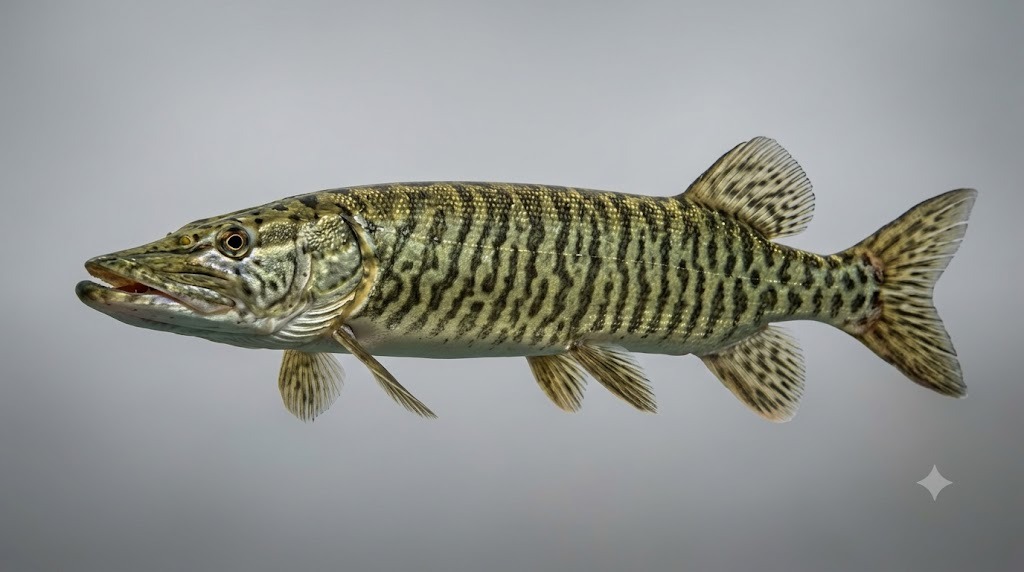
The tiger muskie is named for its markings. The body is long, torpedo-shaped, and built for explosive acceleration, colored greenish, brassy, or grayish, and overlaid with bold, dark, irregular vertical bars and blotches that resemble a tiger's stripes - generally more distinct and contrasting than the markings of a pure muskie. The fins, particularly the lower and tail fins, often show an orange or amber tint.
It blends the identifying traits of its parents. Like the muskie, it has a long head and pointed, duck-bill snout full of teeth. A key field identifier is the cheek and gill cover: the tiger muskie typically has the lower half of the cheek and gill cover scaleless, intermediate between the fully scaled cheek of a pike and the half-scaled cheek of a muskie. The tail lobes are usually more rounded than a pure muskie's. The overall impression is of a bold-striped, heavily built pike-muskie with a mouthful of teeth.
Range & Habitat (US waters)
Tiger muskies are found across the northern and central United States, with their distribution shaped largely by stocking programs. They are common in the upper Midwest and the Great Lakes states - Wisconsin, Minnesota, Michigan - and the Northeast, including New York, Pennsylvania, and surrounding states. Importantly, because they are stocked, tiger muskies also occur well beyond the natural pike-muskie range, including in many Western and Mountain West reservoirs in states such as Colorado, Utah, and others, where agencies use them as a managed predator.
They inhabit lakes, reservoirs, and slower rivers. Tiger muskies favor cool, clean water and relate strongly to structure and cover: weed beds and weed edges, submerged timber and rock, points, drop-offs, and the transitions between shallow flats and deeper water. They use weedy shallows in cooler conditions and move to deeper structure as water warms. Clear-to-moderately-stained lakes with healthy weed growth and good forage are classic tiger muskie water.
Behavior & Feeding
The tiger muskie is a pure ambush predator and a voracious one - hybrid vigor often makes it even more aggressive and faster-growing than its parent species. It positions itself in or beside cover, holding motionless, then attacks prey with a sudden, explosive lunge. It is built to eat large meals: a tiger muskie will readily take prey a quarter to a third of its own length.
Its diet is dominated by fish - suckers, perch, panfish, ciscoes, shad, and other muskies' prey - and large tigers will also take frogs, crayfish, ducklings, and small mammals. They hunt primarily by sight and by sensing vibration, so they are most aggressive in reasonable visibility and in light that favors ambush. Tiger muskies are notorious for "following" - tracking a lure all the way to the boat without committing - which is a hallmark behavior the angler must learn to handle. Because the hybrid is sterile, tiger muskies put all their energy into feeding and growth rather than spawning, which contributes to their fast growth.
Best Seasons & Times to Catch
Tiger muskie fishing has two strong seasons. Late spring and early summer, as fish feed actively in and around shallow weed growth in cooling-to-moderate water, offer good action. Then comes the celebrated fall period: from early autumn until the water grows very cold, tiger muskies feed heavily, putting on weight before winter, and the biggest fish of the year are often caught in this window. Many dedicated muskie anglers consider fall the prime trophy season. Midsummer fishing can be good but is often tougher in the heat, with better activity in low light.
Within a day, low-light periods - dawn, dusk, and overcast conditions - are generally most productive, though tiger muskies feed at all hours and can be triggered any time. Many anglers watch the major and minor solunar feeding periods. Weather matters: a stable warming trend, the front edge of an approaching weather change, and overcast skies often spark activity, while a sharp post-cold-front high-pressure day can produce stubborn, lure-following fish.
Where to Find Them - Reading the Water
Tiger muskies live around structure and cover, and reading the water means finding the ambush points. Weed beds and especially weed edges - the line where green weeds meet open water or deeper water - are the single most important feature; tigers hold in and along these edges waiting for prey. Submerged timber, rock piles, points, humps, and sharp drop-offs all hold fish.
Focus on transitions and edges: the inside and outside edges of weed beds, the spot where a flat breaks into deeper water, the tip of a point. Areas where forage fish concentrate will draw tiger muskies, so locate the bait and the predators will be near. In cooler periods fish the shallower weedy areas; as water warms, work deeper structure and the deeper edges. Wind-blown shorelines and points can be excellent because wind pushes baitfish and triggers feeding. The general principle is to fish the cover and the edges where an ambush predator can hide and strike.
Tackle & Rigs
Tiger muskie tackle is heavy-duty, big-fish equipment, closer to saltwater gear than to bass tackle. A heavy-power muskie rod, typically 7.5 to 9 feet with a strong backbone capable of casting large lures and driving hooks home, is essential, paired with a sturdy, high-capacity baitcasting reel with a smooth, strong drag. Spool with 65 to 100 lb braided line.
A leader is non-negotiable: tiger muskies have razor-sharp teeth that will cut through any unprotected line. Use a heavy fluorocarbon leader of 80 to 130 lb test, or a wire leader, at least 12 inches long, attached with a strong quality snap or swivel. Hooks on lures should be strong, sharp, and well maintained. Just as important is the landing and handling kit: a large rubber-coated landing net big enough to hold the whole fish, long-nose pliers, a hook cutter, and jaw spreaders. This equipment is for the safety of both the angler and the fish - proper handling of a big toothy predator is part of the discipline.
Best Baits & Lures
Tiger muskies are a lure-fishing quarry above all, and the lures are large. Big bucktail spinners are a foundational muskie lure, drawing reaction strikes with flash and thump. Large soft-plastic swimbaits and rubber baits produce trophy fish and have become extremely popular. Big crankbaits and jerkbaits - both gliding and diving styles - imitate wounded baitfish and trigger ambush strikes. Topwater lures, including large prop baits and walking baits, generate explosive, unforgettable surface attacks, especially in low light and warm water.
Color and size are chosen to match forage and conditions: natural perch, sucker, and shad patterns in clear water, brighter and darker contrasting colors in stained water or low light. Large live or dead bait - particularly big suckers - is also a classic and highly effective tiger muskie method, especially in cold water and in the fall, fished on a quick-strike rig that allows a fast, clean hookset and fish-friendly release. The unifying theme is big: tiger muskies want a substantial meal.
Techniques - How to Fish for It
Tiger muskie fishing is often described as the sport of casting a thousand times for one strike - it rewards persistence and precision. The core technique is methodical casting: pick apart weed edges, structure, and ambush points with large lures, making accurate casts and varying retrieve speed and cadence until a fish commits. Cover water, fish the edges, and keep your lure working through and beside the cover.
The single most important skill is the figure-eight. As your lure approaches the boat at the end of every retrieve, sweep the rod tip in a wide, smooth figure-eight pattern through the water, keeping the lure moving in long curves. Tiger muskies are famous for following a lure to the boat, and a well-executed figure-eight turns countless followers into hooked fish. Always finish every cast with it.
The hookset must be hard and deliberate to drive hooks into a bony mouth. When you hook a fish, expect a powerful, surging fight with head-shakes and possible jumps. Use the net properly, keep the fish in the water as much as possible, control the head, use pliers and cutters, support the body horizontally for any photo, and revive and release the fish carefully. Tiger muskies are a precious, slow-replaced trophy resource, and catch-and-release is the strong norm.
Common Mistakes
The biggest mistake is fishing too light - bass tackle, no leader, undersized nets - which loses fish and endangers them. The second is skipping or rushing the figure-eight; this single oversight costs anglers more tiger muskies than anything else. A weak hookset into that hard mouth is another classic error. Many anglers also give up too soon, not accepting that tiger muskie fishing demands sustained effort over many casts and hours. Poor handling is a serious mistake: an unprepared angler with a big toothy fish risks injury to themselves and, more often, to the fish. Finally, not having the right tools - pliers, cutters, jaw spreaders, a big net - turns a release into a disaster. Preparation is everything.
Size, Records & Eating Quality
Tiger muskies grow large and grow fast. A solid fish runs 30 to 40 inches; a true trophy reaches 40 inches and beyond, and the largest exceed 50 inches and 30-plus pounds. The all-tackle world record tiger muskie weighed just over 51 pounds and was taken in Wisconsin many decades ago - a remarkable fish. For most anglers, breaking the 40-inch mark is the milestone trophy, and any tiger muskie is a notable catch.
Eating quality is essentially not the point. The flesh is white and edible, but tiger muskies are managed almost universally as a catch-and-release trophy species, they are slow to grow to large size, and stocking programs depend on returning fish to the water. Many waters have high minimum length limits or are catch-and-release by regulation. The overwhelming ethic, and in many places the law, is to release every tiger muskie. The reward of this fish is the catch, the photo, and the release - not the fillet.
Pros & Cons (as a target species)
Pros: a genuine apex-predator trophy with explosive strikes and a powerful fight; striking, beautiful tiger-striped appearance; fast-growing thanks to hybrid vigor, so trophies develop relatively quickly; sterile and stocked, so it can be managed without overrunning a fishery and is available in many waters outside the natural pike-muskie range; a deeply rewarding challenge for dedicated anglers.
Cons: a demanding, low-frequency quarry - long hours and many casts per fish; requires investment in heavy specialized tackle and proper handling tools; not a table fish, managed strictly for release; hard on light gear; the steep learning curve and physical demands can frustrate casual anglers.
Best Suited For
The tiger muskie is for the dedicated trophy hunter - the angler who measures success in inches and is willing to cast all day for one explosive strike. It suits patient, persistent fishermen who enjoy mastering technique, especially the figure-eight, and who take pride in proper big-fish handling and release. It is well matched to anglers in the upper Midwest, Northeast, and the many Western reservoirs where tigers are stocked. It is an excellent species for those who want a top-tier challenge and a true catch-and-release trophy. It is not for anglers who want frequent action, light tackle simplicity, or a fish for the table.
FAQ
What exactly is a tiger muskie? It is a hybrid, the offspring of a muskellunge crossed with a northern pike. It can occur naturally where the two species overlap, but most tiger muskies anglers catch are hatchery-raised and stocked. The hybrid is essentially sterile, so it cannot reproduce.
Why do agencies stock a sterile hybrid? Because it cannot reproduce, the tiger muskie population is fully controlled by stocking - it cannot overpopulate or overrun a fishery. That makes it a manageable apex predator, useful for thinning overabundant panfish or rough fish and for providing a trophy fishery without ecological risk.
What is the figure-eight and why does it matter so much? It is a wide, smooth figure-eight pattern you sweep with your rod tip and lure beside the boat at the end of every retrieve. Tiger muskies habitually follow lures without striking, and the figure-eight converts those followers into hooked fish. Skipping it costs anglers more fish than any other mistake.
Do I really need a steel or heavy leader? Yes, absolutely. Tiger muskies have rows of razor-sharp teeth that slice through unprotected line instantly. A heavy fluorocarbon or wire leader is mandatory equipment, not optional.
Should I keep a tiger muskie to eat? No. Tiger muskies are managed as catch-and-release trophy fish, they grow slowly to large size, and many waters legally require their release or impose high length limits. The flesh is edible, but the strong ethic - and often the law - is to release every one.