Tarpon
The tarpon is the "Silver King" - the most iconic and revered gamefish in inshore saltwater.
🗓️ Last reviewed: June 2026
Overview
The tarpon is the "Silver King" - the most iconic and revered gamefish in inshore saltwater. A big tarpon is a chrome-plated giant that can exceed 150 pounds, leaps repeatedly and acrobatically when hooked, and tests every knot, every drag setting, and every ounce of an angler's endurance. Tarpon are not a meat fish; they are almost entirely catch-and-release, pursued purely for the spectacle of the fight. Watching a 100-pound tarpon clear the water and shake its head against a screaming reel is, for many anglers, the pinnacle of the sport. They are an ancient species, able to gulp air at the surface, and chasing them - whether in a deep pass, along a beach, or on a poled flat - is a rite of passage in saltwater fishing.
Identification & Appearance
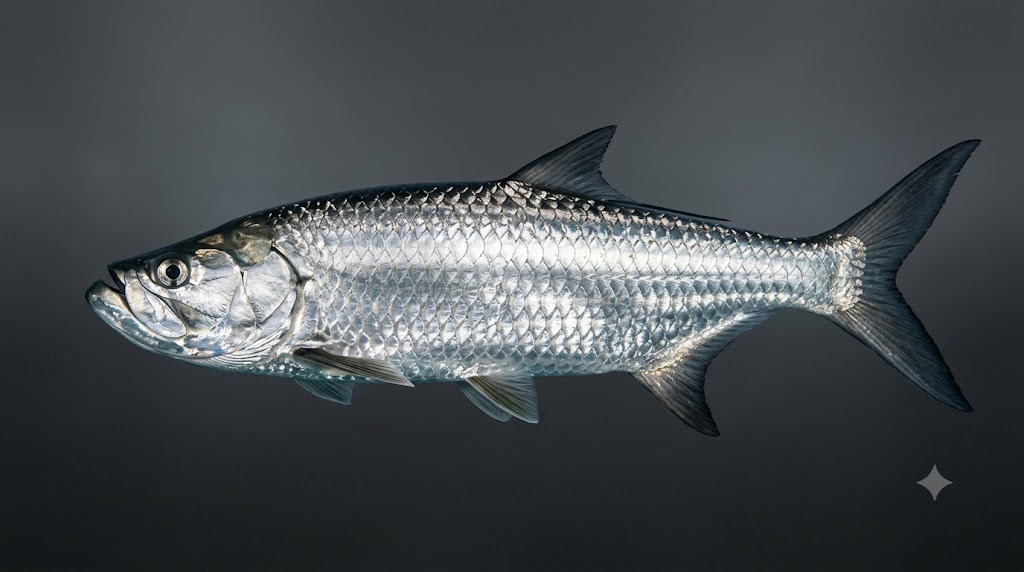
Tarpon are unmistakable: a large, slab-sided fish armored in huge, mirror-bright silver scales, with a dark blue-green or gunmetal back. The body is deep and compressed. The mouth is large and upturned, with the lower jaw jutting out and a hard, bony interior - the reason tarpon are so notoriously hard to hook. The last ray of the dorsal fin extends into a long trailing filament. The eyes are large. A specialized swim bladder lets tarpon roll and gulp air at the surface, a behavior that often reveals their location. Juveniles look like miniature versions of the adults and live in backwater nurseries. No other inshore fish carries that combination of giant chrome scales and the upturned, bony mouth.
Range & Habitat (US waters - inshore / offshore)
In US waters tarpon are concentrated in Florida - the Keys, Boca Grande Pass, Tampa Bay, and both coasts - and along the Gulf into Alabama, Mississippi, Louisiana, and Texas. In summer migrating fish reach the Carolinas and occasionally farther north. They are warm-water fish and move with the seasons.
Tarpon use a broad range of habitats. Adults travel beaches and passes, hold in deep channels and inlets, cruise flats in the Keys, and stage in bays and harbors. Juveniles live in sheltered backwaters - mangrove creeks, canals, ditches, and stagnant ponds with low oxygen, which they tolerate by breathing air. Migratory adults follow the coast, which makes tarpon fishing a seasonal, location-specific pursuit.
Behavior & Feeding
Tarpon feed on baitfish, crabs, and shrimp, often herding bait and feeding in coordinated schools. During the famous "hill tide" crab flushes around the full and new moons, tarpon gorge on pass crabs swept out on the current. They are highly visual but feed by all senses, and they roll at the surface to gulp air - a roll reveals a fish's location, direction, and rough size. Tarpon migrate in long strings along beaches and "daisy-chain" in slow circular schools during pre-spawn. Hooked, a tarpon's defense is the jump: an explosive series of leaps and head-shakes designed to throw the hook, which it does with high success against unprepared anglers.
Best Seasons & Times to Catch
Tarpon fishing is overwhelmingly a warm-season pursuit. The legendary migration runs from roughly April through July, peaking in May and June, when huge schools move along Florida's beaches and stack in passes like Boca Grande. Late summer and early fall offer continued action as fish feed and scatter. In south Florida and the Keys, resident and backcountry fish can be caught much of the year, and juvenile tarpon in canals and creeks are available year-round. Winter shuts down most of the fishery as fish move to the warmest deep water. The best times of day are dawn and dusk, and tarpon fishing keys heavily on tides and moon phases - crab flushes around the full and new moons are prime.
Where to Find Them - Reading the Water
Look for rolling fish - a tarpon breaking the surface to gulp air is the single best indicator. In passes and inlets, fish the deep channels and the current seams, especially on tides that flush crabs and bait. Along beaches, scan for migrating strings of fish moving just outside the bar, often visible as dark masses or rolling backs. On Keys flats, pole quietly and look for laid-up or cruising fish. Backcountry juveniles roll in canals, creeks, and culverts. Bridges with lights and current hold fish at night. Always watch for the roll, the daisy-chain, and nervous bait being pushed.
Tackle & Rigs
Tarpon demand heavy, balanced tackle. For big migratory fish, an 8-foot heavy spinning rod with a 6000-8000 reel, or a 30-50 lb conventional outfit, is standard. Spool with 50-80 lb braid. Fly anglers use 11- and 12-weight outfits.
The leader system is crucial: a heavy shock leader of 60-100 lb fluorocarbon (or up to 80-100 lb mono) protects against the tarpon's abrasive jaws and gill plates, joined to the main line with a strong knot. Circle hooks (5/0-8/0) are now required or recommended in many areas for natural bait and dramatically improve hookups in the corner of the jaw. For juveniles, scale down to medium spinning gear and 30-40 lb leader.
Best Baits & Lures
Natural baits dominate. Live or fresh-dead crabs - especially pass crabs during the moon-tide flushes - are the premier bait. Live baitfish such as mullet, pinfish, threadfin herring, and menhaden are excellent, as are large live shrimp for smaller fish. Cut bait works in passes and at bridges.
For artificials, big soft plastic swimbaits and paddletails on a heavy jighead are effective, as are large bucktail jigs ("Boca Grande jigs") bounced in deep passes, swimming plugs, and topwater plugs at dawn. Fly anglers throw tarpon "toads," baitfish patterns, and crab flies. Natural colors for clear water and bright passes; darker profiles for low light and stained water.
Techniques - How to Fish for It
A core method is to position up-current of rolling or staging fish and drift a live crab or baitfish naturally with the tide into the school - a natural drift draws far more eats than a dragged bait. In passes, anglers also bounce heavy jigs through the deep channel. On the flats, sight-fishing means leading a cruising fish and presenting the bait or fly so it crosses the fish's path. The defining skill is the fight: when a tarpon jumps, "bow to the king" - point the rod at the fish and give slack during the leap so a tight line and head-shake can't tear the hook free. Keep low, steady, side pressure between jumps, and use the boat to chase and shorten the fight, since a long battle exhausts and endangers the fish.
Common Mistakes
The biggest mistake is failing to bow to a jumping tarpon - keeping a tight line during a leap throws the hook almost every time. Setting a circle hook by jerking, rather than letting the rod load, pulls the hook out of that bony mouth. Anglers also fish too light, breaking off fish that then tow leaders. Dragging bait against the current instead of drifting it naturally produces refusals. Overplaying a fish to total exhaustion - and then mishandling it - can kill a tarpon; landed fish should be revived in the water and never lifted aboard. Finally, running a boat through a string of migrating fish scatters them and ruins the fishing for everyone.
Size, Records & Eating Quality
Tarpon are giants. Adults commonly run 60-120 pounds, and trophy fish exceed 150 pounds; the IGFA all-tackle world record is a 286-pound, 9-ounce fish from Sierra Leone. Backcountry juveniles range from a few pounds to 30 or 40. Tarpon are essentially never eaten in the US - the flesh is bony, oily, and unpalatable, and the fish are far more valuable alive. In Florida a harvest tag is required even to possess one, and the species is managed strictly as catch-and-release. Best practice is to keep tarpon in the water for photos and release them quickly and gently.
Pros & Cons (as a target species)
Pros: The ultimate inshore trophy; spectacular, repeated aerial jumps; enormous size and power; available from boats, beaches, bridges, and flats; juveniles offer year-round light-tackle action; a true bucket-list fish. Cons: Notoriously hard to hook in the bony mouth and easy to lose on the jump; demands heavy, balanced tackle and real skill; strictly catch-and-release with no table value; highly seasonal and weather-dependent; long fights can stress fish and require careful handling.
Best Suited For
Tarpon are best suited for the dedicated, experienced angler chasing a once-in-a-lifetime fight and willing to invest in the right gear, learn the tides and moon phases, and accept a low landing percentage. They are the dream fish of fly anglers and light-tackle specialists. Beginners can connect on juvenile tarpon in backcountry canals, which is the perfect proving ground, before stepping up to the giants of the beaches and passes.
FAQ
Why do I keep losing tarpon when they jump? Because the line stays tight during the leap. You must "bow to the king" - drop the rod tip toward the fish and give slack on every jump so the head-shake can't lever the hook out of the bony mouth.
Can you eat tarpon? Practically, no. Tarpon flesh is bony and oily, and the fish are managed as catch-and-release. In Florida a tag is required even to keep one.
When is the best time to catch big tarpon? The migration peaks in May and June along Florida's coasts. Crab flushes around the full and new moons in late spring and early summer are prime.
Why are tarpon so hard to hook? Their mouth interior is hard and bony, giving a hook little to grab. Circle hooks fished correctly - letting the rod load rather than jerking - greatly improve hookups in the soft corner of the jaw.
Where can I catch tarpon if I'm new to it? Juvenile tarpon in south Florida canals, creeks, and culverts are available year-round and are the ideal place to learn the jump, the fight, and the handling before tackling adult fish.