Yellowfin Tuna
The yellowfin tuna is the ultimate prize for blue-water anglers - a sleek, golden-finned ocean missile that combines blistering speed, raw stamina, and a stubborn deep-water fight that can last hours on big fish.
🗓️ Last reviewed: June 2026
Overview
The yellowfin tuna is the ultimate prize for blue-water anglers - a sleek, golden-finned ocean missile that combines blistering speed, raw stamina, and a stubborn deep-water fight that can last hours on big fish. Found in warm offshore waters along both U.S. coasts and famously in the Gulf of Mexico, yellowfin draw anglers far from shore in pursuit of screaming runs, deep bulldogging battles, and some of the finest sashimi-grade meat in the sea. A yellowfin tuna trip is a serious offshore commitment, but the payoff - a powerful, beautiful fish and a cooler of premium tuna - makes it one of the most coveted experiences in saltwater fishing.
Identification & Appearance
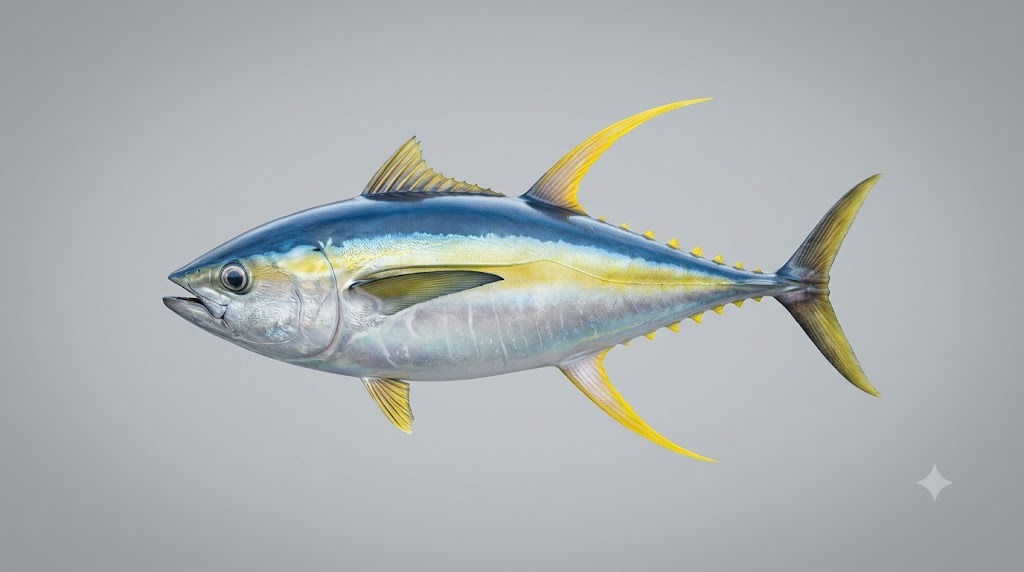
Yellowfin tuna are built for speed: a torpedo-shaped, metallic dark-blue body fading to silver-white below, with a band of yellow along the flank. The defining feature is the long, bright yellow second dorsal and anal fins, which on large fish stretch dramatically toward the tail like sickles. A row of small yellow finlets edged in black runs along the rear of the body to the deeply forked tail. The lower sides often show pale spots and broken vertical lines. Yellowfin can be confused with bigeye tuna, but bigeye have a larger eye, a stouter body, and shorter fins. The vivid yellow fins are the giveaway on a true yellowfin.
Range & Habitat (US waters - inshore / offshore)
Yellowfin tuna are a warm-water pelagic species found offshore on both U.S. coasts and abundantly in the Gulf of Mexico, where the deep water and oil platforms create world-class fishing. They roam the open ocean, far from any bottom structure, and relate instead to oceanographic features: temperature breaks, current edges, color changes, weed lines, and areas of concentrated bait. In the Gulf, the floating oil and gas platforms in deep water act as massive fish-attracting structures, holding bait and tuna. Yellowfin range from the surface down into deeper water, often following bait through the water column.
Behavior & Feeding
Yellowfin tuna are fast, powerful, schooling predators that hunt baitfish, squid, crustaceans, and other small marine life. They are visual hunters with excellent eyesight and can be both aggressive and surprisingly selective. Schools push bait to the surface in spectacular feeding frenzies, often with birds wheeling and diving overhead - a tuna "bite" can be a chaotic explosion of activity. Yellowfin frequently associate with dolphins, with floating debris, and with anything that holds bait. They feed actively around dawn and dusk and through the night near platforms. Hooked yellowfin make long, fast runs and then settle into a grueling, deep, circling fight that tests both angler and tackle.
Best Seasons & Times to Catch
Yellowfin can be caught year-round in the Gulf of Mexico, with productive fishing in many months, while seasons on the Atlantic and Pacific coasts are more defined by water temperature and the movement of warm currents - generally the warmer months. The most consistent action often comes around dawn and dusk, and night fishing around lit platforms and on the chunk can be extremely productive. Watch for periods when bait is concentrated and conditions are stable. Calm to moderate seas make the long offshore run safer and the fishing more effective.
Where to Find Them - Reading the Water
Finding yellowfin means reading the ocean. Look for diving birds, surface-busting bait, and feeding frenzies - birds are the best free fish-finder offshore. Target temperature breaks and color changes where blue water meets green, current rips, and weed lines that concentrate bait. In the Gulf, the deep-water oil platforms and floating production facilities are prime, holding bait and tuna around their structure. Spotting dolphins or porpoises can lead to tuna traveling with them. Modern anglers also use sea-surface-temperature and chlorophyll charts to plan trips before leaving the dock.
Tackle & Rigs
Yellowfin demand serious offshore tackle matched to fish that may run from 30 to well over 100 pounds. Stand-up conventional outfits with strong, high-capacity reels spooled with 50 to 100-pound braid or mono are standard for chunking and live-baiting; lever-drag reels are preferred. For trolling, matched conventional outfits run from 30 to 80-pound class. Popping for surface-feeding fish uses heavy spinning gear with 65 to 100-pound braid. Leaders are typically 60 to 130-pound fluorocarbon. Use strong circle hooks for bait fishing and quality terminal tackle throughout - a yellowfin will find any weak link. A fighting belt or harness is essential for big fish.
Best Baits & Lures
Yellowfin fishing uses several proven approaches. Live bait - hardtails (blue runners), threadfin, mullet, and other baitfish - fished on circle hooks is deadly, especially around platforms. Chunking, in which cut chunks of bait such as menhaden are drifted back in a chum slick, is a classic and highly effective Gulf technique. For trolling, spreads of skirted trolling lures, cedar plugs, feathers, and rigged ballyhoo cover water and locate fish. When tuna are crashing bait on the surface, casting poppers and stick baits produces explosive strikes. Vertical jigging with speed jigs reaches fish holding deeper in the column.
Techniques - How to Fish for It
Several techniques produce yellowfin. Trolling a spread of lures and rigged baits at 6 to 9 knots covers ground and finds schools - when one rod goes off, tuna often pile on. Chunking involves anchoring or drifting near a platform or temperature break and steadily feeding cut chunks back in a slick, with hook baits hidden among them; this builds a feeding frenzy and is superb at night. Live-baiting around platforms, casting poppers into surface-feeding schools, and deep jigging all have their place. Once hooked, settle into the fight: use the rod and a harness, gain line on the up-pump, and prepare for long deep circles. Steady, relentless pressure wins; a big yellowfin is a marathon, not a sprint.
Common Mistakes
A common mistake is undergunning the fish - light tackle leads to break-offs and fish that die from exhaustion before they can be landed or released. Anglers also fish hooks and leaders too heavy or visible for selective tuna, or too light for the power involved; balance matters. Poor drag settings and failing to clear other lines on a hookup cause tangles and lost fish. Ignoring the birds and bait and trolling blind wastes fuel. Fighting a tuna with arms alone instead of using a harness and proper pumping technique leads to exhaustion. Finally, neglecting to bleed and ice fish immediately ruins the premium meat.
Size, Records & Eating Quality
Yellowfin tuna commonly run 30 to 100 pounds, with trophy fish exceeding 150 to 200 pounds and the largest specimens - sometimes called "cows" - surpassing 200 pounds. The IGFA all-tackle world record is 427 pounds, caught off Baja Mexico. On the table, yellowfin are world-class - firm, deep-red meat that is the foundation of sashimi and seared "ahi" dishes and is among the most valuable food fish in the world. Proper handling is essential: bleed the fish immediately and ice it down to preserve the quality of the meat.
Pros & Cons (as a target species)
Pros: blistering speed and a powerful, lengthy fight; reach enormous trophy sizes; world-class sashimi-grade eating; spectacular surface feeds and frenzies; year-round availability in the Gulf. Cons: require a long offshore run and a capable, seaworthy boat; demand expensive, heavy tackle; physically exhausting fights; weather-dependent; selective at times and require reading the ocean to find.
Best Suited For
Yellowfin tuna are best suited to committed offshore anglers with a seaworthy boat, the right tackle, and the physical fitness for long, grueling fights. They are a bucket-list target for charter clients in the Gulf and on warm-water coasts, where guides handle the logistics and put anglers on fish. They reward those who enjoy the full offshore experience - the long run, reading the water, and a marathon battle. Anglers seeking easy, close-to-shore fishing should look elsewhere, but for blue-water thrills and premium meat, yellowfin are a pinnacle target.
FAQ
How do I tell a yellowfin from a bigeye tuna? Yellowfin have long, bright yellow second dorsal and anal fins that grow sickle-shaped on big fish, plus a yellow flank band. Bigeye have a notably larger eye, a stouter body, and shorter fins.
What is chunking? Chunking is a Gulf technique where you drift cut chunks of bait back in a steady chum slick to build a feeding frenzy, hiding your hook baits among the free chunks. It is highly effective, especially at night near platforms.
Why do birds matter when tuna fishing? Diving and wheeling birds are the best free fish-finder offshore. They mark schools of tuna pushing bait to the surface, so running toward working birds often puts you right on feeding fish.
How big do yellowfin tuna get? They commonly run 30 to 100 pounds, with trophies over 150 to 200 pounds. The all-tackle world record exceeds 400 pounds.
How should I handle a yellowfin for the best meat? Bleed the fish immediately and get it on ice as fast as possible. Proper, prompt handling preserves the firm red meat that makes yellowfin world-class sashimi.