How to Dive for Abalone
A famous delicacy prised off cold rocky reefs while free-diving - but heavily depleted, with many fisheries closed and strict rules where any harvest is still allowed.
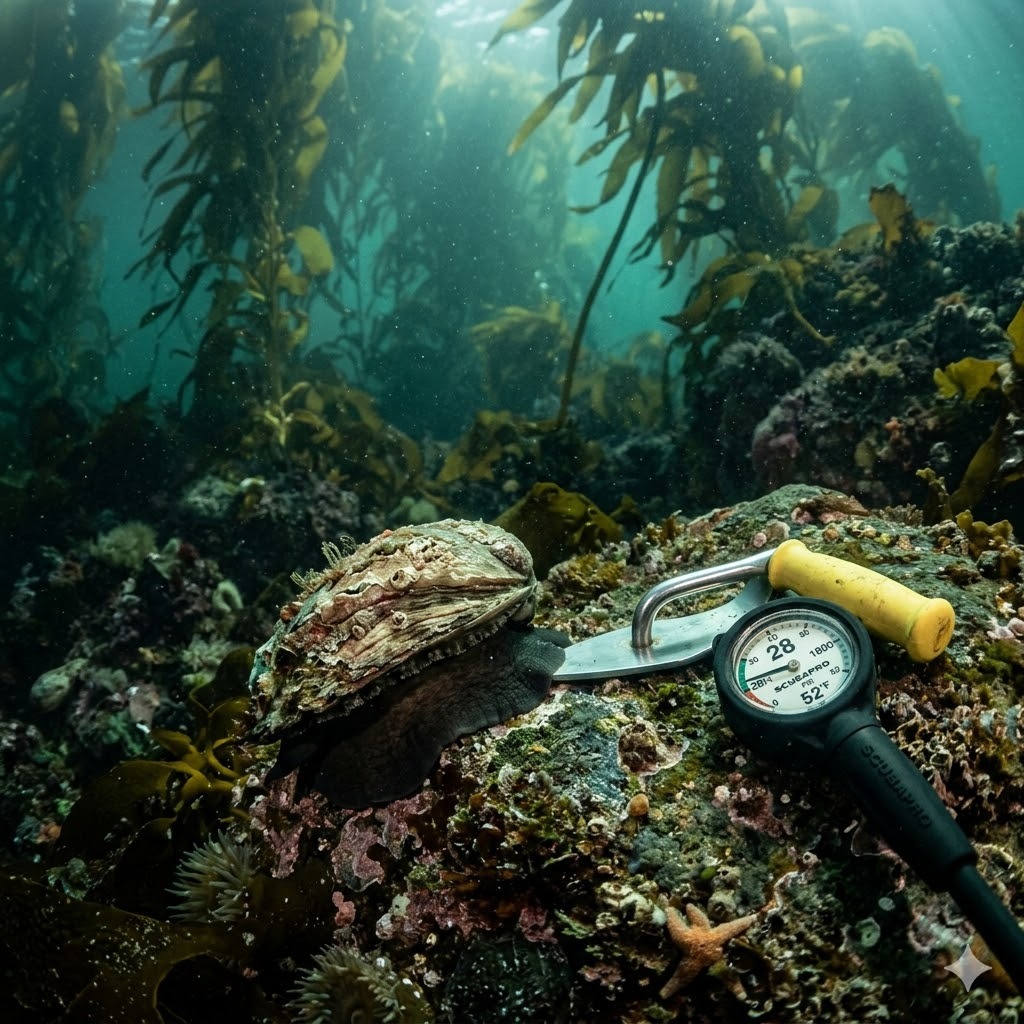
🔴 Abalone rules are among the strictest in shellfishing - permits, tags, size limits, breath-hold-only diving, and total closures are common. Poaching carries heavy penalties. Cold-water free-diving is dangerous; never dive alone.
Abalone are large single-shelled sea snails that clamp onto rocky reefs with a powerful muscular foot. Where they can still be taken, they are prised off the rock with a flat tool called an abalone iron, usually while free-diving on a single breath. The meat is a famous delicacy, and the pursuit has a long tradition on cold-water coasts. It is also, without exaggeration, the pursuit in this whole section that demands the most caution - for legal reasons and for safety reasons both.
Read this before anything else: abalone are heavily depleted across much of their former range, and many fisheries are now completely closed. Much of California's recreational abalone fishery, for example, has been shut. Where any harvest is still allowed at all, the rules are extremely strict - permits, tags, minimum sizes, breath-hold-only diving, and seasonal closures are all common. This is an advanced pursuit, and the very first thing you must do is find out whether taking abalone is legal where you are at all. If it is not, this guide is a look at how it is done, not an invitation to do it.
Why go for abalone
You go for abalone, where it is legal, because it is one of the great prizes of the sea - prized meat, a real physical challenge, and a deep tradition on cold-water coasts. Free-diving a kelp reef, finding a legal abalone and working it off the rock is a genuine skill that takes years to do well and safely.
But be completely honest about the reality. In many places you cannot go for abalone at all, because the fishery is closed to protect a depleted population. Where it is open, the season may be short, the limits tiny, and the enforcement heavy. This is not a casual gather. What the pursuit involves:
- A famous delicacy, where any legal harvest remains
- A serious cold-water free-diving challenge
- Strict, closely enforced rules you must follow to the letter
- A pursuit only for the fit, trained and well-prepared
Where and when to find them
Abalone live on cold, rocky, wave-washed reefs, clamped to rock surfaces and tucked into crevices and under ledges. They graze on kelp and other seaweed, so healthy kelp reefs in clean, cold, moving water are classic ground. They are found from the low intertidal down into deeper water, and the accessible ones are usually reached by free-diving down to the reef.
Timing, where a season exists at all, is tightly controlled and varies by region. Open seasons are often short and specific, chosen to protect the animals during spawning and to limit pressure. Sea conditions matter enormously for safety: calm, clear water with low swell and good visibility is what you want, and you should never dive a big swell or poor visibility for the sake of a few abalone.
But the honest answer to "where and when" for abalone is: first find out whether it is legal to take them where you are at all, and if so, exactly when the season is open and where. This is not optional detail - it is the whole starting point. Check with your local fisheries authority before you plan anything.
How to dive for them
Where it is legal, abalone are taken by free-diving - descending on a single breath, without scuba tanks, which is a requirement in many abalone fisheries. You locate an abalone clamped to the reef, and you have only seconds on the bottom to act before you need to surface.
The tool is an abalone iron - a flat, blunt-edged bar, its dimensions often specified by law. The technique is to slide the iron under the foot of the abalone in one smooth, quick motion and pop it off the rock before it clamps down hard. An alarmed abalone grips with astonishing force, so speed matters: if you fail on the first attempt and it clamps, it becomes very hard to remove without damaging it, and a damaged undersized abalone that must be returned may not survive.
Before taking any abalone, you measure it against the legal minimum with a fixed gauge, on the spot, underwater or at the surface. Only legal-sized animals may be kept, and in many fisheries each one must be tagged immediately. Undersized abalone are returned to the exact spot, pressed firmly back onto rock. See our gear notes for free-diving kit, an abalone iron and a gauge - but remember that the specifications of these tools are often set by law.
Handling, cleaning and cooking
Handle abalone carefully and keep them cool and moist after diving. Where tagging is required, tag each one as the law directs before you do anything else. Keep them alive and out of the sun until you clean them.
Cleaning takes a little work. Slide a blunt tool between the muscular foot and the shell to release the animal, then trim away the dark guts and the frilly edge, keeping the firm white muscle - the foot - which is the part you eat. Scrub off the dark skin. The muscle is dense and, like conch and whelk, tough unless you tenderise it. Honest ways to cook it:
- Tenderised and pan-fried. Slice the foot into steaks, pound them thin to break down the muscle, then fry quickly and briefly. Overcooking turns abalone to rubber.
- Thinly sliced. Very fresh abalone can be sliced paper-thin and eaten raw or lightly cooked, a prized way to serve it.
- Slow-cooked. Braised long and gently, abalone becomes tender in a different way, good in stews and Asian-style dishes.
The muscle is rich and prized, and worth the care. For more on turning your catch into a meal, see our catch and cook guide.
Safety and the law
This is the most important part of the guide, and it splits into two: is it even legal, and can you do it safely. The most important habit is to check your local regulations first - see our shellfish safety page for how to check seasons, closures and permits in your area.
Legal points specific to abalone:
- Check whether any harvest is legal at all. Many abalone fisheries are completely closed to protect depleted stocks. Before anything else, confirm whether you may take abalone where you are. If it is closed, do not take any.
- Permits, tags, sizes and seasons. Where abalone may be taken, expect strict requirements: a specific permit or card, a limited number of tags, a minimum size measured on the spot, breath-hold diving only, and short defined seasons. Follow every one of them exactly. Check your local rules.
- Poaching carries heavy penalties. Abalone poaching is treated seriously and punished hard, with large fines and confiscated gear. It also directly harms an already fragile population. Never take undersized, over-limit or out-of-season abalone.
Safety points specific to abalone diving:
- Cold-water free-diving is dangerous. Breath-hold diving in cold water, in swell and among kelp, carries real risks including shallow-water blackout, entanglement and getting caught by waves against the reef. It is an advanced skill.
- Never dive alone. Always dive with a buddy who watches you, and know the signs of blackout and how to respond.
- Respect the conditions. Do not dive big swell, cold shock or poor visibility. No abalone is worth your life.
Confirm the law before you even consider it, dive only when trained and never alone, and treat every rule as non-negotiable. More background is on the main shellfish section.