Smoking Fish at Home
A practical first guide to smoking fish: brining, drying the pellicle, why beginners should hot-smoke, wood choices, target temperatures, and how to store it safely.
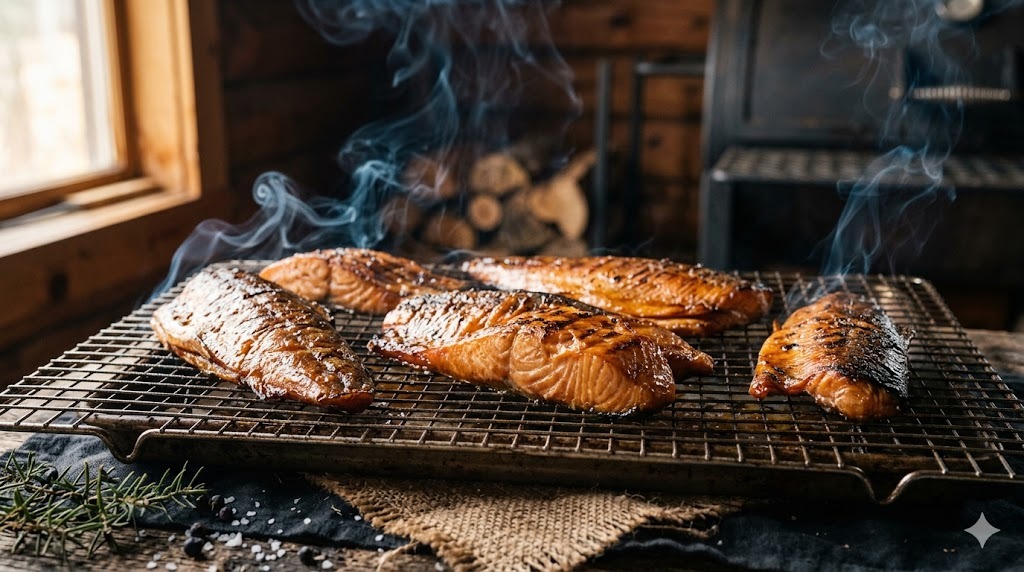
Smoking is one of the oldest and best things you can do with a catch, and a home smoker or even a covered grill gets you there. The flavour is worth the patience, but smoking is also where food safety actually matters, so it pays to do it properly. This guide covers the beginner-friendly path: hot smoking, with a brine, a pellicle, and temperatures you can trust.
Part of our Catch & Cook series - the half of fishing that happens after the net: cleaning, cooking and eating what you keep.
This picks up after the fillet knife. If you need to get there first, see cleaning and filleting fish.
Hot smoke vs cold smoke - start with hot
There are two very different processes that both get called “smoking,” and the difference matters for safety.
- Hot smoking cooks the fish while it smokes, at roughly 175 to 225F, until it reaches a safe internal temperature. The result is flaky, fully cooked, ready to eat. This is what you want as a beginner.
- Cold smoking flavours the fish with smoke below about 90F without cooking it. It produces silky, lox-style fish, but it leaves the flesh in the danger zone for bacteria and relies on precise cure ratios and careful temperature control. It is not a beginner project, and getting it wrong risks serious illness.
Everything below is for hot smoking.
Brine first - it’s not optional
A brine seasons the fish, firms the flesh, and helps it hold moisture through the smoke. A wet brine is the easiest to start with.
- A simple ratio: about 1 cup of salt and 1/2 cup of brown sugar per quart (roughly a litre) of cold water. Stir until dissolved.
- Submerge fillets fully and refrigerate. Thin panfish or trout fillets need about 2 to 4 hours; thicker pieces like chinook salmon, 8 to 12 hours.
- Add flavour if you like: bay, peppercorns, garlic, a splash of soy or a little maple.
- Keep the fish cold the entire time. Brine in the fridge or in a cooler with ice, never on the counter.
After brining, rinse the fillets briefly under cold water and pat them dry.
Dry the pellicle - the step everyone skips
The pellicle is a thin, slightly tacky skin that forms on the surface as the fish air-dries after brining. It is what smoke actually clings to, and skipping it gives you weak, uneven flavour.
- Set the rinsed fillets on a wire rack, skin-side down, uncovered, in the fridge or in front of a fan in a cool spot.
- Give it 1 to 4 hours. You’re looking for a surface that’s dry and slightly glossy-tacky to the touch, not wet.
- Don’t smoke straight from the brine. Wet fish steams, the smoke slides off, and you waste your wood.
Wood choices and how much
Wood is flavour, and a little goes a long way with fish. Mild fish takes on smoke fast, so heavy-handed smoking turns it acrid.
- Alder is the classic for fish - clean, light, slightly sweet, and forgiving. Start here.
- Apple, cherry and other fruit woods are mild and a touch sweet, great with brook trout and salmon.
- Oak is a bit stronger but balanced.
- Go easy on hickory and mesquite; they’re strong and can overpower delicate fillets.
- Use wood that’s properly seasoned or food-grade chips/chunks. Never use treated, painted, or resinous softwood like pine.
Target temperatures and timing
This is the part to measure, not guess. Use a smoker thermometer for the chamber and an instant-read probe for the fish.
- Run the smoker at roughly 175 to 225F. Lower and slower gives a moister result and better smoke uptake.
- Smoke until the thickest part of the fish reaches an internal temperature of 145F (63C). That’s the food-safety target for fish, and the point at which it flakes cleanly.
- Time is only a rough guide because it varies with thickness and weather, but expect somewhere between 1 and 3 hours for most fillets.
- Resist the urge to keep opening the lid. Every peek drops the temperature and stretches the cook.
Storage and safety
Smoked fish is not shelf-stable. Hot smoking cooks it, but it does not preserve it like commercial canning or curing does.
- Cool the fish, then refrigerate promptly. Eat within about 3 to 4 days.
- For longer storage, vacuum-seal and freeze. Frozen, it keeps well for a couple of months; vacuum-sealing fights freezer burn.
- A specific warning: vacuum-sealing creates a low-oxygen environment where Clostridium botulinum can grow if the fish sits warm. Keep vacuum-sealed smoked fish frozen or thoroughly chilled, never at room temperature.
- As with any catch, keep the fish cold before you cook it, and don’t smoke fish taken from waters under a consumption advisory or known contamination. These are general guidelines; follow your local health advice.
Once you’re comfortable, smoked fillets fold beautifully into the wider repertoire in our catch and cook guide - flaked into chowder, mashed into a pâté, or eaten plain off the rack while it’s still warm.