How to Gather Bay Scallops
Bay scallops are small, sweet shellfish living in shallow eelgrass beds, gathered by wading or snorkelling with a dip net - a fun, family-friendly outing where you spot the row of tiny blue eyes.
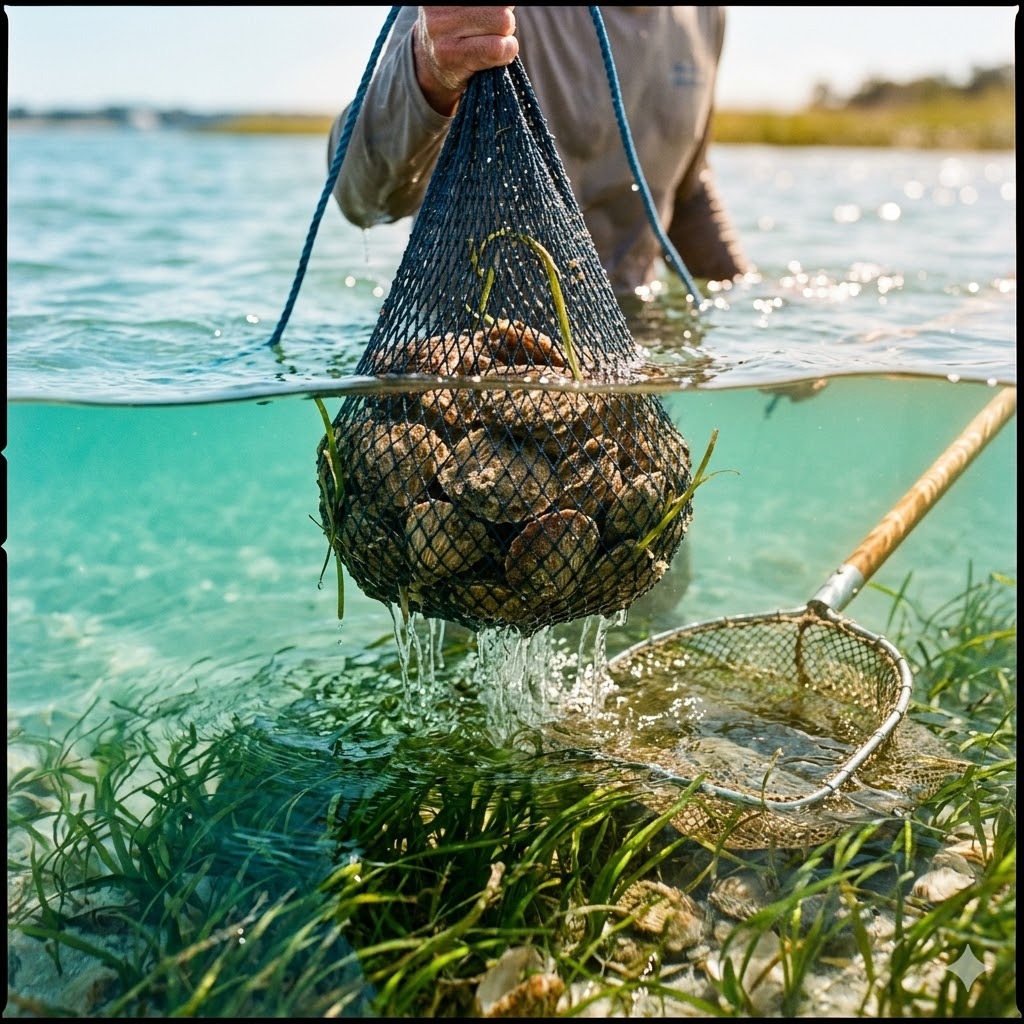
Open season, bag limits and no-harvest zones apply and vary by area. Watch depth and current when snorkelling, and go with a buddy.
Bay scallops are one of the most enjoyable and family-friendly shellfish to gather. Unlike clams that hide buried in sand, bay scallops live loose on the bottom among shallow eelgrass beds, so gathering them feels more like an underwater treasure hunt than digging. You wade or snorkel through clear, shallow water on a warm day, spot the scallops, and scoop them up with a dip net or by hand. It is active, easy and genuinely fun for all ages.
Part of the charm is spotting them. A live bay scallop often lies with its shell slightly open, and along the edge of the mantle sits a striking row of dozens of tiny bright blue eyes. Once you learn to pick out that little line of blue dots against the eelgrass, you start seeing scallops everywhere. This is a real beginner-friendly pursuit, best done as a group on a sunny day.
Why go for bay scallops
Bay scallops are prized for their flavour. The sweet white adductor muscle is tender and delicate, considered by many to be finer than the larger sea scallop, and it needs only the quickest cooking to be at its best. Gathering your own means eating them at their freshest, which is a real treat you rarely get to buy.
The gathering itself is a pleasure. It happens in warm, shallow, clear water, usually in late summer or autumn, and it suits families and beginners perfectly - there is no heavy digging, just wading, looking and scooping. Snorkelling over an eelgrass bed on a bright day, spotting the blue-eyed scallops and filling a bag, is about as pleasant as shellfish gathering gets. It is social, gentle and rewarding.
Bay scallops live in shallow coastal bays, harbours and estuaries with healthy eelgrass, so where the habitat is good and the season is open, a productive bed is within easy reach of the shore or a small boat.
Where and when to find them
Bay scallops depend on eelgrass. Look for shallow, sheltered bays, coves and estuaries with beds of eelgrass over sand or mud, in water usually shallow enough to wade or snorkel comfortably. The scallops rest on and among the grass, so the healthiest eelgrass beds hold the most scallops. Local knowledge of which bays produce is invaluable.
Timing is set firmly by the season. Bay scallops are typically gathered during a defined open season, often in late summer and into autumn, and outside that season the beds are closed to protect the population. Check the local season dates before you plan anything. Within the season, calm, clear, sunny days are ideal because you rely on seeing the scallops - flat water and good light make spotting the blue eyes far easier.
To find them, move slowly and scan the bottom among the eelgrass. Watch for the pale, fan-shaped shells and, crucially, the tell-tale row of tiny blue eyes along the open edge of a live scallop. Sometimes a disturbed scallop will clap its shells and "swim" a short distance in a puff of jerky movement, which gives it away. Wade or snorkel gently so you do not stir up the bottom and cloud the water.
How to catch them
The method is refreshingly simple. In shallow water you can wade with a bucket and a long-handled dip net, scooping up scallops as you spot them. In slightly deeper water, snorkelling is the classic approach: you glide over the eelgrass, spot the scallops below, and either scoop them with a net or pick them up by hand and pop them into a mesh catch bag.
There is no digging and no special force involved - the challenge is entirely in the spotting. The more time you spend learning to recognise a live scallop resting in the grass, the faster your bag fills. A dive mask and snorkel transform the experience, letting you see clearly and cover ground.
Keep a mesh bag or a bucket with a little seawater for your catch, and grade as you go: return any obviously small or clearly undersized scallops so the bed keeps producing. Take note of the local rules on size and count before you start (see below). For advice on nets, masks, snorkels, water shoes and catch bags, see our gear guide.
Handling, cleaning and cooking
Keep your scallops cool and alive on the way home - a bucket with seawater, or a cool bag, works well. The part you eat is the round white adductor muscle, and shucking a scallop is quick once you get the knack. Slide a knife into the shell, cut the muscle free from the top shell, open it, and separate the white muscle from the surrounding mantle and guts. Some people also keep the orange roe. Rinse the cleaned muscles briefly.
Because the meat is small, sweet and delicate, the golden rule is to cook it fast and lightly. A quick sear in a hot pan with a little butter for barely a minute a side gives you tender, sweet scallops; overcooking makes them tough and rubbery. They are also delicious raw when impeccably fresh and from safe waters, or lightly ceviche-style. Simple is best - let the sweetness of your own catch speak for itself. For preparation steps and recipe ideas, see our catch and cook guide.
Safety and the law
Read this section before you gather. Scallops are shellfish that feed by filtering seawater, and while bay scallops are generally considered less prone to accumulating marine biotoxins than clams and mussels - partly because most people eat only the muscle rather than the whole animal - they are not exempt from the risks. Algal blooms can still cause problems, and local waters can carry bacterial pollution. So the rule holds: follow local advisories every time, and do not gather from waters that are closed or under a shellfish warning.
Where a whole scallop or its guts and roe might be eaten, treat biotoxin advisories with the same seriousness you would for any bivalve, because cooking does not remove biotoxins. If in any doubt, stick to the muscle and heed every posted closure and warning.
The legal side is straightforward but firm. Bay scallops are managed with a defined open season, a daily bag limit on how many you may take, minimum size rules, and no-harvest or protected zones where gathering is banned to protect the beds. Many places also require a licence or permit. These rules exist to keep the fishery healthy year after year, so learn and follow them before you go.
Practical safety matters too. You will be in the water, so mind your depth and any current, wear suitable footwear against sharp shells, and above all go with a buddy rather than alone - especially when snorkelling. Keep an eye on tide and weather, and do not stray out of your depth or comfort. For the full guidance on shellfish biotoxins, closures and safe gathering, read our shellfish safety guide, and browse the main shellfish section for more species to try.