How to Catch Blue Crab
A sweet, feisty estuary crab you can catch from a dock with a bit of string and a chicken neck - one of the friendliest ways into shellfishing.
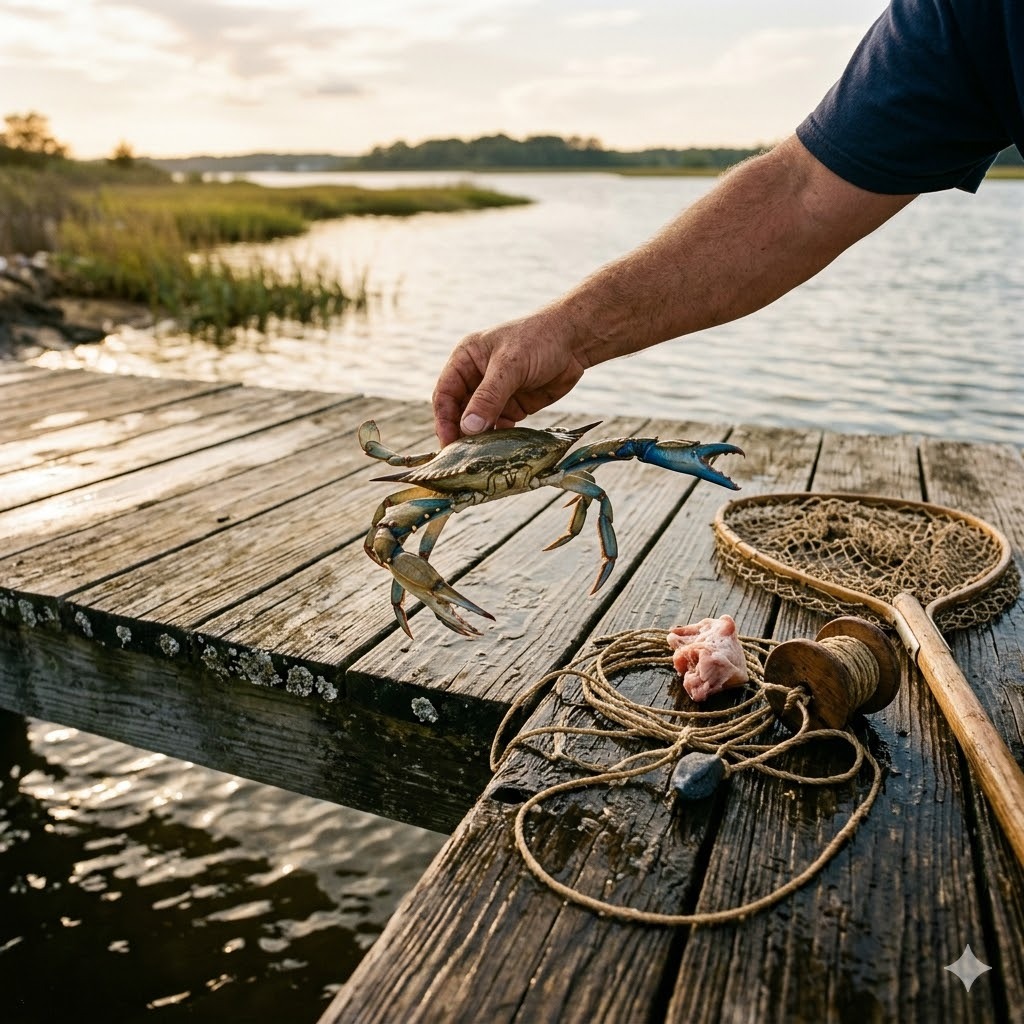
Check your state's minimum size and throw back egg-bearing (sponge) females. Handle live crabs by the back legs or shell rear to avoid the pincers.
The blue crab is the crab most people from the East and Gulf coasts of the United States picture when they think "crabbing". It lives in brackish estuaries - the mixing zone where rivers meet the sea - and you will find it around bays, docks, marsh creeks and grassy shallows. It is aggressive, quick, and armed with a pair of claws it is very willing to use, but the meat is worth the trouble: sweet, delicate and one of the best-eating crabs you can gather yourself.
The one thing that shapes the whole pursuit is that blue crabs come to bait. You do not need to hunt them across the seabed or dig them out of sand. You hang something smelly in the water, wait, and the crab comes to you. That simplicity is why blue crab is the most family-friendly shellfish going - kids can catch them with a hand line, and a decent afternoon off a public dock can fill a bucket. It suits complete beginners, anyone with young children, and anglers who want a relaxed, low-cost day rather than a technical one.
Why go for blue crab
You go for blue crab because the effort-to-reward ratio is excellent for a beginner. The gear is cheap or improvised, the locations are often free public docks and shorelines, and the meat is genuinely first-rate. Be honest with yourself about yield, though: blue crabs are not big animals, and picking the meat out is fiddly. A good haul is measured in a full bucket of legal crabs, not in kilos of meat. The fun is as much in the catching as the eating.
Expect a session to be active and a little chaotic. Crabs will steal your bait, drop off just as you lift them, and pinch you if you are careless. That is part of it. What you actually get:
- A cheap, beginner-friendly day with minimal kit
- Sweet, prized meat that costs a fortune to buy
- A pursuit that works brilliantly with kids and family
- Repeatable action - once you find a productive dock or creek, you can return again and again
Where and when to find them
Blue crabs live in brackish water, so look where fresh and salt water mix. Marsh creeks, tidal rivers, the backs of bays, boat docks, and shallow grassy flats are all classic ground. They favour muddy and sandy bottoms with some structure - pilings, oyster beds, weed edges - where they can ambush prey and hide from predators.
Season matters. Blue crabs are most active in warm water, so the warmer months are your window; in cold water they burrow into the mud and become sluggish and scarce. Within a day, tide is the key. Moving water - the run of an incoming or outgoing tide - switches the crabs on and brings them in to feed. Slack water at the top or bottom of the tide is usually slower. A useful habit is to fish the last of the flood and the first of the ebb around a dock or creek mouth.
To read the ground, watch for crabs already working: you will sometimes see them swimming near the surface or scuttling on the shallow bottom on a bright day. Cloudy, food-rich water near a marsh drain is a good sign. If you drop a bait and it is stripped clean in minutes, you are on them - stay put and work that spot.
How to catch them
There are two easy methods, and most people run both at once.
The classic beginner method is the baited hand line. Tie a chicken neck (or any tough, smelly bait - fish heads work too) to the end of a length of strong string. Lower it to the bottom off a dock or bank and let it settle. When you feel a steady tug and a bit of weight, do not yank - a crab is not hooked, it is simply holding the bait, so any sudden move makes it let go. Instead, raise the line slowly and smoothly, hand over hand, until you can see the crab feeding just under the surface. Then have a helper slide a long-handled dip net under it from behind and lift. A dip net is essential kit - see our gear notes for what to look for.
The other method is a baited trap or drop net. Collapsible pyramid traps and ring nets sit open on the bottom, baited in the centre; when you haul them up smartly, the sides close and trap any crab feeding inside. Bait it, drop it, wait a few minutes, and pull it up in one steady motion. Traps let you cover several spots at once while you also work a hand line, which is why they are so productive.
Whichever method you use, the rules of thumb are the same: fresh smelly bait, a slow lift, and a net always ready. Keep your catch in a bucket or basket with a lid, because blue crabs are champion escape artists and will climb straight back out.
Handling, cleaning and cooking
Handle blue crabs with respect - the claws can draw blood. Pick a crab up from the rear, thumb and finger on the back edge of the shell behind the swimming legs, keeping well clear of both claws. Even better, use tongs.
Keep your catch alive until you cook it. Blue crabs die quickly in warm standing water or if left in the sun. Store them in a cooler out of direct water, kept cool and damp with a wet cloth or some seaweed, not submerged in a sealed bucket where they will suffocate. A crab that has died before cooking should be discarded - do not eat crabs that were dead when they went in the pot.
Cooking is simple and where the reward pays off. Three honest methods:
- Steamed. The traditional approach. Steam over water and a splash of vinegar with plenty of seasoning until the shells turn bright red-orange. Steaming keeps the meat sweet and firm.
- Boiled. Drop live crabs into a rolling, well-salted (or spice-heavy) boil and cook until they float and turn colour. Simpler than steaming, though slightly more watery.
- Picked for meat. Once cooked and cooled, pick out the lump body meat and claw meat for crab cakes, soups or salads. It is slow work but the payoff is superb.
Whatever you choose, cook crabs thoroughly and eat them fresh. For more on turning your catch into a meal, see our catch and cook guide.
Safety and the law
Blue crab is beginner-friendly, but the rules exist for good reasons and you must know them before you go. The single most important habit is to read your local regulations first - see our shellfish safety page for how to check licences and water quality in your area.
Key points specific to blue crab:
- Licence. Many states require a recreational crabbing or fishing licence, and some limit gear numbers. Check what your state requires before dropping a line.
- Minimum size. Legal crabs are measured across the widest part of the shell, point to point. There is a minimum size - check your local minimum and carry a measuring gauge or ruler. Return undersized crabs unharmed.
- Egg-bearing (sponge) females. A female carrying eggs has a large spongy orange or brown mass under her tail flap. These "sponge" crabs are the next generation - in most places it is illegal to keep them, and even where it is legal it is bad practice. Release every sponge female gently.
- Bag and gear limits. There are usually daily catch limits and rules on the number and type of traps. Check your local limit.
- Water quality. Estuaries near towns, marinas and storm drains can carry pollution and bacteria. Crab only from waters open for harvest, and never after a heavy rain or a pollution advisory.
- Handle by the back legs. For your own safety, always lift a live crab from the rear, clear of the claws.
Learn the size gauge and the sponge-female rule until they are second nature, and blue crabbing stays exactly what it should be - a cheap, sustainable, genuinely fun day out. More background is on the main shellfish section.