How to Catch Dungeness Crab
The Pacific coast's prize crab - big, firm and sweet - caught from piers and bays with a pot or ring net, giving a serious yield of meat per crab.
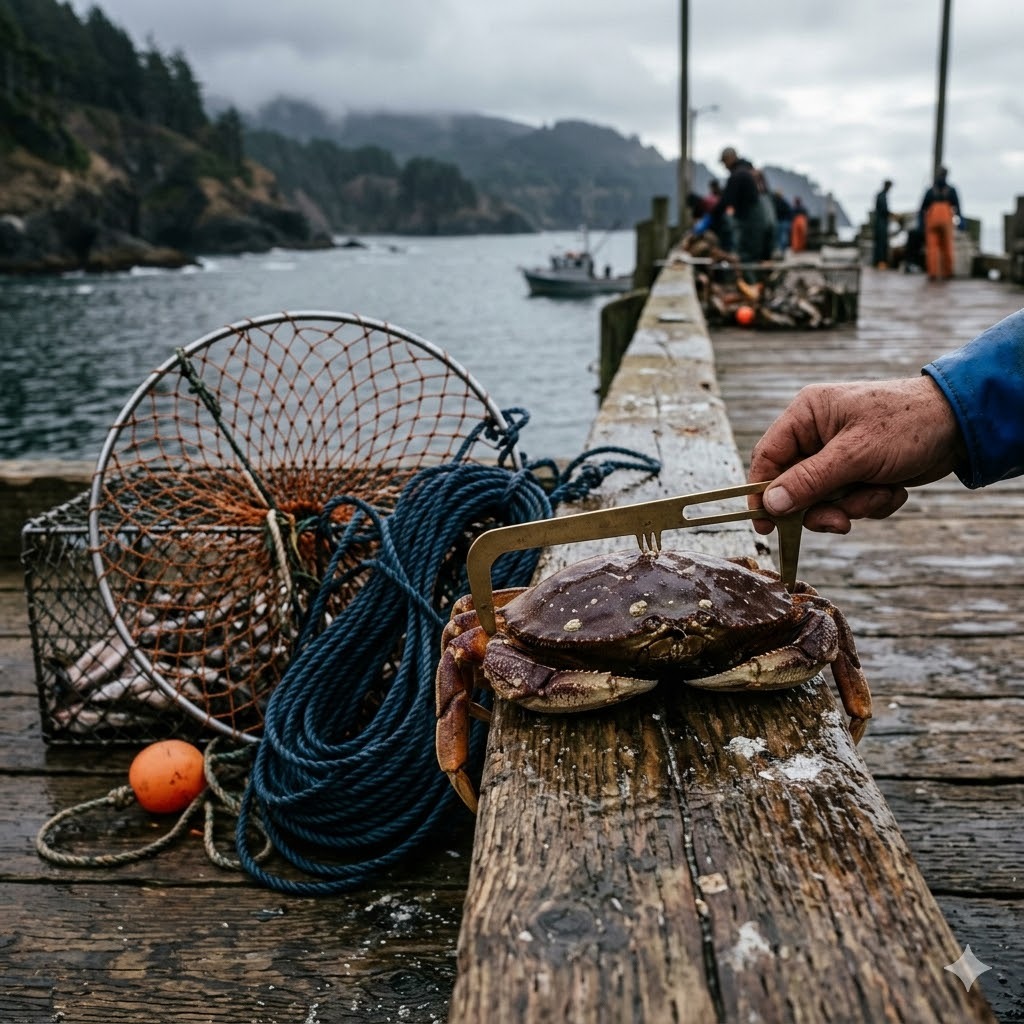
Strict rules: minimum size, males only in most areas, and seasonal domoic-acid closures. Always check the current health advisory and regulations before you keep any.
The Dungeness crab is the crown jewel of the Pacific coast, from central California up through the Pacific Northwest and beyond. It lives in cooler coastal waters, bays and estuaries, and it is a big, meaty animal - a good legal Dungeness gives you far more firm, sweet meat than any small estuary crab. If you have eaten crab on the West Coast and it was worth remembering, it was almost certainly Dungeness.
The one thing that shapes the whole pursuit is that Dungeness crabbing rewards patience with soak time. Unlike hand-lining, you bait a heavy pot or ring net, drop it, and leave it to work on the bottom while the crabs find it. That makes it wonderfully relaxed - a beginner-friendly pursuit you can run from a public pier with no boat at all. It suits anyone who wants a genuine feed of premium crab, families happy to wait between hauls, and newcomers who would rather set gear than chase their catch.
Why go for Dungeness crab
You go for Dungeness because the meat is exceptional and the yield per crab is high. Where you might need a bucketful of small crabs for a meal, a couple of legal Dungeness can feed the table. The firm, sweet body and claw meat is prized by cooks everywhere, and buying it is expensive - catching your own is a real saving.
Be honest about the reality, though. Dungeness crabbing has more rules than most shellfishing, and getting a legal male over the size limit is not guaranteed on every drop. You will pull up plenty of undersized crabs and females that must go straight back. That is normal - it is a well-managed fishery, and the returns are part of what keeps it good.
What you get:
- Large, firm, sweet crabs with a high meat yield
- A relaxed, set-and-wait method you can run from a pier without a boat
- A premium catch that is costly to buy
- A well-regulated fishery that rewards knowing the rules
Where and when to find them
Dungeness crabs live over sandy and muddy bottoms in bays, estuaries and along the open coast. From shore, the most reliable spots are public fishing piers, jetties and docks that reach out over the right kind of bottom. Bays and estuary mouths with a mix of sand and eelgrass are classic ground. From a boat you can reach deeper flats, but plenty of good crabbing is done from land.
Season is tightly controlled here, more than for most shellfish. There are defined open seasons that vary by region and are sometimes delayed or closed at short notice, so the season is the first thing to check every year - do not assume last year's dates. Within an open season, crabs feed on the move, so a running tide tends to fish better than dead slack water. Cooler months are often the prime window in many areas, but this is entirely region-dependent.
To read the ground, aim your gear for clean sandy or muddy bottom near structure rather than heavy rock that will snag your line. If a pier is popular with crabbers, that is usually a sign the bottom below holds crabs - watch where the regulars drop their pots.
How to catch them
Two methods dominate, and both are beginner-friendly.
The crab pot is a wire cage baited in the centre. Crabs climb in through one-way funnels to reach the bait and cannot easily get out. You bait it, lower it to the bottom on a strong line, and let it soak - anywhere from twenty minutes to a couple of hours. Then haul it up hand over hand, sort your catch, and re-bait. A pot is the most productive option because it keeps crabs contained while you wait.
The ring net (or hoop net) is a simpler open frame with netting, baited in the middle. It sits flat and open on the bottom; when you haul it up smartly the net forms a bowl and lifts any crab feeding inside. Ring nets need shorter, more attentive soaks - check them every fifteen minutes or so - but they are cheap, easy to handle, and great for learning.
For bait, oily fish carcasses, fish heads, chicken or squid all work well - the stronger-smelling the better. Secure the bait so crabs cannot strip it in seconds. Bring a bucket or cooler with a lid, sturdy gloves, and above all a measuring gauge (more on that below). For a rundown of pots, ring nets and lines, see our gear notes.
Whatever you use, the rhythm is the same: bait, drop, soak, haul smartly in one motion, measure and sort. The single most important tool at the sorting stage is your gauge.
Handling, cleaning and cooking
Handle Dungeness carefully - the claws are powerful. Grip the crab from the rear across the back of the shell, keeping your fingers clear of both claws, or use tongs.
Keep your catch cold and, ideally, alive until cooking. Store legal crabs in a cooler kept cool and damp - a wet cloth or seaweed over them works well - not submerged in a sealed bucket where they suffocate in warm water. A crab that dies before cooking should be discarded; do not cook a crab that was already dead.
Three honest cooking methods:
- Whole boiled. The simplest and most traditional. Drop live crabs into a large, well-salted rolling boil and cook until the shells turn bright orange. Cool, then crack and pick.
- Whole steamed. Steaming over seasoned water keeps the meat a touch sweeter and firmer than boiling and is easy to get right.
- Cleaned and cooked (backing). Some crabbers "back" the crab - killing and cleaning it before cooking by removing the top shell and innards, then halving it - which cooks faster and cleaner. It is a small skill worth learning once you are comfortable.
Cook thoroughly, eat fresh, and pick the body and claws for the reward. For turning the catch into a meal, see our catch and cook guide.
Safety and the law
Dungeness crab is one of the more heavily regulated shellfish you can catch recreationally, and the rules protect both the fishery and you. Check your local regulations before every trip - our shellfish safety page explains how to find current seasons, closures and health advisories in your area.
The points that matter most for Dungeness:
- Licence and season. A fishing or shellfish licence is normally required, and there are defined open seasons that change and can close at short notice. Confirm the current season is open before you go.
- Minimum size - carry a gauge. Dungeness has a firm minimum size measured across the shell. Every crabber must carry a proper Dungeness gauge and measure each crab. Undersized crabs go back immediately and unharmed.
- Males only in most areas. In most regions you may keep only male crabs and must release all females. You tell them apart by the shape of the abdominal flap on the underside - males have a narrow, pointed flap; females a broad, rounded one. Learn this before you go.
- Domoic acid closures. This is the big health issue. Dungeness can accumulate domoic acid, a natural biotoxin, and areas are closed to harvest when levels are unsafe. These closures are seasonal and unpredictable - never eat crab from an area under a domoic-acid advisory, and check the current status every trip.
- Bag limits. There is a daily limit on how many you may keep. Check your local limit.
Learn to sex a crab, carry your gauge, and check the domoic-acid status before you cook a single crab. Get those three right and Dungeness crabbing is safe, sustainable and one of the best feeds the Pacific coast offers. More background is on the main shellfish section.