How to Gather Hard Clam (Quahog)
Rake or tread quahogs from sandy-mud flats at low tide - an easy beginner shellfish, but only ever from officially open, approved waters, as clams concentrate bacteria and biotoxins.
🔴 Only harvest from waters officially OPEN and approved for shellfishing - closed areas carry bacteria and biotoxins. Check your state shellfish map and any red-tide/PSP advisory every single time. Obey size limits.
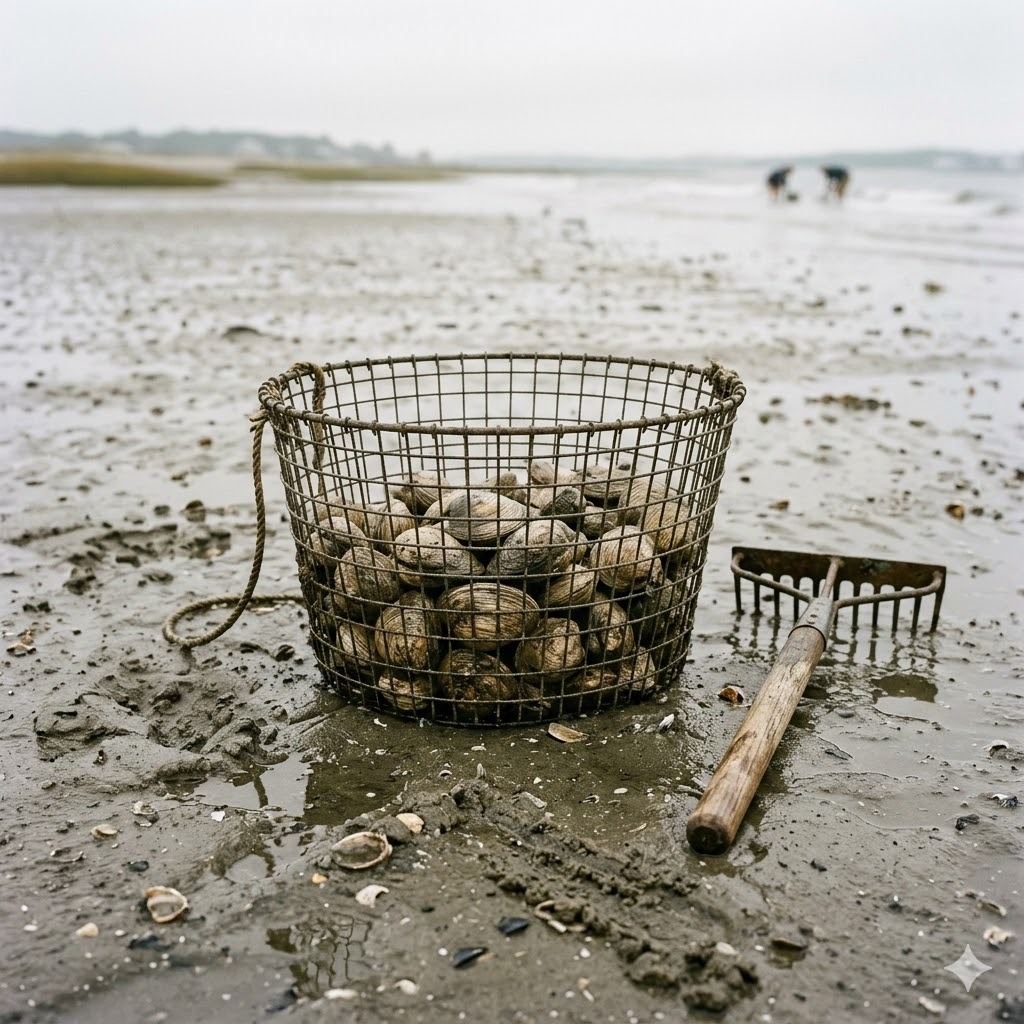
The hard clam, or quahog, is the workhorse clam of many coasts, and gathering them is one of the simplest ways into shellfishing. They live buried just below the surface of sandy-mud intertidal flats, and at low tide you can walk out and collect them by hand, with a rake, or simply by feeling for them underfoot. No boat, no casting, no complicated technique - just a bucket, a falling tide and a bit of patience.
Size decides the destiny of your catch. Small quahogs, the littlenecks and cherrystones, are prized for eating raw on the half shell or lightly steamed. Bigger, older clams - the chowder clams - have tougher meat that comes into its own chopped into a rich chowder. Before any of that, though, comes the single most important rule of clamming, which we will cover in full below: clams are filter feeders, and you must only ever gather them from waters that are officially open and approved. Get that right, and quahogging is a rewarding, low-cost way to bring shellfish home.
Why go for hard clams
Simplicity is the great appeal. Hard clams sit and wait to be found - they do not swim away, they do not need bait, and they are forgiving of beginner mistakes. A first-timer can go out at low tide, follow a few basics, and come home with a meal. That makes quahogging one of the best shellfish activities for families and newcomers, provided the waters are safe and open.
The eating rewards the effort across a wide range. Small littlenecks are sweet and tender enough to eat raw or barely cooked, a genuine delicacy. Middle-sized cherrystones are excellent grilled or steamed. The big chowder clams give you generous, meaty flesh perfect for chowders, fritters and pasta sauces. One species covers everything from a raw-bar starter to a hearty winter pot, and you choose which by the size you keep.
There is also a quiet satisfaction in the hunt. Learning to read a flat - where the clams sit thickest, how the bottom changes, feeling that solid tap through a rake or under your bare foot - is a skill that deepens every trip. It is calm, methodical work, done at a walking pace with the tide out and the flat to yourself.
Where and when to find them
Hard clams live in sandy-mud intertidal flats, in bays, estuaries and protected coves where the water is calm enough for them to settle. They favour firmer sand-mud mixes over pure soft mud, and they bury just an inch or two down, so they are within easy reach. Look for flats that are exposed at low tide, and note that clams often concentrate in particular patches rather than spreading evenly - once you find a productive area, work it thoroughly.
The tide dictates everything. You gather quahogs on a falling and low tide, when the flats are exposed or the water is shallow enough to work. The lowest tides of the month, around the new and full moon, expose the most ground and give you the best access. Aim to be on the flat as the tide bottoms out, and keep a close eye on the turn so you are not caught out as the water floods back in.
The most important siting decision has nothing to do with where the clams are and everything to do with whether the water is safe. Only gather from areas that the local shellfish authority has classified as open and approved for harvest. Never assume a flat is safe just because it holds clams. Check the shellfish-status map for your area every single time before you go, and see /shellfish/safety/ for how.
How to catch them
The tell-tale method needs nothing but your bare feet. Wade into shallow water over a sand-mud flat and shuffle slowly along, and you will feel the hard, smooth shells of quahogs under your soles. When you feel one, reach down and dig it out with your hand or foot. Treading like this is a wonderful way to find clams and works well in shallow water where a rake is awkward. Wear something on your feet if there is any risk of sharp shells or glass, and go barefoot only where you know the bottom is clean.
A clam rake is the classic tool for working exposed or slightly deeper flats. Drag the tined rake through the top few inches of sand and mud, and you will feel the distinct clunk as it strikes a shell. Work the rake in short pulls, dig down when you feel a hit, and lift the clam out. A basket rake catches the clams as you go. Rakes let you cover more ground and reach clams a little deeper than treading allows.
Whichever method you use, measure every clam. Hard clams have a legal minimum size, usually checked with a simple gauge across the shell, and undersized clams must go straight back, gently reburied where you found them so they survive. Keep only what you will use, well within any daily limit. Rinse the flat's mud off your keepers in seawater, and keep them cool and damp - not submerged in fresh water - in a bucket or mesh bag until you get home.
Handling, cleaning and cooking
Keep your clams alive and cool from the moment you collect them. Store them in a bucket or mesh bag, out of direct sun, ideally on ice or in the fridge, but never sealed in fresh water or an airtight container, which suffocates them. A live hard clam is shut tight or closes when tapped; discard any that stay gaping open and will not close, as those are dead and unsafe.
Before cooking, purge and scrub them. Let the clams sit in clean, cold seawater or salted water for an hour or two so they spit out sand, then scrub the shells under running water. This grit-removal step makes all the difference to the finished dish. Discard any that are cracked, damaged or will not close.
For the table, size guides the method. Small littlenecks are eaten raw on the half shell with a squeeze of lemon, or steamed open in a splash of wine and served with the broth. Cherrystones are lovely grilled until they pop open, or baked stuffed. The big chowder clams are shucked, chopped and simmered into a proper clam chowder with potato and cream or a clear broth. Steam any clam just until the shells open, and discard any that stay firmly shut after cooking. For more, see our catch-and-cook guide.
Safety and the law
This is the most important section, and for clams it can genuinely be a matter of health. Hard clams are filter feeders: they pump large volumes of water through their bodies and concentrate whatever is in it, including harmful bacteria, viruses and natural biotoxins such as those behind red tide and paralytic shellfish poisoning. This is the single most important thing to understand about gathering any clam. Only ever harvest from waters that the local shellfish authority has officially classified as OPEN and approved for shellfish harvest. Never gather from closed, unclassified or unknown waters, no matter how clean they look.
You must check the shellfish-status map and any current advisories every single time before you go, because a flat that was open last week can be closed today after rain, pollution or a biotoxin bloom. Closures happen fast and for good reason. And understand this clearly: cooking does not remove biotoxins. Heat kills many bacteria, but the toxins responsible for red tide and paralytic shellfish poisoning are not destroyed by cooking, so a clam from contaminated water is dangerous however you prepare it. There is no way to cook your way out of a bad harvest area - the only protection is gathering from approved, open waters.
On the legal side, clamming almost always requires a licence or permit, and there are minimum size limits and daily bag limits that you must respect. Measure every clam, return the small ones, and keep within your limit. Rules vary by area and are strictly enforced. On general safety, watch the incoming tide so you are never cut off on a flat, wear footwear against sharp shells, and take care on slippery mud.
Read /shellfish/safety/ in full before every trip - for clams especially, it is the difference between a good meal and a serious mistake. Browse other species in the shellfish section, and find rakes, buckets and boots in our gear guide.