How to Catch Octopus
A clever, strong animal taken by hand from rocky dens or in pots where legal - rich meat that needs tenderising, and one species you must never touch.
Methods and seasons are regulated and some areas ban octopus harvest entirely - check first. A few species (e.g. blue-ringed) are dangerously venomous, so know what lives in your waters and never handle unknown octopus.
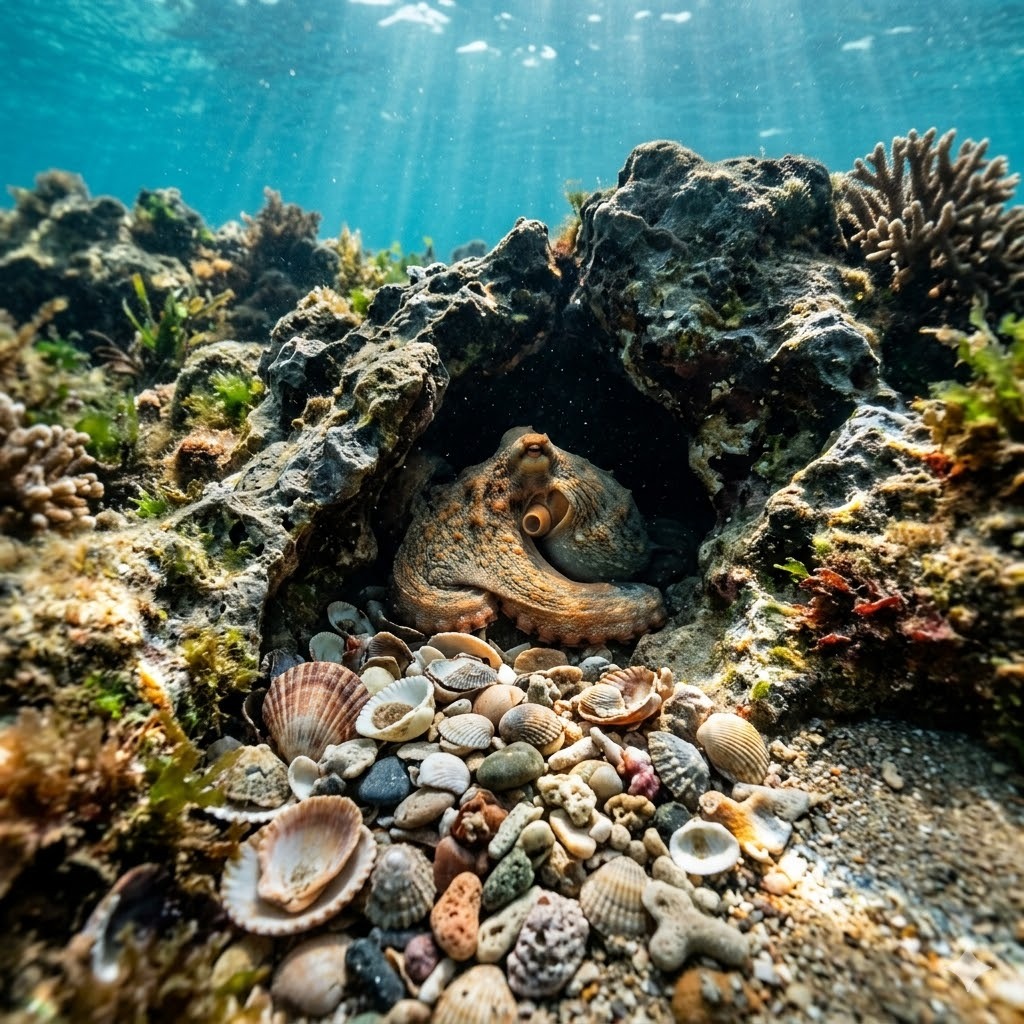
Octopus is one of the more absorbing animals to pursue, because catching one is as much about detective work as anything else. An octopus lives in a den - a hole, crevice or gap under a rock on a reef or a rocky shore - and rarely strays far from it in daylight. The classic way to find one is to spot the tell-tale sign outside the door: a midden, a small pile of empty crab and shell fragments the octopus has discarded after feeding. Find the midden and you have found the den.
From there, the two main methods are taking one by hand while snorkelling, or setting pots where the law allows it. Neither is complicated, but both call for a bit of patience and a steady nerve, because an octopus is strong, quick and surprisingly clever. This is an intermediate pursuit - not because the technique is hard, but because the rules are strict, some places ban it outright, and one point of safety is absolutely non-negotiable, which we cover at the end. Read that section first if you read nothing else.
Why go for octopus
You go for octopus because it is a genuinely engaging hunt and the meat is excellent - rich, firm and prized across Mediterranean, Asian and Pacific cuisines. Finding a den by reading the midden, then working out how to get the animal out, is a satisfying skill that improves every time you go.
Be realistic about the challenge, though. An octopus can wedge itself into a crevice with astonishing grip, squeeze through gaps you would think impossible, and change colour to vanish against the rock. Landing one is not guaranteed, and losing one is common. What you actually get:
- An absorbing hunt built on tracking and observation
- Rich, prized meat that rewards proper cooking
- A pursuit that teaches you to read a rocky reef
- A real sense of achievement when you land one
Where and when to find them
Octopus live on rocky ground: reefs, boulder fields, rock ledges, harbour walls and the broken rocky bottom just off shore. They need holes and crevices for a den, so smooth sandy areas hold few of them. Look at low tide around rocky shorelines, or snorkel over reef and boulder ground in clear water.
The midden is your best clue. An occupied den usually has a scatter of cracked crab shells, empty mussel and clam halves and other debris just outside the entrance, sometimes with the hole itself looking suspiciously clean and clear. A den may also be partly walled off with a few gathered stones. Learn to spot these signs and you will find octopus far more reliably than by chance.
Timing depends on your method. For hand-gathering while snorkelling, calm, clear water and good light let you see into crevices. Octopus tend to be more active around dawn, dusk and at night, and hide up tight in bright midday sun. Where pots are legal, they are left down and checked over time. As always, local seasons apply, so check when octopus may be taken in your area before you plan a trip.
How to catch them
The hand method, while snorkelling, is the classic. Once you have found an occupied den, the challenge is persuading or drawing the octopus out and getting a firm grip before it wedges itself in. Some people work it out of the hole by hand; the animal will often grip your arm, which is unnerving but not dangerous for the common edible species. Get a firm hold on the body, not just an arm, or it will simply pull free. This takes practice, and many attempts end with the octopus retreating deeper into the rock, at which point the right thing to do is leave it.
The other method is pots or traps, where the law allows them. Octopus will readily take shelter in a pot, an unbaited "octopus jar" or a length of pipe left on the bottom, treating it as a ready-made den. These are set on rocky ground and checked periodically. Pot rules vary enormously by region, and in many places recreational potting for octopus is restricted or banned, so this route depends entirely on local law.
Whichever method you use, an octopus is powerful and slippery. Have a bag or bucket with a secure lid ready the moment you land one, because they are expert escape artists and will climb out of anything left open. See our gear notes for snorkelling kit and a container that will actually hold your catch.
Handling, cleaning and cooking
Handle a caught octopus with a firm, confident grip and get it into a sealed container quickly. Keep it cool. The common edible species are not dangerous to handle, but see the safety section below, because not every octopus is safe to pick up.
Cleaning is straightforward. Turn the body (the mantle) inside out and remove the innards. Cut out the two eyes, and press out the hard beak from the centre where the arms meet. Rinse thoroughly. You are left with the mantle and the arms, all of which you eat.
The one thing everyone should know about octopus is that the meat is tough unless you help it along, so tenderising is essential. Honest approaches:
- Long slow cooking. Simmer or braise gently for an hour or more until a knife slides in easily. This is the most reliable route to tender octopus.
- Freezing first. Freezing and thawing before cooking breaks down the muscle and genuinely improves tenderness - a well-known trick worth using.
- Grilled after par-cooking. Simmer until tender, then char quickly on a hot grill for flavour. Grilling raw, untenderised octopus gives you rubber.
Get the tenderising right and octopus is superb. For more on turning your catch into a meal, see our catch and cook guide.
Safety and the law
This is the section that matters most for octopus, so read it carefully. The single most important rule: never handle an octopus you cannot confidently identify. Some species - most famously the blue-ringed octopus of the Pacific and Indian Oceans - carry a venom that can kill a person, and there is no antivenom. A blue-ringed octopus is small, often no bigger than a hand, and flashes bright blue rings when disturbed. If you see any blue rings, or you are simply unsure what species you are looking at, do not touch it. This applies especially to anyone gathering in Australian and Indo-Pacific waters.
Beyond that, the legal picture is strict and varies widely:
- Methods and seasons are regulated. How you may take octopus, and when, is controlled in most places. Some areas ban recreational octopus fishing entirely. Check your local rules before you go - see our shellfish safety page.
- Some areas ban it outright. Do not assume it is allowed. If in doubt, treat it as prohibited until you have confirmed otherwise.
- Size and bag limits. Where octopus may be taken, there are usually size and daily limits. Check your local limit and return anything undersized.
- Snorkelling safety. Never dive or snorkel alone, watch the conditions, and know your limits in cold or moving water.
- Water quality. Take octopus for eating only from clean water open for harvest.
Get the identification right, respect the local law, and treat every unfamiliar octopus as something to look at and leave. More background is on the main shellfish section.