How to Gather Periwinkle
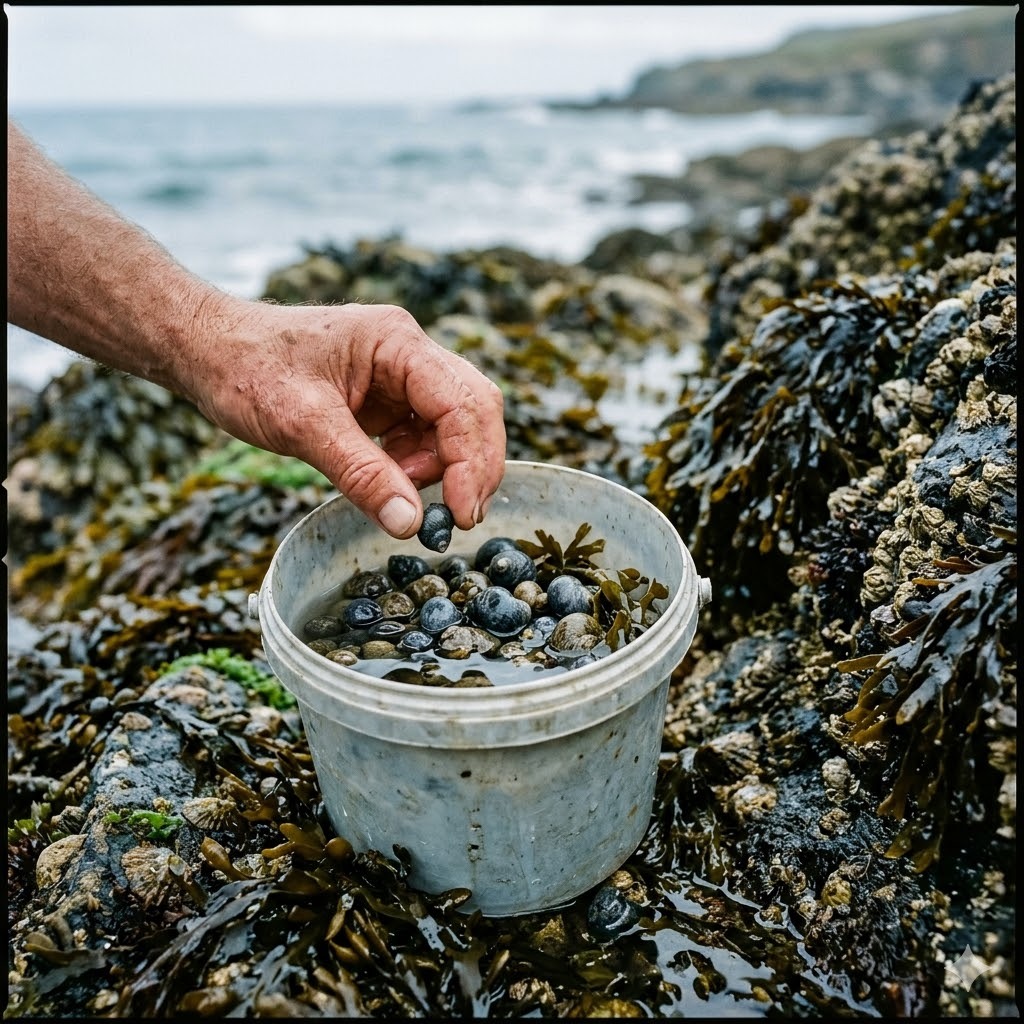
Little dark sea snails covering intertidal rocks and seaweed, picked by hand into a bucket - the easiest, cheapest, most family-friendly introduction to gathering.
🔴 Gather only from clean, open, approved shoreline and rinse thoroughly. Avoid areas near outfalls or closures. Simple and low-risk otherwise.
Periwinkles - "winkles" to most people who gather them - are small, dark sea snails that cover intertidal rocks and seaweed in huge numbers. Gathering them could not be simpler: you walk down to the shore at low tide with a bucket and pick them up. There is no gear to buy, no technique to learn and no chasing involved. If you want to try gathering your own shellfish for the first time, this is the place to start.
Winkling is a genuine free-food tradition on rocky coasts, especially around the British Isles and northern Europe, and it is about as beginner-friendly and family-friendly as any pursuit gets. The catch is that periwinkles are tiny and fiddly to eat - you winkle each one out of its shell with a pin - so it is a labour of love rather than a quick feed. But as a cheap, easy, hands-on introduction to the shore, nothing beats it.
Why go for periwinkle
You go for periwinkles because they are the simplest, cheapest gather there is. No licence-heavy gear, no boat, no diving - just a bucket and a low tide. It is a brilliant first taste of foraging your own seafood, and it works wonderfully with children, who tend to be very good at spotting and picking up the little snails.
Be honest about the yield and the effort at the table. Periwinkles are small, and once cooked you extract each one from its shell with a pin, which is slow, fiddly work. You gather a lot of shells for a modest amount of meat. But that is part of the tradition - it is a sociable, unhurried thing to do. What you actually get:
- The cheapest, easiest introduction to gathering there is
- A genuine free-food tradition to share with family
- A relaxed, low-stress day on the rocky shore
- Firm, tasty little snails to eat winkled out with a pin
Where and when to find them
Periwinkles live on rocky intertidal shores - the zone that is underwater at high tide and exposed at low tide. Look on and under rocks, in rock pools, and among seaweed, especially the wracks and other brown weeds they graze on. On a good shore they cluster thickly, and once your eye is in you will see them everywhere: small, rounded, dark grey to black or brownish snails, often gathered in the damp shade under weed and in crevices.
Low tide is your window, and the bigger the tide the more shore it uncovers. A low spring tide exposes the most ground and the most winkles. Work the middle and lower shore as the tide drops, picking as you go. They do not move fast, so a productive patch stays productive.
Choose your shore with care. Clean, open, healthy coastline is what you want - avoid anywhere near a sewage outfall, storm drain, harbour or industrial site, because filter-feeding snails take on whatever is in the water. A rocky, weedy shore away from towns and outfalls is ideal. As always, some areas have local rules on gathering, so check what applies where you are before you fill a bucket.
How to gather them
There is no method to speak of beyond picking them up, which is exactly why winkling is such a good place to start. Take a bucket down to the rocks at low tide and work along the shore, lifting periwinkles off the rocks and out of the weed by hand. Turn over stones and part the seaweed to find the ones sheltering underneath. Drop them straight into the bucket.
The only real skill is knowing a winkle from a similar-looking snail and picking the clean, healthy ones. Take live snails - a periwinkle with the animal sealed inside behind its little "trapdoor" is alive; an empty or light shell is not. Leave the very smallest ones to grow on, both to be sustainable and because they are not worth the effort at the table.
Keep the bucket out of the sun and add a little seawater or damp weed to keep your catch fresh while you gather. That is genuinely all there is to it. See our gear notes for a suitable bucket - and do not forget a pin or two for later.
Handling, cleaning and cooking
Periwinkles are completely safe and easy to handle. The main job before cooking is cleaning, because they carry sand and grit. Rinse them well in several changes of clean water, and it is worth leaving them for a few hours in a bucket of clean seawater so they clear out grit before you cook them. Discard any with broken shells or that do not seal up.
Cooking is simple. Boil the winkles in well-salted water - roughly seawater strength - for a few minutes until cooked, then drain. The eating is the fiddly part: use a pin, a needle or a cocktail stick to hook out each little animal from its shell. Twist the shell as you pull and the whole snail comes free. Pick off the small horny trapdoor first. Honest ways to enjoy them:
- Simply boiled. Cook, drain, and winkle them out to eat warm or cold with a little vinegar, salt or butter. This is the classic way.
- With bread and butter. A big bowl of winkles, a pin each and some buttered bread is the traditional shore feast - unhurried and sociable.
- In a seafood mix. Add the picked meat to a shellfish platter or salad alongside other gathered shellfish.
Rinse well, cook thoroughly, and eat fresh. For more on turning your catch into a meal, see our catch and cook guide.
Safety and the law
Periwinkle gathering is about the safest, simplest shellfishing there is, but the water-quality rule still matters. The most important habit is to check your local situation first - see our shellfish safety page for how to check water quality and any local rules in your area.
Key points specific to periwinkle:
- Gather from clean, open, approved shoreline only. Periwinkles take on whatever is in the water around them. Pick only from clean coastline that is open for harvest, and stay well away from sewage outfalls, storm drains, harbours and industrial areas.
- Avoid outfalls and after heavy rain. Do not gather near drains or outfalls, and avoid the days after heavy rain, when runoff can carry pollution and bacteria into the shallows.
- Rinse and purge well. Rinse thoroughly and purge in clean seawater before cooking to clear grit and to be sure of what you are eating.
- Take live snails and leave the smallest. Gather only live winkles, leave the tiniest to grow on, and do not strip a single patch bare.
- Check local rules. Some areas set rules or limits on shellfish gathering. Check what applies where you are before you go.
Pick from clean open shore, rinse well, and gather sustainably, and winkling stays exactly what it should be - the easiest, friendliest way into gathering your own shellfish. More background is on the main shellfish section.