How to Gather Razor Clams
Razor clams are long, blade-shaped bivalves that dig astonishingly fast, so gathering them is a race - spot the show, pump or lure quickly, and always check safety first.
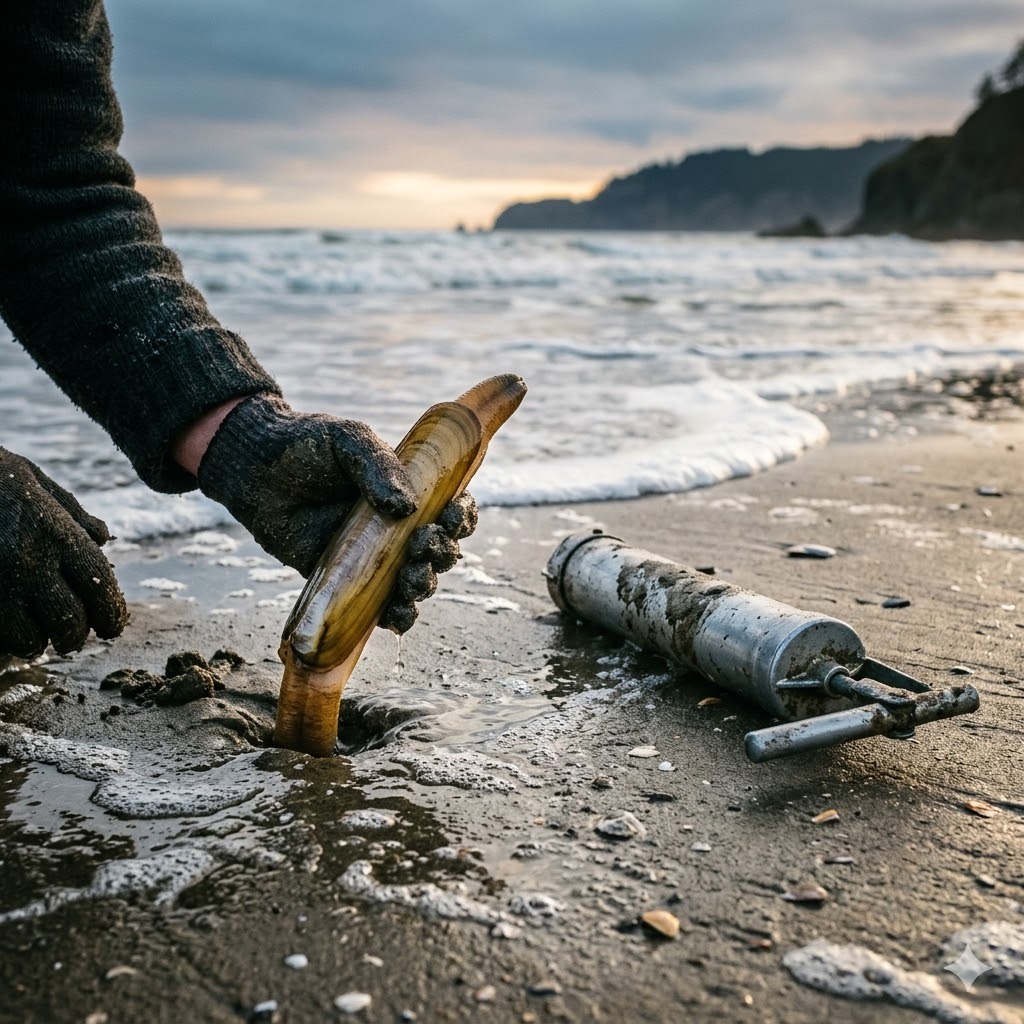
🔴 Pacific razor clams require testing for domoic acid - only dig on officially opened days and heed every closure. Check size/limit rules. The shell edges are sharp.
Razor clams are one of the more exciting shellfish to gather, mostly because they do not sit around waiting for you. These long, slim, blade-shaped clams live buried in sand and can dig themselves deeper faster than you can dig them out. That single fact shapes everything about how you go after them: speed, timing and reading the beach matter far more than brute force.
There are two broad approaches depending on where you are. On Pacific surf beaches you look for the "show" - a dimple or small hole the clam leaves in the wet sand - and pump the sand out fast with a clam gun before it escapes downward. On European estuary sand flats, anglers often coax the clam up out of its burrow with a pinch of salt. Both work, both are satisfying, and both reward a bit of practice. This is a fair intermediate-level pursuit rather than a beginner one, simply because the clams move.
Why go for razor clams
Razor clams are prized eating. The meat is sweet, firm and a little chewy, and it takes well to quick cooking - a fast fry, a grill over coals, or a splash into a pasta or chowder. Many people rate them above most other clams for flavour, and a good haul feeds a family generously.
Beyond the plate, gathering them is genuinely fun. It gets you out on a wide open beach at low tide, usually in bracing air, and there is a real skill to reading the sand and moving quickly. It is active, tidal, weather-dependent gathering that feels more like hunting than collecting. If you enjoy being out on the shore and want something a bit more sporting than raking cockles, razor clams are a great step up.
They are also fairly widely distributed. Pacific razor clams line surf beaches on the western coast of North America, while different razor species are common on sand flats around Europe and the British Isles. Wherever you are, the same principles apply once you learn the local method.
Where and when to find them
Razor clams live in clean sand, and timing is everything. You want the lowest tides of the month - the big spring low tides around the new and full moon - because that exposes the most sand and the most clams. A tide table is essential. Aim to be on the beach as the tide is dropping toward its lowest point, and work the freshly uncovered wet sand.
On Pacific surf beaches, walk the flat wet sand near the waterline and look for "shows": small dimples, keyhole shapes or tiny holes where the clam's siphon has withdrawn. Stamping near a suspected spot or the vibration of your footsteps can make a clam show itself. Once you see a show, you have to move - the clam is already heading down.
On European estuary and beach flats, look for the distinctive keyhole-shaped burrow openings at the surface of firm, damp sand at low water. Here the classic trick is to trickle ordinary salt into the hole. The change in salinity irritates the clam and it rises up out of the burrow far enough for you to grab it. You need to be ready and quick, because it will dart back down if you fumble.
Calm, low-tide days after a stretch of settled weather tend to be best. Storms can rework the sand and scatter the clams, though they can also wash beds into reach.
How to catch them
For the Pacific method, the two main tools are a clam gun and a clam shovel. A clam gun is an open-ended tube, often with a handle and a thumb vent hole at the top. You place it over the show, push it down into the sand, cover the vent hole with your thumb to create suction, and pull straight up. The tube lifts a core of sand - and hopefully the clam - out of the ground. You may need a couple of pulls, working fast, then reach in and lift the clam free. A narrow clam shovel is the alternative: dig quickly on the seaward side of the show and reach in.
The golden rule is speed and commitment. Razor clams dig with a strong muscular foot and go down fast, so hesitation loses them. Dig or pump decisively the moment you spot the show.
For the European salt method, carry a tub of ordinary table or rock salt. Find a keyhole burrow, pour a good pinch of salt straight into it, and wait a few seconds. When the clam eases up out of the sand, take a firm grip low down near the shell and draw it out with steady pressure rather than a sharp yank, which can snap the shell or leave the foot behind. Only re-salt a hole once or twice; if nothing comes, move on.
Whatever the method, handle the shells with care - the edges are genuinely sharp, which is where the name comes from. A good pair of gloves is worth having. For more on tools and clothing for shore gathering, see our gear guide.
Handling, cleaning and cooking
Keep your razor clams cool and alive until you cook them. A bucket with a little seawater, or a damp cloth over them in a cool bag, keeps them fresh on the way home. Discard any that are badly cracked or that stay wide open and do not react when tapped - those are dead and not worth the risk.
Razor clams hold a fair bit of sand, so cleaning matters. A short purge in clean seawater or salted water for a few hours lets them spit out grit. To prepare, a quick blanch in boiling water for a few seconds pops the shells open; then you can remove the meat, trim away the dark digestive parts and the tougher tip, and rinse well. Some cooks grill or fry them straight in the shell instead.
The meat cooks in moments. Overcooking turns it rubbery, so treat it like squid - hot and fast, or slow and gentle, never in between. A quick sear in butter and garlic is hard to beat. For recipe ideas and a full walk-through of preparing your catch, see our catch and cook guide.
Safety and the law
This is the most important section, so read it before you gather anything. Razor clams are bivalves - filter feeders that pump large volumes of water through their bodies. In doing so they concentrate whatever is in that water, including harmful bacteria and, more dangerously, natural marine biotoxins produced by algal blooms. These include the toxins behind paralytic shellfish poisoning (PSP), often linked to "red tide," and domoic acid, which causes amnesic shellfish poisoning and is a recurring concern for Pacific razor clams in particular.
Cooking does not destroy these biotoxins. A clam that carries them is dangerous no matter how thoroughly you cook it. This is not something you can see, smell or taste.
Because of this, the single firm rule is: only gather razor clams from waters that are officially open and approved for shellfish harvesting, and check the current advisory every single time before you go. Authorities test beaches and open or close them based on toxin levels and bacterial contamination. Pacific razor clam beaches are frequently closed pending domoic acid testing, and safe digging days are announced when levels are clear. A beach that was fine last month may be closed today. Never assume.
Alongside the biotoxin rules, most places have a licence or permit requirement, a minimum size, a daily limit on how many you may take, and sometimes rules that you must keep the first clams you dig regardless of size (to reduce waste from clams that will not survive being reburied). Learn and follow your local regulations before you start.
Practical safety matters too: razor shells are sharp enough to cut, so wear gloves and take care. Watch the tide constantly on open surf beaches, keep an eye on the water and never get so absorbed in digging that the sea cuts you off. For the full rundown on shellfish biotoxins, closures and staying safe, read our shellfish safety guide, and see the main shellfish section for other species to gather.