How to Catch Shrimp (Cast-net)
Throw a cast net over tidal creeks and estuaries to gather wild shrimp - sweeter than shop-bought, doubling as prime bait, and worth the practice to master the throw.
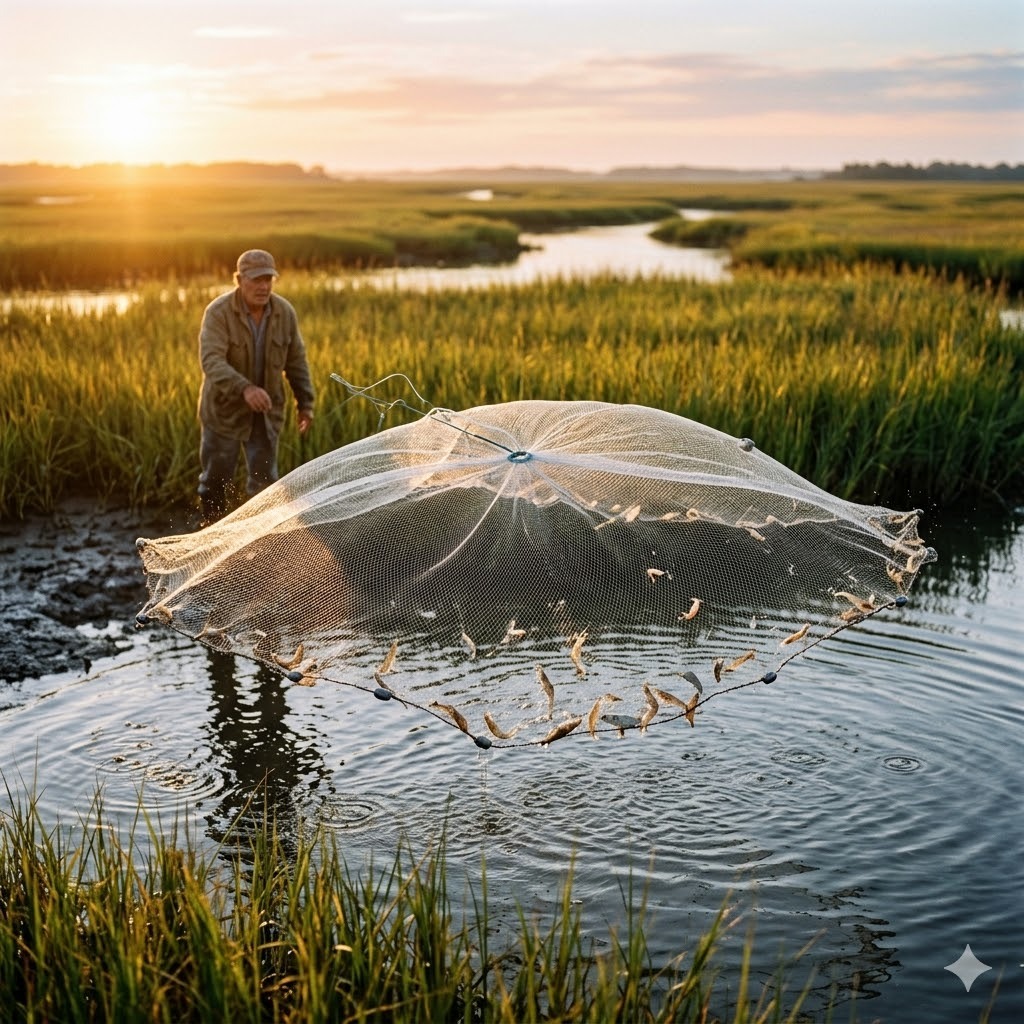
Follow local seasons, licence rules and net-size limits. Keep the catch cold and alive-fresh; shrimp spoil fast in warm air.
Wild shrimp move through tidal creeks, estuaries and the brackish edges of the coast in enormous numbers at the right time of year. Catching them with a cast net is one of the most satisfying skills in shallow-water fishing: a well-thrown net opens into a wide circle, drops flat over the water, and sinks around a shoal before they can scatter. It takes practice, but once it clicks, you can gather a bucket of shrimp in an evening.
The reward is worth the effort on two fronts. Fresh-caught shrimp, cooked within hours, are noticeably sweeter and firmer than anything you will buy from a shop counter. And any you do not eat make superb bait for a huge range of species, from bass and flounder to whiting and croaker. That dual purpose - dinner and tackle in one throw - is why cast-netting for shrimp is a favourite among coastal anglers who like to work for their catch.
Why go for shrimp
Freshness is the headline. Shrimp start to lose quality the moment they leave the water, so shop shrimp - however well handled - can never match the flavour of ones you caught yourself an hour before the pan. Cook them the same evening and the difference is obvious: sweeter, cleaner and with a firmer bite. For anyone who cares about eating well from the sea, this alone justifies learning the throw.
The bait value is the practical bonus. Live or fresh-dead shrimp are among the most effective natural baits in inshore and estuary fishing. Predators everywhere key in on them. If a session produces more shrimp than you want for the table, the surplus goes straight into the bait bucket rather than to waste, which makes cast-netting doubly efficient for a working angler.
There is also the skill itself. Throwing a cast net well is genuinely satisfying - a physical, rhythmic craft that rewards repetition. Reading the water for shoaling shrimp, timing your throw, and watching the net bloom open is a pleasure in its own right, quite apart from what ends up in the bucket. It is an intermediate technique, harder than dropping a trap, but the learning is half the fun.
Where and when to find them
Shrimp gather where fresh and salt water mix: tidal creeks, estuaries, marsh drains, canals and the brackish margins of bays. Look for softer, muddy or sandy bottoms, channel edges, and the mouths of creeks where the tide funnels shrimp through. At night they are drawn to light, so docks, bridges and jetties with lighting can concentrate them, and many shrimpers hang lanterns over the water to pull them in.
Timing follows the tide and the season. Moving water - the run of a falling or rising tide - keeps shrimp on the move and easier to net than dead slack water. Many shrimpers favour the hours around dawn, dusk and after dark. Seasonally, shrimp runs are strongly tied to local seasons that are often set and regulated, so the right months vary by region and are usually defined by law rather than guesswork.
Because shrimp seasons and locations are so heavily regulated, this is a case where you must check local rules before you plan a trip. Open seasons, permitted waters and gear restrictions are set locally and change from place to place. See /shellfish/safety/ for how to find the current regulations for your area.
How to catch them
The cast net is the tool. These come in a range of diameters and mesh sizes - a smaller net is easier to learn with, a larger one covers more water once you are skilled. Crucially, mesh size and net radius are often capped by law, so buy a net that is legal for your area before anything else. The net has a weighted lead line around its edge and a central line (the horn line) that closes it into a bag as you retrieve it.
Throwing takes practice, and there is no substitute for it. The goal is to make the net open into a full flat circle before it hits the water, so it sinks evenly and traps shrimp underneath. There are several throwing styles, and it is worth watching someone experienced or practising on a lawn before you take it to the water. Expect a lot of half-open throws at first - persistence is the whole game. Once the net lands, let the weights sink to the bottom, then draw the horn line steadily to purse it closed and lift.
To find the shrimp, watch for signs: shrimp flicking at the surface, jumping ahead of a moving net, or showing up under lights at night. Chumming an area with bait can draw them into a tighter group for a better throw. Work the moving tide, cover different depths, and be ready to move if a spot is not producing. Empty a good throw straight into a cooler, and pick out any bycatch of small fish or crabs to return.
Handling, cleaning and cooking
Shrimp spoil fast, so keep them cold from the moment they hit the bucket. A cooler with plenty of ice is essential - lay the shrimp on ice or in an ice slurry immediately. Warm shrimp deteriorate within hours and develop off flavours quickly, so this step is not optional if you plan to eat them.
Cleaning is simple. For eating, twist off the head, peel away the shell, and if you like, run a knife down the back to lift out the dark digestive vein. Some people cook them head-on and shell-on for maximum flavour, then peel at the table. For bait, you can use them whole and fresh, or peel them, depending on what you are targeting.
For the table, shrimp cook in minutes and are ruined by overcooking. Boil them briefly in seasoned water until they just turn pink and curl, then pull them straight out. They are equally good sauteed in butter and garlic, grilled on skewers, or dropped into a spicy boil with corn and potatoes. Fresh-caught shrimp need very little dressing up. For more ideas on cooking your catch, see our catch-and-cook guide.
Safety and the law
The legal side is the most important part of shrimping, because it is one of the more tightly regulated forms of gathering. Shrimp are governed by local seasons that open and close by law, by licence requirements, and by strict limits on gear. Cast-net radius and mesh size are commonly restricted, and using an over-size or under-mesh net can land you in serious trouble. There are usually catch limits too. You must confirm the current season, the licence you need, the legal net dimensions and the bag limit for your specific area before you fish. Do not rely on last year's rules or a friend's memory - check the official source every time.
On safety, cast-netting means working around water, often on slippery banks, docks and mud, sometimes in the dark. Wear footwear with grip, watch your footing, and be careful throwing a weighted net near other people or overhead lines. The lead line can hurt if it catches you. If you wade, know the depth and the tide, and never get cut off by a rising tide in a marsh or creek.
For eating, freshness and cold storage are your main safeguards - shrimp that have warmed up and gone off are not worth the risk, so ice them hard and cook them soon. Avoid gathering from waters with pollution advisories or runoff. For the full picture on closures, advisories and local regulations, read /shellfish/safety/ before you go. Browse other species in the shellfish section, and find nets, coolers and waders in our gear guide.