Raising Giant Tiger Prawns: A Large Premium Prawn
A guide to farming giant tiger prawns - a large, striped, premium marine prawn raised in warm brackish ponds across Asia, bigger and pricier than whiteleg shrimp but equally demanding.
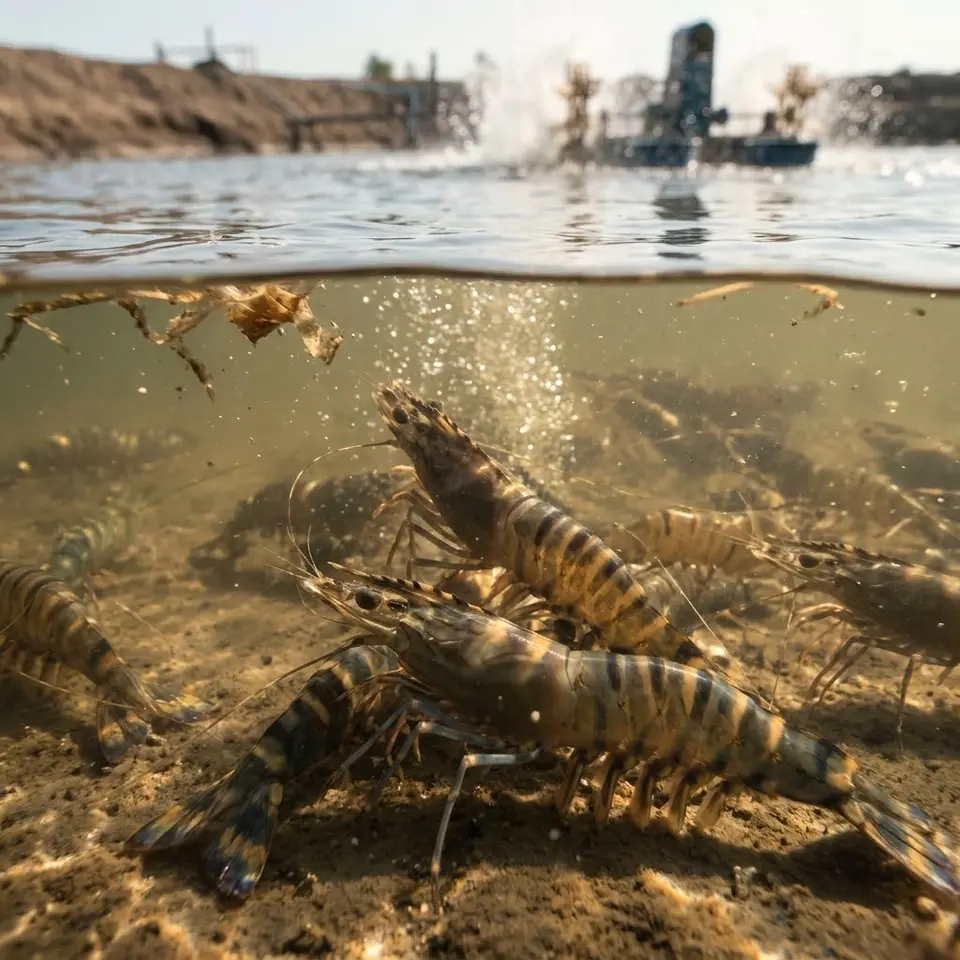
The giant tiger prawn is the big, boldly striped premium prawn of Asian aquaculture, growing larger than the more common whiteleg shrimp and fetching a higher price. Raised in warm brackish ponds, it is a productive, valuable species - but like all farmed shrimp it is sensitive to water quality and disease, so strict biosecurity and stable conditions are essential.
The giant tiger prawn (Penaeus monodon), sold as black tiger shrimp, is a large marine prawn of the Indo-Pacific, banded red and white across the body. Females can reach about 33 cm (13 in) but are typically 25-30 cm and 200-320 g; males are slightly smaller at 20-25 cm and 100-170 g. It is the second most widely farmed prawn in the world after the whiteleg shrimp (Wikipedia).
Is it right for you?
Tiger prawns suit a grower who wants a large, premium prawn and can manage brackish water and biosecurity carefully. They are more valuable than whiteleg shrimp but just as demanding.
System & Space
Warm brackish grow-out ponds are the classic system, with strong aeration and water exchange or filtration; large indoor tanks work at smaller scale.
Water & Temperature
They need warm water and brackish salinity held stable; swings stress them and invite disease. For optimal growth they are raised at 28-33 °C, and although the species survives a wide range of salinity, its optimum is about 15-25 g/L (Wikipedia). Reliable aeration and water management are essential.
Stocking & Feeding
Stock disease-free post-larvae and feed a compound prawn diet, which on farms comes as dried pellets (Wikipedia); grade and manage density to reach large sizes. Water quality management is the core daily task.
Health & Care
Disease is the major risk: the species is very vulnerable to fungal, viral and bacterial infections, and white spot and yellowhead disease have hit shrimp farming worldwide; yellowhead can even pass from Australian red claw crayfish (Wikipedia). Certified disease-free stock, strict biosecurity and stable water quality are the defenses. Avoid mixing in wild or untested prawns, or other crustaceans.
Harvest & Enjoying Them
They reach a large market size in a few months, giving big, sweet, premium prawns harvested by draining or netting.
Getting Started
Set up a stable warm brackish system, source certified post-larvae, and master aeration and water quality before scaling up.
What Usually Goes Wrong
Weak biosecurity, unstable salinity or temperature, and untested stock are the serious errors, just as with whiteleg shrimp.
FAQ
Bigger than whiteleg shrimp? Yes - and premium-priced for their size.
Same disease risk? Yes - biosecurity is just as critical.
What is a giant tiger prawn? Penaeus monodon, a large Indo-Pacific marine prawn banded red and white; females reach about 33 cm, and it is the second most farmed prawn after the whiteleg shrimp (Wikipedia).
Is it found in US waters? It is invasive in the northern Gulf of Mexico and the Atlantic off the southern US (Wikipedia), so farmed prawns must never be released.
Kit for raising fish
As an Amazon Associate we may earn from qualifying purchases - at no extra cost to you. We link gear types, not sponsors' picks: you choose the exact product.