Boat Anchors for Fishing
The right anchor turns a windy or current-swept fishing spot into a stable casting platform. The wrong anchor drags, swings, or fails when you need it most. Here is the complete…
The right anchor turns a windy or current-swept fishing spot into a stable casting platform. The wrong anchor drags, swings, or fails when you need it most. For anglers, anchor choice matters more than for casual boaters - you anchor on specific structure, often in current, and you reset frequently. Holding steady over a spot is what makes many fishing techniques work at all.
This guide covers the major anchor types, the bottom they hold best in, and the right picks for kayaks, jon boats, bass boats, and bigger lake boats.
How Anchors Actually Hold
Anchors hold through two forces: weight and bottom penetration. A pure weight anchor (like a mushroom in mud) relies on its mass. A penetrating anchor (fluke, plow, grapnel) digs into the bottom and uses leverage. The scope of your rode - the length of line out relative to water depth - determines holding power; a 5:1 or 7:1 ratio is standard.
The anchor’s hold also depends on the bottom: sand, mud, weed, rock, and gravel each favor different designs.
The Major Anchor Types
Fluke (Danforth-Style)
Two pivoting flat blades that dig into the bottom. Lightweight relative to holding power. Holds extremely well in sand and mud but slides in rock and weed.
Best for: lake bass boats, jon boats, inshore saltwater on sand/mud bottoms.
Mushroom Anchor
Inverted bowl shape that buries into soft bottoms. Modest holding power but excellent for kayaks and small boats in mud or sand. Common in 5-25 lb sizes.
Best for: kayaks, canoes, dinghies; soft bottoms; calm conditions.
Grapnel (Folding)
Multiple flukes that fold for storage. Hooks rock, weed, brush, and submerged structure. Limited hold in clean sand or mud.
Best for: kayaks, small boats; rocky or weedy bottoms; pack-friendly fishing.
Plow / CQR
Single triangular plow that digs in as the boat pulls. Strong, reliable in mixed bottoms. Heavy. Used more on cruising boats but works on larger fishing boats.
Best for: larger fishing boats; varied bottoms; serious holding.
Bruce / Claw
Three-pronged claw shape that rotates and resets. Good general-purpose anchor for mixed bottoms.
Best for: bigger lake and bay fishing boats; moderate weight requirements.
Box / Navy
Heavy steel box anchor with sliding rod. Very strong hold in mud and sand. Used by serious lake fishermen and offshore boats. Heavy and bulky.
Best for: large fishing boats; heavy current; sand/mud bottoms.
Stake-Out Pole
Not a traditional anchor - a fiberglass or carbon pole pushed into a soft bottom to hold a small boat. Popular on flats boats and kayaks in shallow water.
Best for: shallow flats, kayaks, technical poling skiffs in soft bottoms under 6 feet.
Drift Sock / Sea Anchor
A parachute-shaped fabric anchor that doesn’t touch bottom - it slows drift for controlled fishing in deep water.
Best for: deep-water drifting; trolling speed control; offshore.
Kayak Anchors
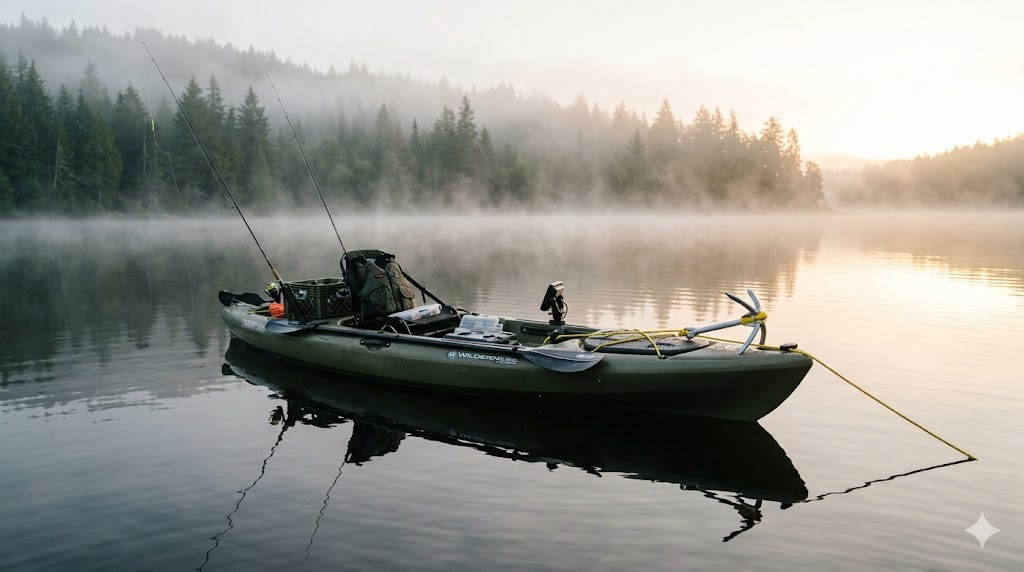
A fishing kayak is light, low to the water, and benefits from anchors you can deploy single-handed.
Top Picks
- 1.5-3 lb folding grapnel - Compact, hooks rock and structure. The most popular kayak anchor.
- 3 lb mushroom - Soft bottoms, calm lakes.
- Stake-out pole (6-8 ft) - Shallow grass flats, marsh, ponds under 6 feet.
- Drift chute - Slow drift over deep water.
Anchor Trolley
Almost mandatory for kayak anchoring. Runs along the side of the kayak so you can position the anchor at bow, stern, or midship to control how the boat lies to wind and current. Without a trolley, anchoring from one fixed point swings the boat broadside.
Jon Boat Anchors
Jon boats fish in ponds, rivers, and small lakes - often shallow and weedy.
Top Picks
- 8-13 lb fluke (Danforth-style) - Versatile for most lake and pond bottoms.
- 10-15 lb mushroom - Soft bottoms only.
- 5-8 lb grapnel - Rocky or wooded bottoms; rivers with snags.
- Stake-out pole - Shallow backwaters.
Many jon boat anglers run two anchors - one off bow, one off stern - to lock the boat parallel to a fishing target.
Bass Boat Anchors
Most bass boats now rely on a Power-Pole, Talon, or shallow-water anchor instead of a traditional anchor. These hydraulic or electric poles drop a spike into the bottom on command in water under 8-12 feet. They are silent, fast, and ideal for tournament fishing on shallow structure.
For deeper water, bass boats may carry a small fluke anchor for emergencies, but most use trolling motor spot-lock features (Minn Kota i-Pilot, Garmin Force) for active fishing.
Lake Boat / Walleye / Cruiser Anchors
Larger fishing boats need real anchors for wind, waves, and current.
Top Picks
- 15-25 lb fluke - Good general lake anchor for sand and mud.
- 15-25 lb claw or plow - Mixed bottoms; reliable hold.
- Box / Navy anchor 20-50 lb - Heavy current or holding through wind shifts.
- Drift sock - For controlled walleye drift fishing.
Sizing rule of thumb: 1 lb of anchor per foot of boat length is conservative; size up for windy conditions.
Anchor Rode (The Line)
The anchor is only half the system. The rode - chain, rope, or both - provides the right angle of pull to keep the anchor digging in.
- Kayaks/small boats: 50-75 feet of 1/4” nylon line; a few feet of chain helps.
- Jon boats and small lake boats: 100 feet of 3/8” nylon, 6-10 feet of chain.
- Larger fishing boats: 150-200 feet of 1/2” line, 10-20 feet of chain.
Chain adds weight near the anchor to keep the pull horizontal, dramatically improving hold.
Scope (line let out relative to depth) should be 5:1 minimum, 7:1 for windy or heavy conditions.
Anchoring Technique for Fishing
- Approach upwind or upcurrent of your target.
- Drop the anchor with the boat moving slowly downwind/downcurrent. Never dump the anchor at one spot - pay out line as the boat drifts back.
- Pay out scope - 5:1 to 7:1.
- Set the anchor by reversing or letting the wind/current pull it tight. Verify it is holding by sighting against shore landmarks.
- Tie off at a cleat or anchor point.
- Adjust position for casting toward the target.
To retrieve: idle up over the anchor, pulling line in as you go.
Two-Anchor (Lock-Off) Technique
For bass boats and walleye fishing, anchoring with one anchor off the bow and one off the stern locks the boat parallel to a structure (a weed line, drop-off, or rip-rap) and prevents swinging. Place the bow anchor first, drift back, and drop the stern anchor.
FAQ
What anchor for a 10-foot kayak? A 1.5-3 lb folding grapnel with 50 feet of line and an anchor trolley covers most situations.
How much anchor for a 16-foot jon boat? 8-13 lb fluke anchor with 75-100 feet of rode and 6 feet of chain is a versatile setup.
Are Power-Poles worth it? Yes - for serious bass and inshore fishing in shallow water. Game-changing for stealth and precision. Expensive ($1,500-3,000 installed).
Can I anchor in rivers? Yes, but carefully. Use grapnel-style anchors for rock and structure. Be aware of swinging in current and never anchor by the stern in fast water - the boat can swamp.
Why is my anchor dragging? Most common causes: too short scope, wrong anchor for the bottom type, or insufficient anchor weight. Add scope, add chain, or upsize.
Conclusion
The right anchor is small, often overlooked gear that dramatically changes how well you can fish. Match the anchor type to your boat, the bottom, and the conditions: grapnels for rocks, flukes for mud and sand, mushrooms for soft calm bottoms, and stake-out poles or Power-Poles for shallow precision. Carry enough rode, use proper scope, and the right anchor will hold you exactly where the fish are.
🛒 Recommended Gear on Amazon
- Fluke boat anchors - browse current options and reviews on Amazon.
- Anchor rope kit - browse current options and reviews on Amazon.
- Mushroom anchors - browse current options and reviews on Amazon.
As an Amazon Associate, we earn from qualifying purchases - at no extra cost to you. This helps us keep producing free, in-depth guides.