Fishing Kayak vs Canoe
Choosing between a fishing kayak and a fishing canoe shapes how you fish for the next decade. Here is the honest comparison of stability, gear capacity, paddling, and the…
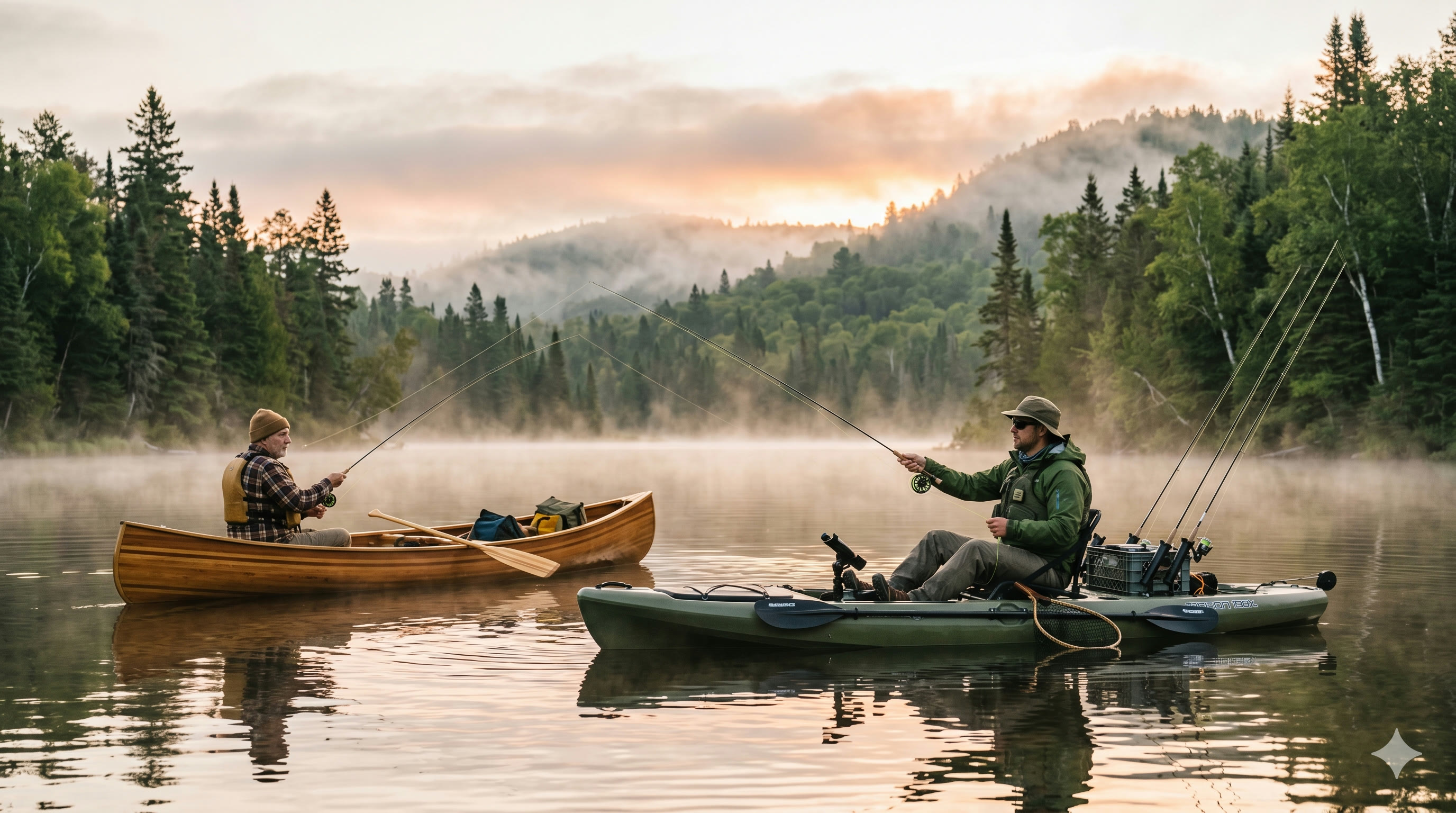
Choose a fishing kayak if you mostly fish solo, want better stability in wind and chop, and value pedal-drive options; choose a canoe if you carry a lot of gear, fish calm lakes and slow rivers, or want room for a second person or a dog. Both reach water a bank angler can’t.
Choosing between a fishing kayak and a fishing canoe shapes how you fish for the next decade. Both put you on water that bank anglers cannot reach, both cost a fraction of a powerboat, and both let you sneak up on the freshwater species you are chasing without an outboard. But they fish very differently. The right choice depends on where you fish, what you fish for, and how you like to spend a day on the water.
This guide breaks down the real-world differences, the situations each excels in, and the specific models that earn their reputations among serious anglers.
The Core Differences
A fishing kayak is a sit-on-top or sit-inside hull paddled with a double-bladed paddle while you sit low and centered. Modern fishing kayaks are wide, stable, and rigged with rod holders, gear tracks, and often pedal drives.
A fishing canoe is an open hull paddled with a single-bladed paddle from a higher seat, or sometimes propelled with a small motor or pole. Canoes carry more gear, more people, and more weight than a kayak of similar length.
The fundamental tradeoff: kayaks are personal, low to the water, and easier to solo. Canoes are bigger, more versatile, and better for hauling people, pets, and gear.
Stability and Standing
Modern fishing kayaks built on tunnel or pontoon hulls are remarkably stable. Models like the Hobie Pro Angler, Old Town Sportsman, and Bonafide SS127 are designed to be stood up in for sight fishing and fly casting. They are stable enough that most anglers can stand and cast comfortably in calm water within a few outings.
Canoes are less stable in a single-paddler load. A canoe is most stable when balanced with two people or with weight low and centered. A solo angler standing in an unballasted canoe is a YouTube video waiting to happen. Some specialty fishing canoes like the Old Town Discovery 119 Solo Sportsman address this with wider beams and lower seats.
If standing to fish is important, kayak wins, and it opens up sight-fishing approaches worth exploring in our fishing techniques library.
Gear and Capacity
Canoes carry more. A 16-foot canoe will haul two anglers, a cooler, multiple tackle boxes, rod tubes, an anchor, a small motor, and a dog with room to spare. Capacity ratings on common fishing canoes run 700-1000 pounds. Loading and unloading is easier because the open hull is accessible from the top.
Kayaks have made huge gains in storage. Tankwells, sealed hatches, and gear tracks let you mount and stash plenty for a day trip, but you are still limited by the closed hull layout. A fishing kayak typically carries 400-600 pounds total.
For day trips alone, kayaks have enough room. For multi-day camping, two people, or hauling kids and gear, canoes pull ahead.
Paddling, Pedaling, and Speed
A fishing kayak with a pedal drive (Hobie MirageDrive, Old Town PDL, Native Propel) is hands-free and lets you fish while you move. This is a game-changer for trolling, fighting wind, and keeping casting time high. Paddled kayaks track well and cruise efficiently with a double-bladed paddle.
A canoe paddled solo with a single blade requires more skill to track straight, especially in wind. Two paddlers in a canoe are fast and efficient. A canoe can also be poled in shallow flats or fitted with a small electric or 2hp gas motor.
For solo, hands-free fishing, a pedal kayak wins. For two-person paddling or motorized canoe use, canoes are excellent.
Transport and Launch
Both load on a roof rack or trailer. Kayaks generally weigh 60-100 pounds for fishing models; pedal-drive models often exceed 120 pounds. A two-person canoe weighs 60-90 pounds depending on material (aluminum vs Royalex vs composite).
Launching a kayak is simpler from a beach or boat ramp. You straddle it and sit. A canoe requires more care to balance during entry, especially solo.
Both fit on a car roof. Heavy pedal kayaks may require a trailer or a loading wheel.
Cost
- Entry-level fishing kayak (paddle): $400-700 (Pelican Catch, Lifetime Tamarack)
- Mid-range fishing kayak: $1,000-1,800 (Old Town Sportsman 106, Bonafide RS117)
- Premium pedal kayak: $2,500-5,000 (Hobie Pro Angler, Old Town Sportsman PDL)
- Entry-level fishing canoe: $600-1,000 (Old Town Discovery, Pelican Explorer)
- Premium fishing canoe: $1,500-2,800 (Wenonah, Northstar composite models)
Kayak entry pricing is lower, but pedal drives raise the ceiling.
Best Picks: Fishing Kayaks
- Old Town Sportsman 120 PDL - Pedal drive, stable enough to stand, excellent rigging out of the box.
- Hobie Pro Angler 14 - Top-tier pedal fishing platform, full standing deck, premium price.
- Bonafide SS127 - Hybrid hull, exceptional stability, paddle only.
- Pelican Catch Classic 100 - Budget pick that fishes far above its price.
Best Picks: Fishing Canoes
- Old Town Discovery 119 Solo Sportsman - Purpose-built solo fishing canoe, stable and motorizable.
- Old Town Discovery 158 - Classic tandem fishing canoe, tough Polylink hull.
- Mad River Adventure 14 - Wide-beam stable canoe with comfortable seats.
- Wenonah Spirit II - Premium tandem with great paddle performance.
When Each Wins
Choose a fishing kayak if:
- You fish solo most of the time.
- You want to stand and sight-fish or fly cast.
- You want hands-free pedaling.
- Stealth and low profile matter (sight fishing, spooky fish).
- Storage and transport simplicity are priorities.
Choose a fishing canoe if:
- You often fish with a partner, kids, or a dog.
- You take multi-day or camping trips.
- You want to motorize a small craft easily.
- You fish lakes and rivers where capacity matters.
- You like a higher seat and traditional paddling.
FAQ
Are fishing kayaks safer than canoes? Both are safe when used within their limits and worn with a PFD. Sit-on-top kayaks are self-bailing and easier to remount after a capsize. Canoes hold more water if swamped but are stable when loaded properly.
Can I motorize a kayak? Yes - small transom-mount or kayak-specific trolling motors (Newport Vessels, MotorGuide) fit most fishing kayaks with mounting brackets.
Which handles wind better? A loaded canoe with two paddlers handles wind well; a solo canoe struggles. A pedal kayak handles wind very well thanks to hands-free propulsion.
How much weight can each carry? Fishing kayaks: 400-600 lbs. Fishing canoes: 700-1000 lbs. Always stay well below the maximum.
Are pedal drives worth the extra cost? For most fishing styles yes. Hands-free movement transforms how you fish and dramatically increases casting time per trip.
Conclusion
Both fishing kayaks and fishing canoes catch fish. Kayaks have become the dominant solo fishing platform thanks to pedal drives, standing-stable hulls, and dedicated rigging. Canoes remain unbeatable for tandem fishing, capacity, and camping trips. Match the boat to how you actually fish - solo and stealthy versus loaded and traveling - and either will outperform a powerboat for the kind of fishing it was built for.
🛒 Recommended Gear on Amazon
- Sit-on-top fishing kayaks - browse current options and reviews on Amazon.
- Kayak cart - browse current options and reviews on Amazon.
- Fishing life vest - browse current options and reviews on Amazon.
As an Amazon Associate, we earn from qualifying purchases - at no extra cost to you. This helps us keep producing free, in-depth guides.