Fishing Pliers vs Forceps
Hook removal is where most fish injuries happen during catch and release. The right tool - pliers or forceps - removes the hook fast, protects the fish, and keeps your fingers off…
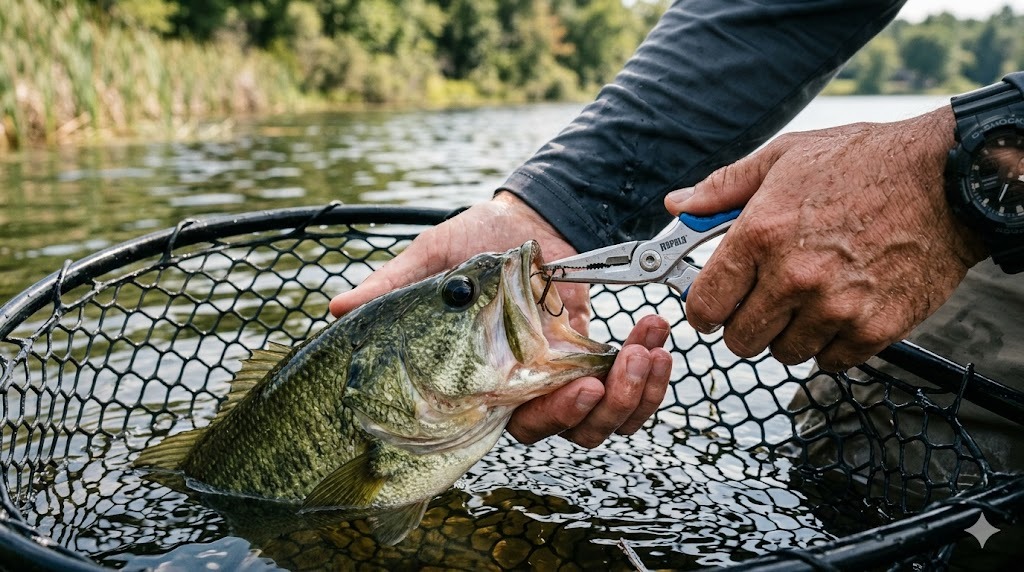
Hook removal is where most fish injuries happen during catch and release. Fumbling for the hook with bare fingers, prying with the wrong tool, or pulling the fish too hard kills more fish than the hookset itself. The right tool - pliers or forceps - removes the hook fast, protects the fish, and keeps your fingers off treble points and gill plates.
This guide explains when pliers win, when forceps win, the best models in each category, and the dehooking techniques that get you back to fishing in seconds.
The Core Difference
Pliers are robust, multi-purpose tools with cutting jaws, split-ring openers, and a strong grip. They handle big hooks, crimps, leaders, and even cutting through wire and braid.
Forceps (sometimes called hemostats) are slim, locking surgical tools with long thin tips. They reach deep into a fish’s mouth to grip a small hook with precision.
Most serious anglers carry both. Pliers handle heavy work; forceps handle finesse.
When to Use Pliers
Pliers excel at:
- Bass-sized and bigger hooks (2/0 and up).
- Treble hooks on crankbaits and topwaters.
- Cutting hooks that are buried deep - easier to cut and back out than wrestle.
- Crimping sleeves for leaders.
- Cutting braid, mono, and even light wire leaders.
- Opening split rings to change hooks.
- Saltwater applications where corrosion resistance and strength matter.
If a largemouth bass has a treble hook in its mouth, pliers give you the leverage and grip to remove it without spinning the trebles into your hand or the fish’s gills.
When to Use Forceps
Forceps excel at:
- Trout and panfish hooks (often #14 to #6).
- Small finesse hooks like the drop-shot, ned, and shaky head rigs covered in our fishing techniques library.
- Deep hooks in a fish’s throat where a slim shaft is needed.
- Locking grip that holds the hook while you work without crushing.
- Fly fishing - the standard trout-removal tool.
- Removing hooks from your own clothing, hat, or skin in a pinch.
Forceps’ locking mechanism is the key feature. Clamp on the hook eye or shank, lock, and back the hook out without re-gripping.
Top Fishing Pliers
Boomerang Tool Snip / Boomerang Pliers
Tethered to a retractable reel, with built-in cutters. Light and compact, great for kayak and wading anglers.
Bubba Blade Aluminum Pliers
Aluminum frame with replaceable tungsten cutters. Strong, corrosion-resistant, excellent for inshore and offshore fishing. $40-70.
Van Staal Aluminum Pliers
Premium pliers built for hard saltwater use. Bombproof construction, smooth action. $200+.
Piscifun Aluminum Fishing Pliers
Budget winner. Aluminum, decent cutters, lanyard-ready. $20-30.
KastKing Cutthroat 7” Pliers
Long-nosed for reaching into bass mouths. Tungsten cutters. Mid-priced and tough.
Donny Boy
A heavier-duty option with cutters that cut through 4/0 hooks like wire - useful for heavy saltwater fishing.
Top Fishing Forceps
Dr. Slick Mitten Scissor Clamp
Combination forceps + scissor in one tool. The fly angler’s standard. $15-25.
Loon Outdoors Rogue Quickdraw Forceps
Quick-release squeeze design, replaces the traditional lock-ring. Fast and intuitive.
Hareline Standard Forceps
Stainless steel, basic, reliable, cheap. $5-15.
Smith Creek Rod Clip & Forceps
Tethered forceps that clip to the fly rod. No fumbling for them mid-fish.
Orvis Comfy Grip Forceps
Comfortable padded handles, smooth lock. Mid-priced.
Dehooking Technique with Pliers
- Wet your hands and the fish before handling.
- Keep the fish in or just above the water if possible. Use a rubber-mesh net.
- Identify the hook location - lip, jaw, throat, treble.
- For a single hook in the lip: grip the hook shank with pliers, twist and back the hook out the way it went in.
- For trebles: grip one hook at a time. Twist the treble back out, or use the leverage of the pliers to work each point free.
- For deep or buried hooks in a fish being released: cut the hook with the cutters and back the pieces out, or cut the leader and leave the hook if it’s a non-stainless hook in a fish that will release it on its own.
- Support the fish while you work, especially for bigger or pregnant fish.
Dehooking Technique with Forceps
- Get the fish in the net or controlled position.
- Open the forceps and clamp on the hook bend or eye, depending on access.
- Lock the forceps closed.
- Twist and back out in the opposite direction the hook went in. For a deep hook, push the fly slightly forward first to free the barb, then back out.
- Release by squeezing the forceps to unlock.
The locking grip is the trick - you can let go of the forceps to use both hands on the fish if needed, and the forceps stay clamped.
Pinch Your Barbs
The single biggest improvement to dehooking speed is pinching barbs flat with pliers before fishing. Barbless hooks come out in seconds with minimal injury. Hook penetration is actually slightly better with barbless hooks (less metal to push through). Fish retention is barely affected if you keep tension on the line.
Hook Removers for Deep Hooks
For deeply hooked fish (often a problem with bait fishing), specialized dehookers reach far down the throat:
- ARC Dehooker - Plastic shaft with a hook-grabbing tip. Slides down the leader to the hook.
- Baker Dehooker - Industry-standard saltwater dehooker for offshore and inshore.
- Hookout / Disgorger - Simple slim tool for small freshwater fish.
For fish that swallowed the hook and won’t release intact, cut the leader at the corner of the mouth - the hook will rust out and the fish has the best survival chance.
Lanyards and Tethers
Both pliers and forceps need a tether. Coiled lanyards, retractable Boomerang reels, or magnetic patches keep tools accessible and prevent the inevitable drop overboard. A $40 set of pliers gone over the side ruins a trip.
FAQ
Can I use regular hardware-store pliers? You can, but they rust fast, lack the right tip shape for hook removal, and the cutters won’t go through hardened hook wire cleanly. Dedicated fishing pliers are worth it.
Do I really need both pliers and forceps? For bass and bigger species, pliers alone work. For trout and panfish, forceps alone work. If you fish multiple species or fly fish and gear fish, carry both.
What cuts hook wire best? Tungsten carbide cutters cut through hooks reliably; lesser cutters dull fast on heavy hooks. Quality pliers like Van Staal, Bubba, and Donny Boy excel.
How do I prevent fishing pliers from rusting? Rinse with fresh water after every saltwater trip, dry, lubricate the pivot. Anodized aluminum and titanium pliers resist corrosion best.
Is it bad to leave a hook in a fish that swallowed it? For deeply hooked released fish, cutting the leader at the mouth and leaving the hook gives the fish the best survival chance. Most non-stainless hooks dissolve in 1-3 weeks.
Conclusion
The right hook-removal tool keeps fish alive, your hands intact, and your fishing time productive. Carry quality pliers for bass, saltwater, and treble hooks; carry locking forceps for trout, panfish, and finesse hooks. Pinch your barbs. Use a tether. With the right tool and technique, hook removal becomes a 5-second process that releases fish in better shape than catching them did.
🛒 Recommended Gear on Amazon
- Aluminum fishing pliers - browse current options and reviews on Amazon.
- Fishing forceps - browse current options and reviews on Amazon.
- Split ring pliers - browse current options and reviews on Amazon.
As an Amazon Associate, we earn from qualifying purchases - at no extra cost to you. This helps us keep producing free, in-depth guides.