Underwater Fishing Cameras Compared
What an underwater fishing camera does that sonar cannot, the kinds on sale, what to compare on the makers' specification sheets, and how to use one through the ice, from a boat or off a dock.
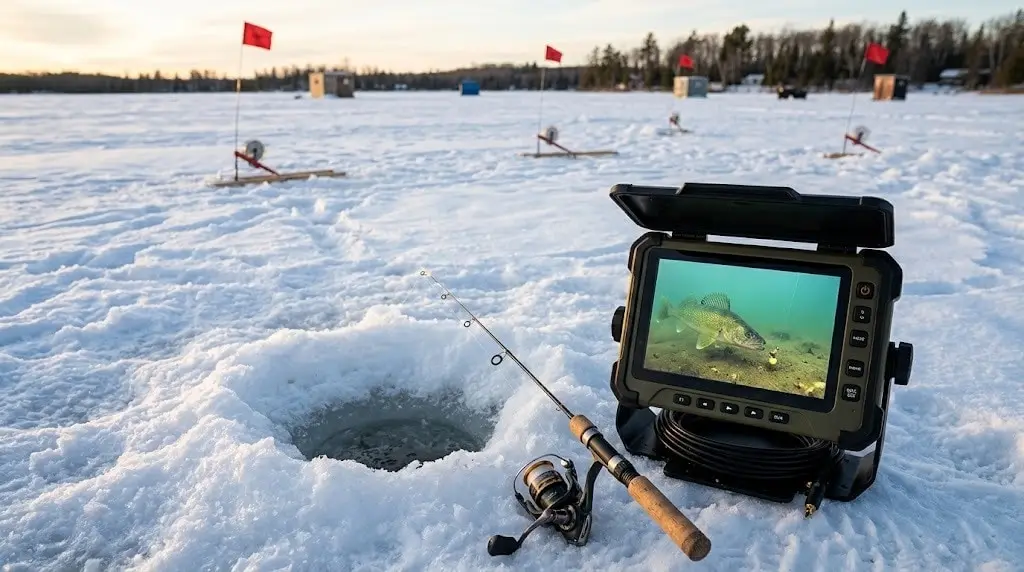
An underwater fishing camera puts a live picture of the water beneath your boat or your ice hole onto a screen beside you. It answers the questions sonar cannot: which species that mark is, what the structure really looks like, how fish react to your lure.
We have not tested these cameras, so this page ranks none and quotes no prices. It explains the kinds on sale, what to compare, and how to use one.
What Underwater Cameras Do
A small waterproof camera hangs on a cable and sends video to a screen at the surface.
Uses
- Ice fishing - see your jig, watch fish approach, time the strike.
- Vertical fishing in open water - drop-shotting, jigging and other close-quarters techniques.
- Scouting structure - look at brush piles, rock and dock pilings.
- Species identification - is that mark on the sonar a walleye or a sucker?
- Dock and pier fishing - lower the camera under the dock to see what is there.
- Curiosity - see what actually lives in your lake.
Limits
- A camera sees only a short distance, and far less in stained water. In muddy water it is useless.
- It does not search. Sonar covers water; a camera confirms what the sonar found.
- It is a stationary tool, for fishing under the boat or the hole, not for casting.
The Kinds on Sale
Cable camera with its own screen. The standard design: camera, cable, and a monitor with a battery, in a case or on a mount. Sold in a wide range of screen sizes and cable lengths.
Compact handheld units. A small screen you can hold or pocket, favoured by ice anglers who move from hole to hole.
Units with recording. Some monitors record to a memory card; with others, anglers simply film the screen with a phone.
Line-mounted cameras. A different thing altogether: a small camera that rides on your line and records for viewing afterwards. There is no live picture.
Not a camera: live sonar. Forward-facing live sonar is often mentioned in the same breath, but it is sonar - it draws a moving sonar image, not video.
Who Makes Them
The category was shaped by specialists in ice-fishing electronics. Aqua-Vu, which began in Brainerd, Minnesota in 1997, is the name most closely tied to it; Marcum, known for ice sonar, sells camera systems too. Alongside them are many low-priced units from marketplace brands. The usual trade-off is the one you would expect - price against build, support and how readable the screen is in sunlight - but we have not measured it, so compare for yourself.
What to Compare
Read the makers’ specification sheets for:
- Screen - size, and whether it is described as readable in daylight. On ice in sun, this matters more than resolution.
- Cable length - enough for the deepest water you fish. Longer cable is bulkier to manage.
- Lighting - infrared or white LEDs for dark water, and whether they can be dimmed or switched off.
- Battery - type, stated running time, and how it copes with cold.
- Recording - built in or not.
- Saltwater rating - if you fish the coast, check that the maker rates the camera for salt water.
- Warranty and service in your country.
Using a Camera
Set the depth and the angle
Hang the camera a little above the bottom, looking sideways, so that structure and approaching fish are seen from the side.
Put the bait in view
Lower your jig into the camera’s field of view, and you can watch fish come in and react.
Go easy on the lights
Lights help in dark water. Some anglers find fish shy away from them; if your unit lets you turn them down or off, try both.
Let it settle
A twisting cable spins the camera. Give it time to settle, or use the fin or weight the maker supplies.
Watch and learn
The lasting value is what you learn about how fish respond - to lift speed, to colour, to the size of the bait.
When Not to Use One
- Murky water - there is nothing to see.
- Searching - find the area with sonar first.
- Tournaments - rules on electronics differ; read them before the event.
FAQ
Are underwater cameras as useful as fish finders? They do different jobs. Sonar covers an area; a camera shows you what is there. Many anglers use both.
Will a camera scare fish? Sometimes, at first: lights and sudden movement can put fish off. We know of no controlled test to cite, so try your own camera with the lights on and off.
Can I use an underwater camera in saltwater? Only if the maker rates it for salt water. Rinse it with fresh water after every use.
What cable length should I choose? Enough for the deepest water you fish, with some to spare. Longer than you need is more to wind in.
Is a premium camera worth several times the price of a budget one? That depends on how often you use it and in what conditions. Compare the specifications listed above, and the warranty, and buy from a seller who will take it back.
Conclusion
A camera does not find fish; it shows you the fish and the bottom you have already found. Choose by screen, cable, battery and service, and use it to learn how fish behave around your bait.
Recommended Gear on Amazon
- Underwater fishing cameras - browse current options and reviews on Amazon.
- High-endurance micro SD card - browse current options and reviews on Amazon.
- 12V lithium battery - browse current options and reviews on Amazon.
As an Amazon Associate, we earn from qualifying purchases - at no extra cost to you. This helps us keep producing free, in-depth guides.