Fly Lines, Explained
In fly fishing the LINE is the casting weight - taper, weight number and density define everything. Decode WF-5-F and the floating/sinking system in one sitting.
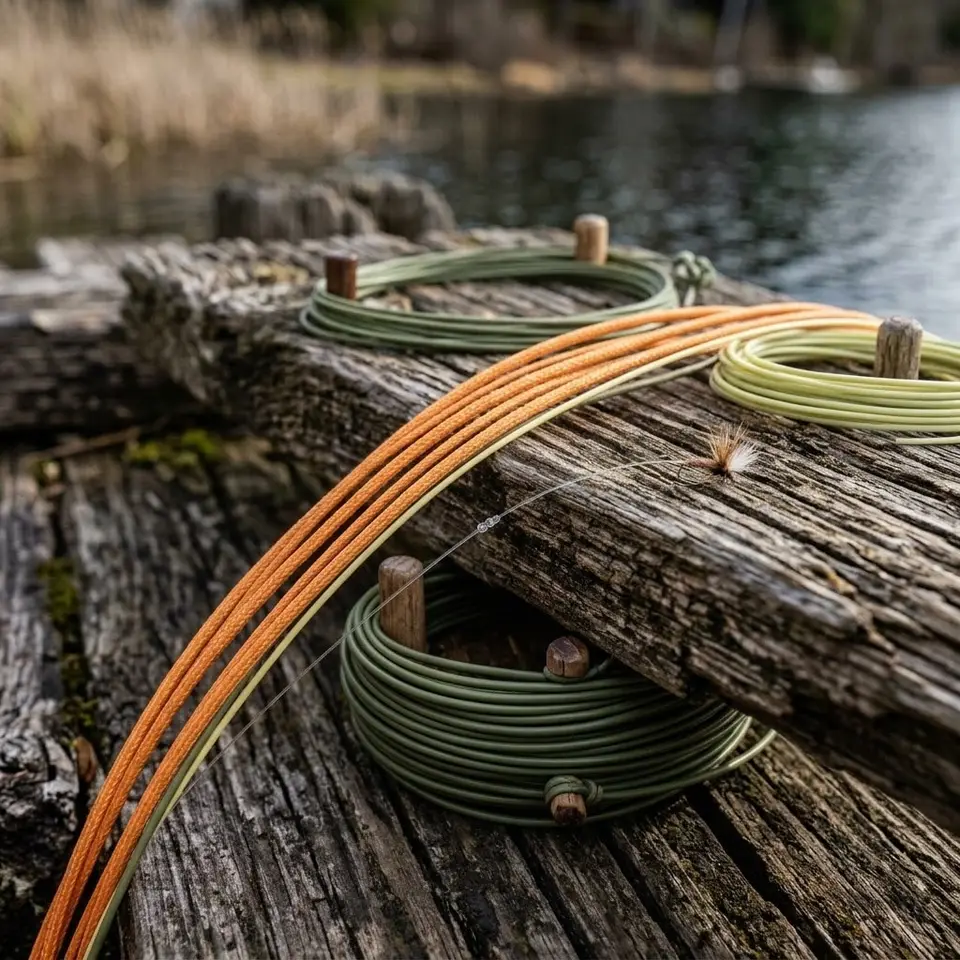
Every other line in this catalog just connects angler to lure - a fly line IS the lure delivery system, its own mass carrying a weightless fly outward. That's why fly lines are engineered like javelins: weighed in standardized numbers (3wt to 12wt+), shaped in tapers (weight-forward, double-taper), and built in densities from full-floating to fast-sinking tips. Decode the box code - 'WF-5-F' - and the entire wall of options collapses into sense.
What it is
A ~27 m tapered PVC- or polymer-coated line whose FIRST 9 meters carry a standardized weight matching rod numbers. Box code = taper-weight-density: WF-5-F is Weight-Forward taper, 5-weight, Floating. Backing behind it, leader and tippet ahead.
Strengths
Casts the uncastable (a size-20 dry fly at 18 m); tapers put energy where you want it - WF for distance and ease, DT for delicacy and roll casts; density options present flies from surface film to 6 m down (sink-tips, full sinkers).
Weaknesses
Costs more than every other line type; wrong-weight pairing ruins a rod's feel entirely; coatings crack with neglect (clean and dress them); one line = one job, so specialization multiplies spools.
Where it wins
This is fly fishing's entire delivery system - the question isn't where it wins but WHICH one: floating WF for 90% of trout work, sink-tips for streamers, heavier weights as wind and fly size grow, specialized heads for spey and salt.
Six Floating Trout Lines in 4 to 6 Weight
The six lines below are all floating trout lines in the 4 to 6 weight range. Each is described from its maker's product page, checked on 26 October 2026; the grain figure is the weight of the first 30 feet, as the makers list it. We have not cast them against one another, and there are no prices here: the Amazon link searches for the exact product, and we may earn a commission if you buy through it.
| Line | Taper | Weights | Head / total length | First 30 ft (4 / 5 / 6 wt) |
|---|---|---|---|---|
| Scientific Anglers Frequency MPX | Weight forward, half a size heavy | WF-3 to WF-7 | 34-38 ft / 85 ft (4-6 wt) | 130 / 150 / 175 gr |
| Scientific Anglers Frequency Double Taper | Double taper | DT-3 to DT-6 | - / 85 ft | 120 / 140 / 160 gr |
| Scientific Anglers Amplitude Smooth Creek Trout | Short-head weight forward | WF-2 to WF-6 | 23-25 ft / 90 ft (4-6 wt) | 140 / 160 / 185 gr |
| Scientific Anglers Air Cel Trout | Weight forward | 5-6 only | 40 ft / 80 ft | 150 gr (5-6 wt) |
| Cortland 333 Trout All Purpose | Weight forward | WF3 to WF10 | - / 90 ft | not listed |
| RIO Fly Line Kit, Stream/Creek | Mainstream line in a kit | 3 and 4 wt | not listed | not listed |
- Scientific Anglers Frequency MPX: an all-round floating trout line, built half a size heavy with more mass toward the front of the head; SA says the emphasis is on presentation. Maker's page · See on Amazon
- Scientific Anglers Frequency Double Taper: SA's trout taper with a mid-length head that it calls ideal for delicate dries, with line control for nymph rigs. Maker's page · See on Amazon
- Scientific Anglers Amplitude Smooth Creek Trout: a short-head line for small creeks, with mass up front for turning over weighted flies and roll casting at short to medium range. Maker's page · See on Amazon
- Scientific Anglers Air Cel Trout: SA's simple, no-frills weight-forward floating line for dries, nymphs and streamers, made in one 5-6 weight size. Maker's page · See on Amazon
- Cortland 333 Trout All Purpose: a durable, high-floating weight-forward line for medium- to fast-action graphite rods; Cortland says the original 333 was the first modern PVC fly line, over 50 years ago. Maker's page · See on Amazon
- RIO Fly Line Kit, Stream/Creek: a 3 or 4 weight floating Mainstream line with backing, a Powerflex leader and a step-by-step rigging guide. Maker's page · See on Amazon
Knots & handling
Modern lines come with welded loops - loop-to-loop the leader on. Backing attaches via arbor + Albright (or loop). Stretch a coiled line gently before fishing, and clean floaters with mild soap when they start sinking at the tip: that's dirt, not death.
What costs you fish
Mismatching line and rod weight (the #1 'this rod casts terribly' cause), buying bargain line for a good rod (backwards - the line does the work), and letting a cracked, sinking 'floating' line ruin seasons a simple cleaning would have saved.
Line locker
As an Amazon Associate we may earn from qualifying purchases - at no extra cost to you. We link gear types, not sponsors' picks: you choose the exact product.