Bass Fishing in Lily Pads
Lily pads are the most reliable bass cover in summer - but they also chew tackle, twist line, and lose fish if you fish them wrong. Here is how to attack pads with confidence…
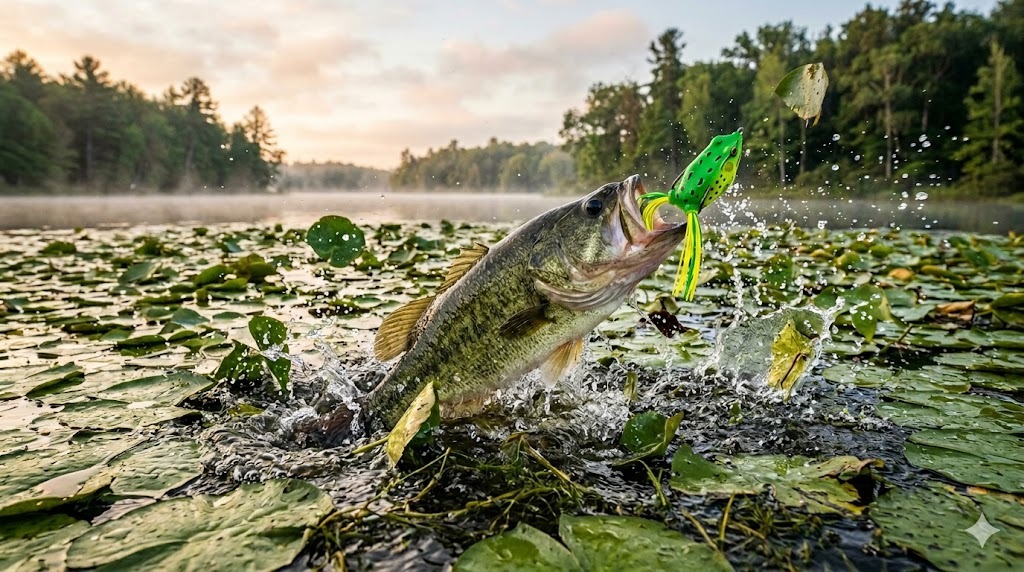
Lily pads are the most reliable cover for largemouth bass in summer. They provide shade, oxygen, ambush points, and a food chain from bluegill fry to frogs to crayfish. Big bass live in pads from late spring through fall, and the explosive blowups on a frog walked across a pad field are among the most addictive moments in freshwater fishing.
But pads also chew tackle, twist line, and lose fish if you fish them wrong. This guide covers the three core pad techniques - topwater frogs, punching, and weedless soft plastics - plus the gear, hooks, and approach that turn lily pads into your favorite summer pattern. For a broader look at presentations beyond the pads, browse our full library of fishing techniques.
Why Bass Live in Pads
Lily pads create a complete bass habitat:
- Shade keeps water cooler beneath the canopy.
- Oxygen from photosynthesis is high during the day.
- Cover from sun and predators.
- Bait - bluegill, small bass, frogs, dragonflies, snails, and crayfish all live in pads.
- Ambush points - bass position under the canopy and explode on prey crossing above.
Bass in pads are usually active, feeding, and willing to commit if you put the right bait in front of them.
Reading a Pad Field
Not all pads are equal. Look for:
- Edges where pads meet open water, deeper channels, or cuts.
- Holes in the canopy where bass can see up.
- Mixed cover - pads with hydrilla, milfoil, or wood underneath.
- Isolated clumps away from main pad fields - often hold big solitary fish.
- Points and indentations in the pad line.
- Inflow areas where current touches the pads.
Sun position matters: bass typically hold on the shaded side of pad clumps and edges.
Technique 1: Hollow-Body Frogs
The classic and most exciting pad technique. A hollow-body frog walks across the canopy, drawing bass up through the pads.
Frog Selection
- Walking frogs (Spro Bronzeye, Booyah Pad Crasher, Stanford Big Sexy Frog) - slide side to side across pads.
- Popping frogs (Spro Bronzeye Popper, Lunkerhunt Popping Frog) - splash and chug in open holes.
- Color - natural green/brown for clear water, white/black for low light or visibility, yellow/chartreuse bellies for stained water.
Frog Gear
- Rod: 7’4” to 7’8” heavy fast casting rod with strong backbone and a tip that loads on a cast.
- Reel: High-speed casting reel (8.1:1+) to pick up slack fast on the hookset.
- Line: 50-65 lb braid - no fluorocarbon, no leader. Pads will saw through anything weaker.
Technique
- Cast across pad fields, not just to the edges.
- Walk the frog with rhythmic twitches; pause in holes and on edges.
- When a bass blows up, do NOT set immediately. Wait until you feel the weight of the fish loading on the line, then drive a hard hookset and reel hard. Setting too early on a missed strike yanks the frog away.
- Once hooked, keep the rod high and pull the fish across the pads to open water.
A frog rod and 65 lb braid is non-negotiable. Mediocre gear costs you fish.
Technique 2: Punching
Punching drives a heavy soft plastic through the pad canopy into the dark water below, where the biggest bass often live during midday.
Punching Gear
- Rod: 7’6” to 8’ extra-heavy flipping/punching rod (Dobyns Champion 806, Falcon Rods Cara, Powell Inferno).
- Reel: High-gear casting reel with strong drag, 8:1+ ratio.
- Line: 50-80 lb braid.
- Weight: 1 to 2 oz tungsten punch weight, pegged with a bobber stopper.
- Hook: 4/0-5/0 heavy straight-shank or punch hook (Owner Jungle Flippin’, Gamakatsu Heavy Cover Flipping).
- Punch skirt (optional) above the bait for added flair and bulk.
Punching Baits
- Reaction Innovations Sweet Beaver
- Missile Baits D Bomb
- Strike King Rage Bug or Rage Craw
- Yamamoto Flappin’ Hog
Black/blue, green pumpkin, and watermelon red are reliable colors.
Technique
- Pitch or flip the rig over thick pad clumps or vegetation mats.
- Let the heavy weight punch through the canopy to the bottom.
- Lift, shake, and drop the bait 2-3 times.
- If no strike, pull out and pitch again to a fresh spot.
- When the line jumps or feels heavy, set the hook hard - these bass eat in the dark and commit fully.
Punching is intense, close-range, and produces giants.
Technique 3: Weedless Soft Plastics
For finesse situations or pressured pads, a weightless or lightly weighted soft plastic worked through pad edges is deadly.
Bait Options
- Senko or stick worm (Yamamoto Senko, Yum Dinger) - Texas-rigged weightless, twitched along edges and open lanes.
- Toad/buzzbait (Zoom Horny Toad, Stanley Ribbit) - buzzed across pad surfaces like a frog but cheaper and faster.
- Swim jig with a chunk trailer worked through pad edges.
Technique
Work the bait slowly through open holes and edges. Pause near pad stems. Strikes are often subtle pickups rather than explosions - feel for weight and set on any tick.
Hookset and Landing
The hookset in pads is unforgiving. Use heavy braid, sharp hooks, and a powerful sweeping or overhead set. Once hooked, never give a bass slack - they will wrap line in stems and break off.
Bring the fish to the boat over the top of the canopy, sliding it across pads. A long-handled net helps for big fish.
Time of Day
- Morning and evening - Frog bites peak; bass cruise edges and open holes.
- Midday - Punching takes over as bass push deep into the thickest cover.
- Cloudy days - All-day frog bite often possible.
- Bluebird sun - Tighter to cover, punching produces.
FAQ
Why do I miss so many frog blowups? Most miss because of setting too early. Wait until you feel the fish, then set. Use high-vis braid to see the line move and confirm a fish has it.
Do I really need 65 lb braid? Yes. Pad stems and the pulling required to land a bass through cover eats anything lighter. Heavy braid also keeps your hook sharper through fewer breakoffs.
Why won’t bass commit to my frog? Try a smaller frog, switch to a popping frog in calm water, or vary cadence. Stained water often calls for white or chartreuse; clear water for natural colors.
Should I trim frog legs? Many anglers trim rubber legs by half to get a tighter walking action and fewer short strikes.
What time of year is best for pad fishing? From the time pads emerge in late spring through fall die-off. Peak is mid-summer to early fall.
Conclusion
Lily pads concentrate bass like few other types of cover. Master three techniques - walking a hollow-body frog, punching heavy soft plastics, and finesse worming the edges - and you will catch fish all summer long. Use the right rod, heavy braid, and a disciplined hookset. The blowup on a frog walked across a pad field never gets old, and the fight that follows is unlike anything else in bass fishing.
🛒 Recommended Gear on Amazon
- Hollow-body frog lures - browse current options and reviews on Amazon.
- 50 lb braided line - browse current options and reviews on Amazon.
- Heavy flipping hooks - browse current options and reviews on Amazon.
As an Amazon Associate, we earn from qualifying purchases - at no extra cost to you. This helps us keep producing free, in-depth guides.