Carp Fishing for Beginners
Common carp are big, strong and often overlooked. Where they live and feed, the baits they take, the hair rig and boilies that European carp anglers use, and how to land and release them, following the Missouri Department of Conservation and Wikipedia.
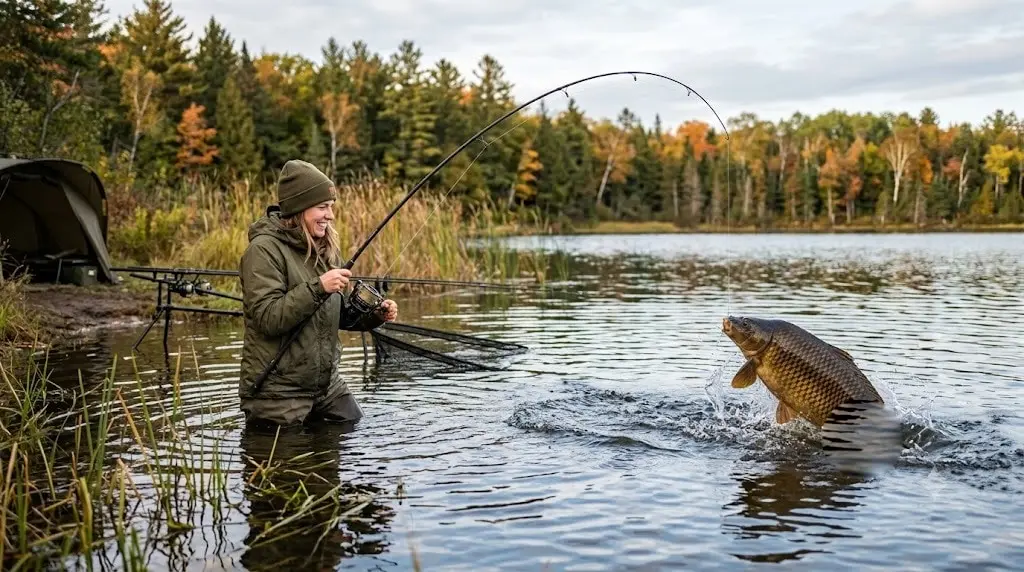
Common carp are big, strong and overlooked by many North American anglers. The Missouri Department of Conservation (MDC) says carp can put up a fight equal to that of any game fish of similar size, and that their sporting qualities should be more widely recognised. This guide covers where they live, what they eat, the baits and rigs used for them, and handling, following MDC’s field guide and Wikipedia; our carp fishing hub has more.
About common carp
MDC’s field guide:
- Size: usually 12-25 inches long and 1-8 pounds; one Missouri carp weighed 47 pounds.
- Origin: a native of Asia, introduced to Europe centuries ago and brought to America as early as 1831; nonnative but now one of the most widespread and abundant large fish in Missouri.
- Habitat: highly adaptable, but least abundant in clear, fast streams; most abundant in big rivers, prairie streams and lowlands.
- Feeding: omnivores, with aquatic insects the most important food. They feed mostly from the bottom but also suck in floating objects, and feeding peaks in late evening or early morning, sometimes in very shallow water. MDC says they probably locate food more by taste than by sight.
- Spawning: mostly March to June, with no nest and no parental care.
Finding carp
- Fish the edges of the day: feeding peaks in late evening and early morning (MDC).
- Look shallow: carp sometimes feed in very shallow water (MDC).
Baits
- MDC: carp can be taken on a variety of baits, including dough balls, whole kernel corn and worms. Its bait guide adds that carp usually do not strike artificial baits.
- Wikipedia: carp anglers use boilies, sweet corn, maggots and bread.
- Boilies: Wikipedia describes boilies as hard, round baits made from a boiled paste (typically fishmeals, milk proteins, bird foods, semolina and soya flour bound with egg) that diffuse slowly in water. They come in sizes from about 8 mm to 40 mm, and buoyant “pop-ups” float the bait just off a weedy or silty bottom.
The hair rig
Wikipedia describes the hair rig as a method of presenting a bait without it sitting directly on the hook. It is mainly associated with boilies, became popular in the 1980s, and was the joint invention of Len Middleton and Kevin Maddocks; Wikipedia says it revolutionised carp fishing. The bait is threaded onto a short “hair” of line that hangs from the hook, often tied with a knotless knot, so it can behave more naturally in the water. Wikipedia also lists many other carp rigs, from pop-up and stiff rigs to bolt, chod and helicopter rigs.
If you want to bait a spot with free offerings, check first that it is allowed on your water.
Tackle
Carp are strong, so use tackle matched to the fish you expect: a sturdy rod, line strong enough for big fish, and a landing net large enough for them. Our fishing techniques section covers bottom rigs.
Landing and releasing carp
- Let the fish run on the drag rather than forcing it; keep the rod high (MDC’s general fishing tips).
- Lead the fish into the net and lift firmly (MDC).
- Releasing: NOAA Fisheries advises handling fish as little as possible and only with wet hands, keeping air exposure under a minute, and supporting the fish’s weight along its body.
FAQ
Are carp nonnative, and should I keep them? MDC describes the common carp as nonnative but long established, and notes that many people eat carp. Rules on keeping carp vary, so check yours.
Do carp really eat sweetcorn? Yes: MDC lists whole kernel corn, and Wikipedia sweet corn, among carp baits.
Do carp take lures? MDC’s bait guide says carp usually do not strike artificial baits.
Conclusion
Carp are big, strong and widespread. Fish the edges of the day with corn, dough or worms, or try a hair-rigged boilie, and handle them gently if they’re going back.
Sources
- Missouri Department of Conservation, field guide Common carp; fishing Bait and lures and Fishing tips. Read 28 October 2026.
- Wikipedia, Carp fishing, Hair rig and Boilie. Read 28 October 2026.
- NOAA Fisheries, Catch and Release Best Practices. Read 28 October 2026.
Recommended Gear on Amazon
- Carp boilies - browse current options and reviews on Amazon.
- Carp hair rigs - browse current options and reviews on Amazon.
- Large landing net - browse current options and reviews on Amazon.
As an Amazon Associate, we earn from qualifying purchases - at no extra cost to you. This helps us keep producing free, in-depth guides.