Tackle Organizers Compared
Standard trays, heavy-duty sealed boxes or soft bags: how the three ways of organizing tackle compare, what to look at when buying, and layouts for bank, kayak, boat and saltwater fishing.
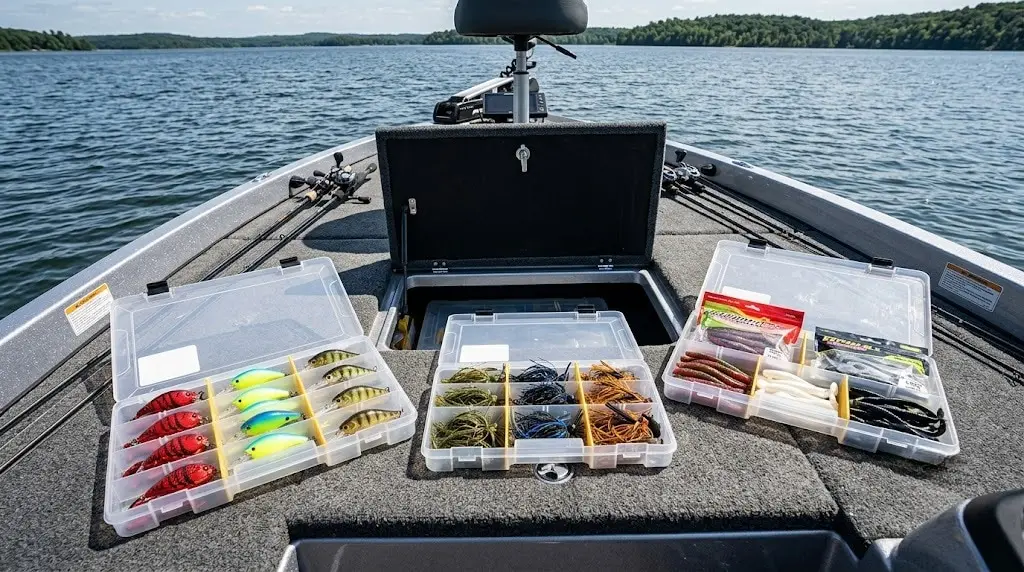
There are three ways to organize tackle: standard plastic trays, heavy-duty sealed boxes, and soft bags loaded with trays. For most anglers, a handful of standard trays in one soft bag does the job.
A disorganized tackle bag costs you casts. Lost lures, tangled rigs, broken plastics, and corroded hooks all trace back to bad storage. The right system saves money, time, and fish - when you can find the right bait fast and trust that it’s in fishable condition, you fish more confidently and more efficiently.
This guide compares the three approaches - standard trays, heavy-duty boxes and soft bag systems - and suggests layouts for different kinds of fishing.
What Tackle Organization Actually Solves
- Fast access - Finding a lure in 5 seconds instead of 5 minutes during a hot bite.
- Protection - Hooks stay sharp, plastics don’t melt onto hardbaits, paint stays on cranks.
- Inventory - You see what you have and what you’re out of.
- Mobility - Compact systems move easily between boats, kayaks, and shore trips.
- Modularity - Swap trays for different trips or species.
The Three Main Systems
Standard Trays
Hard plastic trays in standardized sizes that stack inside soft bags or boat lockers.
- Pros: Cheap, durable enough, modular, widely available, fit nearly every tackle bag.
- Cons: Hinges and latches wear, and basic trays are not sealed against water.
- Best for: Most anglers, most budgets. Solid baseline.
Heavy-Duty Sealed Boxes
Thick-walled hard boxes with rubber seals and beefy latches.
- Pros: Much tougher than a standard tray, sealed against water, heavy-duty hinges.
- Cons: Several times the price of a standard tray. Heavier. Larger overall.
- Best for: Tournament anglers, saltwater, and anyone who keeps crushing lids.
Soft Bags (Loaded with Trays)
Padded soft bags with internal pockets for hardshell trays.
- Pros: Mobile. Multiple trays per bag. Shoulder strap. Extra pockets for tools and accessories.
- Cons: Not protective on their own - the trays inside provide protection.
- Best for: Mobile anglers, kayak fishing, traveling.
Choosing Trays and Boxes
We have not tested boxes against one another, so there is no ranking here and there are no prices - only what to look at.
Tray size. Plano’s tray codes have become the common language of tackle storage, and bags from many makers are sold by the code they take. Plano’s own range runs 3400 (extra small), 3500 (small), 3600 (medium) and 3700 (large), with thin and deep versions of the larger sizes. Pick one size and stay with it, so that every tray fits every bag and locker you own; the 3700 and the 3600 are the two most bags are built around.
Dividers. Adjustable dividers let one tray hold crankbaits this month and jig heads the next. Check that they sit tight - small hooks migrate under loose dividers.
Latches. A tray that pops open inside a bag empties itself. Positive, snap-shut latches are worth a little more, above all for travel.
Seals. Trays with a gasket keep spray and rain out and are the ones to choose for saltwater, kayaks and open boats. A waterproof claim is the maker’s own - read what it actually covers.
Rust protection. Some trays are sold with a rust-inhibiting lining or insert. It helps only if the baits go in dry.
Heavy-duty boxes. Thick-walled boxes with rubber seals and big latches cost several times as much as a basic tray. They earn it where boxes get stood on, soaked or flown; for a shelf in the garage they are more than you need.
Soft bags. A bag is a carrying system, not protection - the trays inside do that. Look at how many trays it takes and in which size, the zips, the shoulder strap, and whether the base is waterproof.
Building a System by Fishing Style
Bank/Walking Angler
- One soft bag with 3-4 trays.
- One tray each: hard baits, soft plastics, terminal tackle, tools/misc.
- Shoulder-carry, hands free.
Kayak Angler
- One waterproof crate or soft bag mounted in tankwell.
- 3-4 trays + tool pockets + leader spools.
- Dry box for phone/wallet.
Bass Boat (Single-Boat Setup)
- 6-10 large trays organized by technique.
- One tray per: crankbaits, jigs, soft plastics by color, topwater, terminal, swimbaits, etc.
- Stored in boat lockers labeled or color-coded.
Tournament Angler
- Sealed heavy-duty boxes for the baits that matter most.
- Standard trays for bulk and seasonal storage.
- Inventory list printed or tagged inside.
Saltwater Inshore
- Gasketed trays or sealed boxes.
- Rinse after every trip.
Organization Strategies
By Technique
- Crankbaits in one tray, jigs in another, frogs in another. Easy to grab the right box for a pattern, and it pairs naturally with the way you break down different fishing techniques on the water.
By Color / Size
- All chartreuse baits together, all black/blue baits together. Useful when color matters more than profile.
By Trip
- Pre-pack a tray for each trip: smallmouth, bass spawn, surf fishing. Saves prep time.
By Confidence
- Top-shelf “A-team” baits in their own box that’s always grabbed first.
Where People Go Wrong
- Mixing soft plastics with hardbaits in the same tray - soft plastics can mar the paint on hardbaits. Keep them separate.
- Leaving hooks in damp trays - they rust. Dry trays before storing wet baits.
- Buying too many sizes - Standardize on one tray size for compatibility.
- Not labeling trays - Adds digging to every session. Label the fronts with a marker or a sticker.
- Over-stuffing - Lures rattle together, paint chips, hooks tangle.
Hooks, Weights, and Terminal Tackle
Small parts deserve dedicated storage:
- Hook organizers keep different hook styles and sizes separate.
- Weight cases keep tungsten and lead weights organized.
- Swivel/snap boxes - tiny compartment trays.
A single large tray with internal dividers handles all of this if you want one tray instead of many.
Soft Plastic Storage
- Original bags (with stickers/zip-locks) preserve color and prevent leaching.
- Soft plastic binders hold many bags upright in one organizer.
- Trays: Avoid mixing colors. Black/blue and chartreuse will bleed onto each other.
Maintenance
- End of season: Empty trays, rinse with fresh water, dry completely. Sharpen hooks, replace rusted ones.
- Saltwater trips: Rinse boxes and trays after every trip.
- Annual purge: Get rid of broken baits, tangled lines, dead batteries.
FAQ
Are expensive tackle boxes worth it? For tournament anglers, saltwater anglers, and people who keep crushing lids, they can be. For casual anglers, standard trays last for years and cost a fraction.
How many tackle boxes do I need? A casual angler does fine with 3-4 trays in one soft bag. A keen bass angler with a boat will fill several times that.
Do soft baits really melt hard baits? They can: soft plastic baits left in contact with painted hard baits are known to mar the finish. Keep them apart.
Standard trays or sealed boxes for kayaks? Sealed boxes or gasketed trays if you can afford them - a kayak is a wet place. Standard trays are fine in a dry hatch.
Best tackle bag for boat use? One that takes the tray size you have standardized on, with a waterproof base. Beyond that, choose by how many trays you carry.
Conclusion
Tackle organization is the unsexy fundamental that separates “fishing more” from “fishing better.” Standardize on one tray size, pick the box quality your budget and use case demand, and organize by technique or color. Keep hard baits and soft baits apart. Label everything. Maintain your system at season’s end. A well-organized tackle setup pays back every trip - and saves you the slow-motion frustration of watching a hot bite die while you dig for the right lure.
Recommended Gear on Amazon
- 3600 tackle trays - browse current options and reviews on Amazon.
- Fishing tackle backpack - browse current options and reviews on Amazon.
- Terminal tackle organizer - browse current options and reviews on Amazon.
As an Amazon Associate, we earn from qualifying purchases - at no extra cost to you. This helps us keep producing free, in-depth guides.