Tournament Prep: Gear List, Pre-Fish, Mindset
Tournament fishing rewards preparation more than any other discipline. Days are won on Sunday by anglers who prepared Monday through Saturday - gear ready, lake scouted, mental game…
Tournament fishing rewards preparation more than any other discipline. Days are won on Sunday by anglers who prepared Monday through Saturday - gear ready, lake scouted, mental game tuned. A weekend bass tournament, a national-level walleye event, or a kayak fishing event all share the same fundamentals: show up prepared, fish your game, manage time and fish, weigh in clean.
This guide covers the practical preparation that separates consistent finishers from one-day wonders - gear checklists, pre-fish strategy, tournament-day routines, and the mental discipline that fights through tough days.
The Gear List
The night before a tournament is not the time to discover a missing reel. Build a complete gear list and check it against the boat before launch.
Rods and Reels
- Pre-rig 8-12 rods for the patterns you plan to fish. Each rod purpose-built: a frog rod, a flipping stick, a Carolina rig rod, a crankbait rod, a topwater rod, etc.
- Backup setups for your two highest-confidence patterns. Break a rod, swap and keep fishing.
- Reels respooled with fresh line - fluorocarbon, braid, mono as needed for each technique.
- Drag set and tested on each reel.
Tackle
- One organized box per technique. Don’t dig through a giant tackle bag. Crankbaits in one tray, jigs in another, soft plastics in resealable bags by color and size. Matching trays to your target with the tackle-by-species reference keeps each box purpose-built.
- Confidence baits in surplus. If you crush them on a Whopper Plopper, carry 4 of them in the color you trust.
- Backup hooks, leaders, weights, swivels - the small consumables that lose tournaments when they run out.
- Pliers, line clippers, hook file, scale, measuring board.
Boat Prep
- Fuel topped off the night before.
- Batteries fully charged - starting and trolling motor.
- Livewell tested - aerator running, water pumps working, drain plug in.
- Electronics powered on and waypoints loaded.
- Anchor or Power-Pole tested.
- Trolling motor tested - spot lock function verified.
Safety and Personal
- Life jackets and kill switch lanyard - required by every tournament.
- Sunscreen, polarized glasses, rain gear, hat.
- Water and food - protein bars, sandwiches, fruit. Hydrate aggressively.
- First aid kit.
- Phone in waterproof case for emergencies (most tournaments restrict in-tournament use).
Documents
- Tournament rules - printed or saved offline.
- Fishing license - verified valid for the tournament water.
- Boat registration, insurance card.
- Lake map - gridded with your waypoints and notes.
Pre-Fish Strategy
The work before tournament day determines the day. Pre-fish is reconnaissance, not catching.
Days Out
- 1-2 weeks before: Study lake maps, recent reports, weather forecasts.
- 3-5 days before: First pre-fish day. Cover water broadly - eliminate dead areas, identify productive zones.
- 2-3 days before: Drill down on best zones, refine pattern, test specific baits.
- Day before official practice: Often a final tune-up; in tournaments with mandatory off-limits before competition, this is the day.
Pre-Fish Goals
- Identify a primary pattern - Depth, structure, bait, time.
- Identify a backup pattern - Different depth/area in case primary fails.
- Identify decision points - If conditions change, what’s the alternative?
- Mark waypoints on every fish caught - note depth, time, and conditions.
- Don’t hook them all. Many tournament anglers shake fish off or use barbless hooks during pre-fish to avoid educating the school.
What to Avoid
- Over-hooking - Educating fish in pre-fish makes them harder to catch in the tournament.
- Burning your spots - Don’t share waypoints with locals; rely on yourself.
- Settling for the first bite - Explore broadly even after catching fish.
- Ignoring weather forecasts - Pre-fish in conditions similar to tournament day if possible.
The Tournament Day Routine
Morning (Pre-Launch)
- Wake early. Allow 90+ minutes between waking and launch.
- Eat real food. A stomach full of caffeine and a Pop-Tart fails by 10 am.
- Final gear check at the truck - rods, reels, livewell plug, kill switch.
- Tournament check-in - verify boat number, blast-off position, weigh-in time.
Launch and First Hour
- Run to your spot at safe speed. The fish will be there in 5 minutes either way.
- Quietly position the boat - kill the big motor early, use the trolling motor for the last 100 yards.
- Start with your most confidence pattern. Catch a quick limit if possible.
- Cull-up if needed. Replace your smallest fish with each better fish.
Mid-Day Management
- Stick to your plan. Don’t run all over the lake chasing rumors.
- Adjust to conditions: wind direction, sun, fishing pressure, water clarity.
- Watch your competition lightly: see what areas they leave, but don’t tail them.
- Eat and hydrate every 2 hours. Tournament fatigue costs fish.
Final Hour
- Lock down the limit. Don’t go for a kicker fish at the cost of losing what you have.
- Travel time considered - Allow generous buffer to return to launch.
- Be early to check-in. Late = disqualified or penalized.
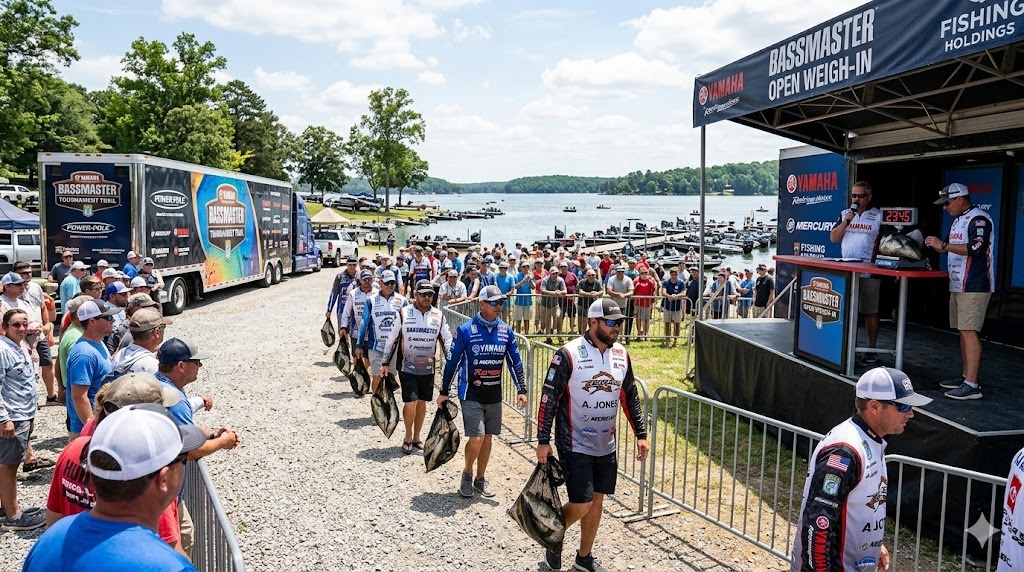
Weigh-In Protocol
- Keep fish alive. Dead fish = penalty in nearly every tournament. Aerator on, ice if hot, rejuvenator additive.
- Limit weighed once per tournament unless rules say otherwise.
- Cull bag for transport from boat to scale.
- Be respectful of weigh-in staff. They are volunteers and stressed.
- Release fish carefully at the release point - proper holds and oxygenation.
The Mental Game
Tournament fishing is a long mental grind. The angler who can grind through tough hours often wins.
Confidence
- Trust your homework. If pre-fish said the pattern worked, work it.
- Don’t change baits every cast. Give your decisions time.
Patience
- Tough days happen. Sometimes only 3 of 50 boats limit. Stay in the game.
- Don’t panic at noon if you have one fish. Tournaments are won in the last hour.
Focus
- Phone in pocket or boat. Limit distraction.
- One cast at a time. Don’t think about the leaderboard mid-day.
Recovery
- After bad days, debrief. What worked, what didn’t, what would you do differently?
- Don’t dwell. The next tournament is another chance.
Common Mistakes
- Running too far on tournament day. Saves you no time and burns fuel.
- Fishing memories instead of conditions. Last month’s pattern isn’t today’s pattern.
- Practicing too late. Day-before pre-fish often misleads - fish move with weather.
- Crowded spots. If 10 boats are there, your odds are diluted.
- Equipment failures from neglect. A broken trolling motor on tournament day is preventable Friday night.
Different Tournament Formats
Bass Club / Local
- 7-8 hour day, 5-fish limit, weigh-in at ramp. Cash-modest, learning-rich.
National Bass Trails (BFL, BASS Opens, MLF)
- Multi-day, professional structure, off-limits periods, advancement format.
Kayak Fishing Tournaments (KBF, Hobie, Kayak Bass Fishing)
- CPR format (catch-photograph-release). Photo verification on identified ruler.
Walleye Tournaments (MWC, AIM)
- Live or dead format depending on body of water and rule.
Inshore Saltwater (IFA, FLW Costa)
Each format has unique rules - read carefully.
FAQ
How many rods should I bring to a tournament? 8-12 pre-rigged rods cover most patterns. Bass pros often carry 16+ deck-rigged setups.
Should I pre-fish or just fish my historical spots? Pre-fish always - even on water you know. Conditions change. Two days of pre-fish before a tournament beats any historical knowledge.
Do I really need an entry-level tournament boat? A clean, reliable boat with electronics and a working trolling motor is enough to start in local club tournaments. Fancy boats don’t catch the fish.
What if I’m not catching anything by mid-day? Make a real change - different area, different depth, different lure. Sometimes a 5-mile move resets the day.
How do I handle pressure on weigh-in day? Stick to your plan, take it cast by cast, eat and hydrate. The leaderboard is a distraction; the next cast is everything.
Conclusion
Tournament fishing is preparation, pre-fish, execution, and mental endurance. Build a complete gear list, scout the water with intent, fish your plan on game day, and grind through the inevitable tough hours. The anglers who consistently cash checks aren’t always the most talented - they are the most prepared. Start with one local club tournament, learn the rhythm, and the skills transfer to every level above.
🛒 Recommended Gear on Amazon
- Fish culling system - browse current options and reviews on Amazon.
- Digital fishing scale - browse current options and reviews on Amazon.
- Livewell treatment - browse current options and reviews on Amazon.
As an Amazon Associate, we earn from qualifying purchases - at no extra cost to you. This helps us keep producing free, in-depth guides.