Choosing a reel.
The reel is where a lot of anglers overthink it. There are really just a few types, each built for a job, and a handful of numbers on the box that tell you what a reel is for. Sort those out and the right choice is obvious.
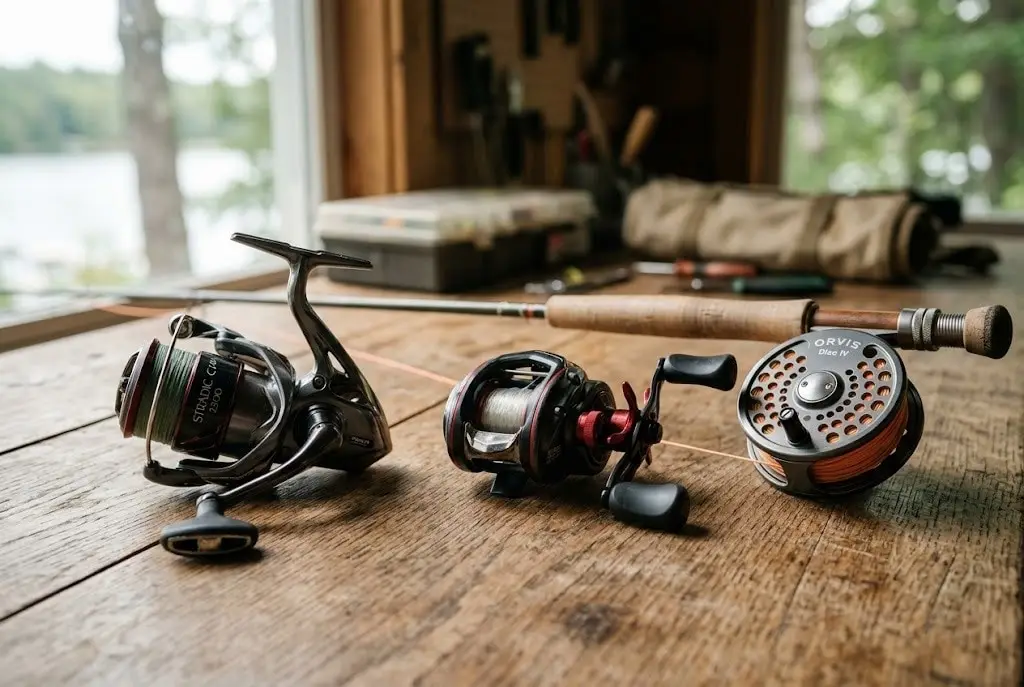
The types, and who each suits
Best forGeneral use, finesse, and beginners.
The open-faced, hang-under-the-rod reel most anglers start and stay with - versatile, easy to cast light lures, and hard to mess up.
Easy to learn, great with light line and small lures, few tangles.
Line twist over time; less raw casting power than a baitcaster.
Best forAccuracy, power, heavier lures and cover.
The reel sits on top of the rod and the spool spins as you cast. It rewards a practised thumb with pinpoint casts and cranking power.
Casting accuracy, heavier line and lures, winching fish from cover.
The learning curve - a backlash ('bird's nest') until you master the thumb and brakes.
Best forKids and absolute beginners.
The closed-face, push-button reel: press the button, cast, release. About as simple as fishing gets.
Almost no tangles, dead-simple, cheap.
Limited casting distance, drag and line capacity - you'll likely outgrow it.
Best forFly fishing.
On a fly rod the rod does the casting and the reel mostly stores line and provides drag - simple, but the drag matters on big, running fish.
Smooth drag for fighting fish, holds line and backing.
Not a casting tool - match it to the rod weight, see the fly rod matcher.
Best forTrolling, offshore and big game.
A stout, high-capacity reel that sits on top for trolling, bottom fishing and heavy saltwater work.
Huge line capacity and drag, built for big fish and deep water.
Overkill for everyday freshwater; heavier and pricier.
One reel of each type
An example of each type described above, from the maker's own page. For the choice most people face first, see spinning vs baitcasting.
| Model | Type | From the maker | Who it suits | Links |
|---|---|---|---|---|
| Abu Garcia Max Pro Spinning | Spinning | Sizes 750 to 4000; 7+1 stainless steel bearings, Carbon Matrix drag, Rocket Line Management, asymmetric body with V-Rotor and V-Spool | The spinning type | See on AmazonMaker's specs |
| Abu Garcia Max Pro Low Profile | Baitcasting, low profile | Asymmetric frame, carbon drag, 90 mm bent aluminium handle; left- or right-hand retrieve | The low-profile baitcasting type | See on AmazonMaker's specs |
| Abu Garcia Ambassadeur C3 Round | Baitcasting, round | Sizes 5500 and 6500; left- or right-hand retrieve | The round baitcasting type | See on AmazonMaker's specs |
| Zebco 33 Micro Trout combo | Spincast | An ultralight rod and reel on Zebco's 33 Micro platform, which Zebco designed for lighter line and smaller baits | The spincast type, sold here as a combo | See on AmazonMaker's specs |
| Redington Classic Trout 4/5/6 | Fly reel | Machined 6061-T6 aluminium, ported mid-arbor narrow spool, adjustable double-clicker drag; for 4 to 6 weight lines | A trout fly reel for 4 to 6 weight lines | See on AmazonMaker's specs |
| PENN Warfare II Level Wind | Conventional, level wind | Sizes 15, 20 and 30, 16.6 to 20.2 oz; graphite frame and sideplates, aluminium spool, HT-100 drag, line capacity rings on the spool | The level-wind conventional type | See on AmazonMaker's specs |
| PENN Fathom II Lever Drag 2-Speed | Conventional, lever drag | Sizes 10XN to 80; stainless steel main and pinion gear, forged and machined aluminium spool, Pull-to-Turn drag presets, two speeds | The lever-drag conventional type; PENN also makes billfish models | See on AmazonMaker's specs |
How we put this together. One model per type from Abu Garcia, Zebco, Redington and PENN, described from each maker's own page (Zebco's is its guide to the combo), checked on 26 October 2026; we have not tested these reels. There are no prices here: the Amazon link searches for the exact model, and we may earn a commission if you buy through it.
Reading the numbers
Spinning reels use numbers like 1000-8000+. Roughly: 1000-2500 = panfish, trout, finesse; 3000-4000 = the all-round bass and general size; 5000-6000 = pike, surf and light saltwater; 8000+ = big saltwater. Bigger number, bigger reel and line capacity.
How much line comes in per handle turn, shown like 6.2:1. Low (5.x:1) = slower but more cranking power, good for deep cranks and big baits; high (7.x:1+) = fast retrieve, great for burning lures and picking up slack; mid (6.x:1) = the do-everything choice.
The drag lets line slip so a running fish doesn't snap you off. The listed max drag is a ceiling, not a setting - a common starting point is to set drag to about a quarter to a third of your line's breaking strength. Smooth, sealed drags are worth paying for.
Reel sorted? Balance it with the right line using the knot & line strength notes, tie it on with a solid knot, and match the whole outfit to your target with tackle by species. Fly angler? See the fly rod & line matcher.
A general buying guide - sizing and gear-ratio conventions vary a little between brands, and the "right" reel depends on your target, water and budget. Handle a few in a shop, and match line rating to both the reel and the rod before you commit.
Reel picks by type
As an Amazon Associate we may earn from qualifying purchases - at no extra cost to you. We link gear types, not sponsors' picks: you choose the exact product.