Bighead Carp
The bighead carp is a giant, invasive Asian carp that has spread through much of the central United States, most notably the Mississippi River basin and its major tributaries.
🗓️ Last reviewed: July 2026
Overview
The bighead carp is a giant, invasive Asian carp that has spread through much of the central United States, most notably the Mississippi River basin and its major tributaries. It is not a fish that most anglers set out to catch on a rod and reel, because it feeds almost entirely by filtering microscopic plankton from the water and rarely bites a hook. Instead it is targeted by bowfishers, taken by commercial netters, and occasionally snagged where that method is legal. For anglers, the bighead is best understood as a serious ecological problem and, in the right hands, an enormous and challenging bowfishing target. A big one is a slab of a fish that can top 40, 50, even 60 pounds.
Identification & Appearance
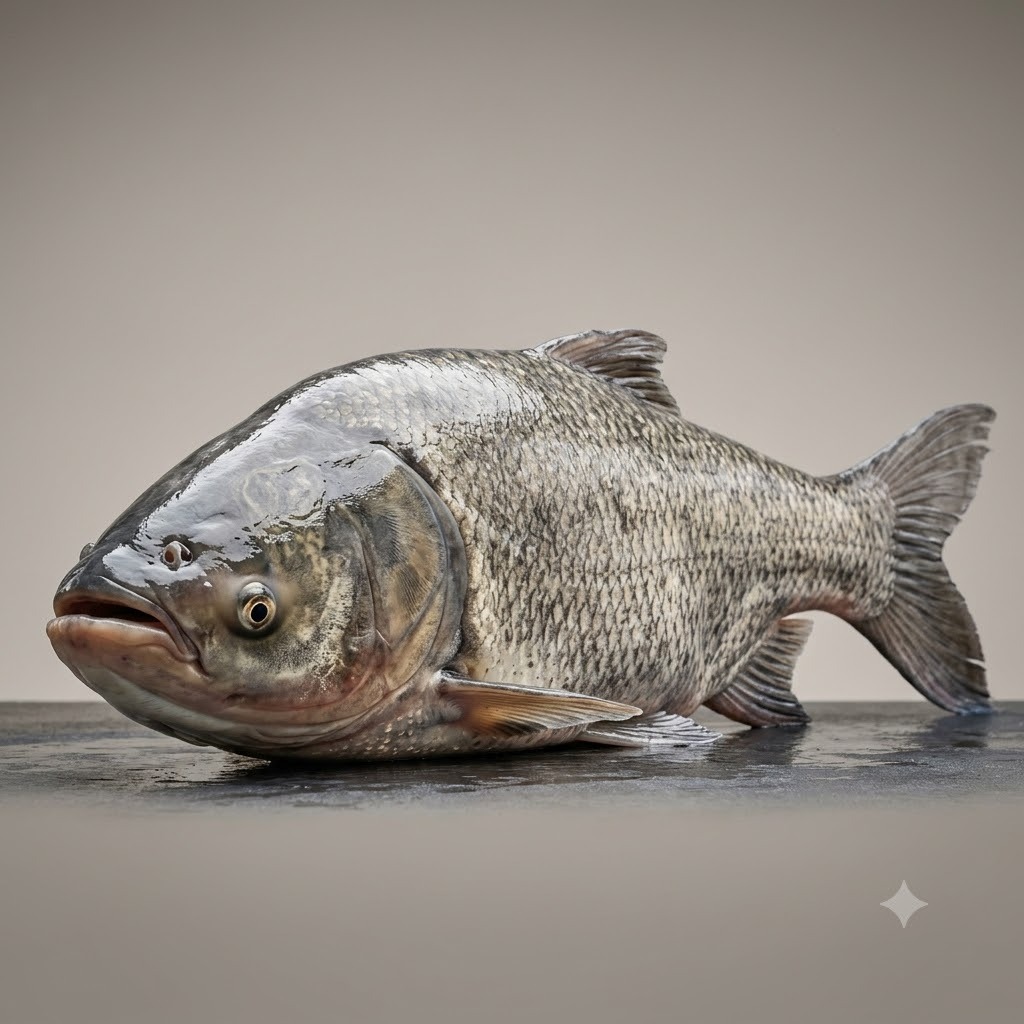
The bighead carp is aptly named: it has an oversized head that makes up a large share of its total length, with no scales on the head and eyes set low, well below the midline of the body. The body is deep and laterally compressed, dark gray to greenish-brown on the back fading to a mottled, blotchy silver on the flanks and a pale belly. Unlike common carp, it has no barbels around the mouth, and the mouth is large and upturned for surface and mid-water filter feeding. It can be separated from the closely related silver carp by its lower-set eyes, its dark mottled coloration, and a keel on the belly that runs only from the pelvic fins back rather than all the way forward.
Range & Habitat (US waters)
Bighead carp are established across the Mississippi River system, including the Missouri, Illinois, Ohio, and lower Mississippi rivers, and they continue to push toward new watersheds. They favor large rivers, backwaters, connected floodplain lakes, and reservoir tailwaters with rich plankton blooms. They tolerate a wide range of temperatures and often concentrate in slow eddies, side channels, and nutrient-rich pools where plankton is abundant. Because they are invasive, their presence is closely monitored, and there is an active regional effort to prevent them from reaching the Great Lakes.
Behavior & Feeding
The bighead carp is a filter feeder. It swims with its mouth open, straining zooplankton and phytoplankton from the water through fine gill structures, and this is the core reason it almost never takes a baited hook. It competes directly with native filter-feeding fish and with the larval stages of many game fish, stripping the base of the food web. Bigheads are less prone to the wild leaping behavior of silver carp, though they will surge and roll near the surface. They tend to travel and feed in loose groups, following plankton-rich water, and can grow rapidly given the abundant food in fertile river systems.
Best Seasons & Times to Catch
Because rod-and-reel catches are rare, the practical "season" for bighead carp is the bowfishing season, which runs strongest in the warm months when fish are shallow and active near the surface. Late spring through summer, when water warms and plankton blooms, brings fish into shallower, more visible water where bowfishers can find them. Early morning and evening in calm conditions are best for spotting fish rolling or cruising just under the surface. Where snagging is legal, tailrace areas below dams during spring high water can concentrate large numbers of fish.
Where to Find Them - Reading the Water
Look for slow, fertile, plankton-rich water. Bigheads stack in river backwaters, the mouths of tributaries, side channels, flooded timber flats, and the slack water behind wing dams and islands. Below dams, they gather in tailrace eddies. On calm days, watch the surface for rolling backs, subtle wakes, and disturbances as fish move through the upper water column feeding on plankton. Nutrient-loaded water with a greenish tint from algae is a strong sign that filter-feeding carp are nearby.
Tackle & Rigs
Standard hook-and-line tackle is largely ineffective because the fish does not eat baits, so the primary "tackle" for bighead carp is bowfishing gear: a heavy bowfishing bow or crossbow with a reel spool, a sturdy fiberglass or carbon arrow, and a barbed bowfishing point rigged to heavy line. Where snagging is legal, anglers use heavy rods, strong braided line, and large weighted treble hooks to foul-hook fish in dense schools. Any method that connects with a fish this size demands heavy, abrasion-resistant gear and a plan for handling a very large, powerful animal.
Best Baits & Lures
There is no reliable bait or lure for bighead carp, and that is an honest and important point - they filter plankton and generally ignore worms, dough, and artificials. Some anglers experiment with tiny suspended dough or bread flake fished on very light gear in fertile water, and a rare fish is caught this way, but it is the exception rather than the rule. For practical purposes, the effective methods are bowfishing and, where legal, snagging, neither of which relies on the fish choosing to eat.
Techniques - How to Fish for It
The main technique is bowfishing. Move slowly and quietly along fertile backwaters and river edges, or drift with a trolling motor, scanning the surface for rolling or cruising fish. Aim low to account for light refraction in the water, and shoot ahead of a moving fish. Once arrowed, a big bighead will run and roll hard, so keep steady pressure and be ready for a heavy fish at the boat. Where snagging is permitted below dams, cast heavy weighted trebles into dense schools and sweep the rod to foul-hook a fish, then fight it with strong, steady pressure.
Common Mistakes
The biggest mistake is expecting to catch bighead carp on conventional bait and lures - it rarely works, and time is better spent bowfishing. Other errors: aiming directly at a submerged fish instead of low to correct for refraction; underestimating the size and power of these fish and using gear that is too light; and, critically, moving a live invasive carp to new water. Never transport bighead carp alive, and never use them as bait in a new watershed - spreading them is illegal in many states and ecologically damaging.
Size, Records & Eating Quality
Bighead carp are enormous. Fish in the 20-40 pound range are common where they are established, and the largest can exceed 60 pounds, making them one of the heaviest fish an angler is likely to encounter in inland waters. The flesh is white and mild but very bony, riddled with fine intramuscular bones that make filleting a challenge; it is nonetheless eaten and increasingly promoted as a food fish under marketing names to encourage harvest. Because it is invasive, keeping and using harvested fish is encouraged wherever local rules allow.
Pros & Cons (as a target species)
Pros: gigantic size makes for a thrilling bowfishing target, harvest helps control an invasive species, they are abundant where established, and the meat is usable. Cons: they almost never take a hook, so traditional anglers will be frustrated; the fine bones make cleaning difficult; handling a 40-plus-pound fish is physically demanding; and their invasive status means they signal a damaged ecosystem rather than a healthy one.
Best Suited For
Bighead carp suit bowfishers and anglers who enjoy a physical, hands-on pursuit of very large fish, as well as those motivated to help remove an invasive species. They are a poor fit for rod-and-reel purists hoping for a cooperative biting fish. For anyone who wants a big-game challenge in fresh water and does not mind an unconventional method, the bighead offers size and action that few native species can match.
FAQ
Can you catch bighead carp on a hook and line? Only rarely. They are filter feeders that strain plankton from the water and generally ignore baits and lures. The practical methods are bowfishing and, where legal, snagging.
How big do bighead carp get? They commonly reach 20-40 pounds where established and can exceed 60 pounds, making them one of the largest fish in the rivers they invade.
Are bighead carp invasive? Yes. Bighead carp are a serious invasive species in the United States. They compete with native fish for plankton and disrupt the food web. Never move them alive to new water.
Do bighead carp jump like silver carp? Much less so. They will surge and roll near the surface but do not display the wild, boat-clearing leaps that make silver carp notorious.
Are bighead carp good to eat? The flesh is mild and white but very bony. Many people do eat them, and harvest is encouraged to help control the population, but the fine bones make preparation a challenge.