American Paddlefish
The American paddlefish is one of the most ancient and unmistakable fish in North America, a living fossil whose lineage stretches back tens of millions of years.
🗓️ Last reviewed: June 2026
Overview
The American paddlefish is one of the most ancient and unmistakable fish in North America, a living fossil whose lineage stretches back tens of millions of years. Often called the "spoonbill" (or wrongly the "spoonbill catfish," though it is no catfish at all), it is a primitive, cartilaginous-skeleton relative of the sturgeon. There is nothing else like it in fresh water: a smooth, scaleless giant with a long paddle-shaped snout, cruising the big rivers of the central United States with its mouth open, straining clouds of microscopic plankton. Because it eats nearly invisible prey and ignores lures and bait entirely, pursuing one is a completely different sport than chasing bass or catfish. Where it is legal, anglers snag these powerful fish during short, tightly regulated seasons, and hooking a fifty- or hundred-pound paddlefish on heavy gear is one of the most demanding fights in freshwater fishing.
Identification & Appearance
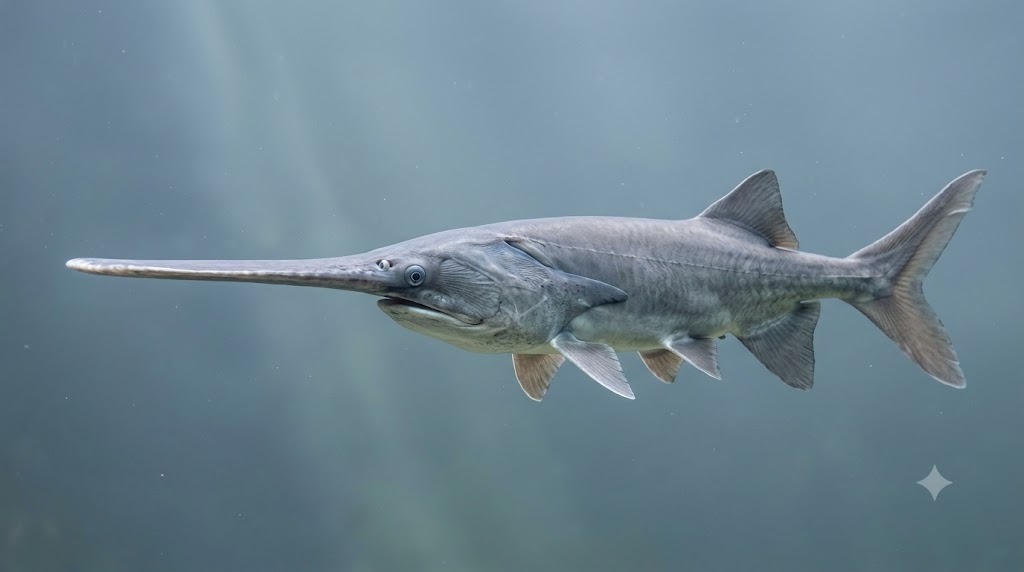
The paddlefish is impossible to confuse with anything else once you have seen one. Its defining feature is an enormously long, flat, paddle-like snout, called a rostrum, that can run roughly one-third of the body length and is packed with sensitive electroreceptors used to locate swarms of tiny zooplankton. The body is long, torpedo-shaped, and entirely scaleless, with smooth skin that ranges from gray to bluish-gray, often paler on the belly. The mouth is large and gaping, set well back beneath the snout, the eyes are surprisingly tiny, and the tail is deeply forked and shark-like (heterocercal). Internally it is even more unusual: the skeleton is largely cartilage rather than bone, a trait it shares with its sturgeon relatives in the order Acipenseriformes. There is simply no other freshwater fish in its range with a smooth gray body and a long flat paddle for a nose.
Range & Habitat (US waters)
The American paddlefish is native to the Mississippi River basin and its major tributaries, including the Missouri, Ohio, and Arkansas river systems, and it ranges through the large rivers and connected reservoirs and oxbows of the central United States. It is a fish of big water: broad, slow rivers and the open basins of large impoundments, where it has room to filter-feed and migrate. For successful spawning it depends on large, free-flowing river reaches with clean gravel bars and the right seasonal flows. Historically widespread, paddlefish populations have declined in many areas due to dams that block spawning runs, loss and alteration of river habitat, and decades of overharvest for both flesh and roe. As a result, the fish is far more abundant in some states than others, and it is protected entirely in parts of its former range.
Behavior & Feeding
The paddlefish is a filter feeder, and this single fact shapes everything about how it lives and how it is caught. Rather than hunting or ambushing prey, it swims slowly through the water column with its huge mouth wide open, straining tiny zooplankton, and occasionally small insects, through long, comb-like gill rakers. The paddle-shaped snout is not a digging tool or a weapon but a sensory antenna, studded with electroreceptors that help the fish detect the faint electrical signatures of dense plankton clouds in murky water. Because its food is microscopic and drifting, the paddlefish does not chase, strike, or bite anything an angler can present on a hook. Its movements track water temperature, flow, and the seasonal abundance and location of plankton, and in spring it undertakes upstream migrations tied to rising water and spawning rather than to feeding.
Best Seasons & Times to Catch
For anglers, the paddlefish season is defined far more by law than by the calendar of the fish, because snagging is only legal in certain states and waters during short, specific windows. Where seasons exist, they most often open in spring, timed to the period when paddlefish concentrate and move upriver toward spawning gravel as water warms into roughly the 50s and 60s Fahrenheit and flows rise. This concentration of fish below dams and in known staging areas is what makes a snagging season possible. Some states also offer limited fall opportunities. On any given day, success depends heavily on water level, current, and clarity rather than on classic dawn-and-dusk feeding patterns, since these fish are not feeding on your hook at all. The single most important rule is to consult the current regulations: open dates, legal waters, permits, and limits change, and fishing outside them is illegal.
Where to Find Them - Reading the Water
During the spring run, the most productive spots are the places where migrating paddlefish stack up. Tailwaters immediately below dams are classic, because the structure halts upstream movement and concentrates fish in the deeper, current-swept water at the base of the dam. Look also to the deep outside bends of large rivers, the heads of long pools, gravel-bar areas where fish stage before spawning, and the upper reaches of reservoirs where rivers enter and current still flows. Because paddlefish hold in the open water column rather than tight to cover, reading depth and current matters more than finding a laydown or weed edge. Many snaggers fish from boats positioned over deeper channels and runs, while bank and wading access below dams produces well in states that allow it. Find the deep moving water where the run is funneled, and you have found the fish.
Tackle & Rigs
Snagging paddlefish is heavy-tackle fishing, because the fish are large, the hooks are big, and the retrieve is hard work. A stout, long rod such as a heavy casting rod or a surf rod gives the leverage to drive large hooks and to cast weighted rigs into deep current. Pair it with a strong reel, baitcasting or large spinning, that can hold plenty of line and absorb a long, powerful fight. Most snaggers spool heavy braided line, often in the 50 to 100-plus pound range, for the strength and the direct, no-stretch connection needed to set big hooks. The terminal rig is simple and built for snagging rather than for tempting a bite: one or more large, weighted treble hooks, with enough lead to reach and hold the proper depth in current. There is no bait, no scent, and no finesse rig involved, only stout components that can survive repeated hard sweeps and a heavy fish.
Best Baits & Lures
Here the paddlefish breaks every rule of conventional fishing, because it does not eat baits or lures at all. As a filter feeder of microscopic plankton, it will not strike a worm, a minnow, a crankbait, or any other offering, which is exactly why baited-hook fishing for paddlefish is essentially impossible and why snagging is the standard legal method where harvest is allowed. In place of baits, the "lure box" for paddlefish is really a selection of large, weighted treble hooks and sinkers chosen to reach the depth where the fish are running and to foul-hook them on a hard pull. Hook size and the amount of added weight are matched to the depth and speed of the current rather than to water clarity or the fish's mood. The takeaway is simple: you are not trying to make a paddlefish eat, you are trying to put a big hook through the water where the fish are holding.
Techniques - How to Fish for It
The technique is snagging, a repetitive, physical motion that bears no resemblance to casting a lure. The angler casts the weighted treble rig out and lets it sink to the level where paddlefish are running, then sweeps the rod hard and steadily to rip the hooks through the water, reeling in the slack between sweeps and repeating the motion across the retrieve. The goal is for a hook to make contact with a fish in the open water column and foul-hook it, since the fish will never take the hook in its mouth on purpose. When you connect, you will know it: a snagged paddlefish is heavy and strong, and landing one demands steady pressure and patience as it uses its size and the current against you. Snagging is hard on the arms and shoulders over a long day, and good snaggers pay close attention to depth and current so their hooks ride at the right level rather than sweeping blindly.
Common Mistakes
The most serious mistake of all is fishing without knowing the law, because snagging paddlefish is legal only in specific states, on specific waters, during specific seasons, and often requires a permit or tag and obeys strict length and harvest limits. Snagging in a closed water or season, or keeping a fish you are not allowed to keep, is a real offense with a protected species. Beyond the legal errors, common technical mistakes include working the rig at the wrong depth so the hooks never reach the running fish, using line and hooks too light for the size and power of the quarry, and setting the drag so tight that a heavy fish breaks off on a hard sweep. Anglers also lose fish by quitting the fight too aggressively rather than wearing the fish down with steady pressure. Finally, careless handling of fish that must be released, or of undersized and out-of-season fish, harms a slow-growing, vulnerable native species.
Size, Records & Eating Quality
The paddlefish is a genuine freshwater giant. Fish in the 30 to 60-pound range are common where populations are healthy, individuals over 100 pounds and five feet long are caught, and they are long-lived, with fish reaching 20 to 30 years or more and females maturing late in life. The IGFA all-tackle world record stands at well over 140 pounds, a fish taken in Oklahoma, which gives a sense of just how large the species can grow. As table fare the paddlefish is well regarded: the boneless, mild white flesh is firm and considered good eating, comparable to other quality white-fleshed fish, and the roe has historically been used as caviar. That caviar value is a double-edged sword, however, since the demand for paddlefish roe has driven poaching and overharvest and is a major reason the species needs careful protection.
Pros & Cons (as a target species)
Pros: the paddlefish offers a completely unique experience, a chance to catch a living-fossil giant unlike any other freshwater fish, the fights are powerful and memorable, the fish reach extraordinary sizes, and the meat is genuinely good where harvest is legal. Cons: opportunity is narrow and tightly regulated, with short seasons, limited legal waters, required permits, and strict limits, so access is far from universal. The method itself, heavy snagging, is physically demanding and is not for anglers who prefer the finesse of presenting a lure. And because the species is slow-growing, late-maturing, and depleted in much of its range, it carries a heavy responsibility to fish ethically and within the rules.
Best Suited For
The paddlefish suits the angler who wants something rare, challenging, and unlike anything else, and who is willing to learn and follow a specialized, heavily regulated fishery. It rewards strong, persistent anglers who do not mind the hard physical work of snagging through deep current for hours, and who take genuine satisfaction in landing a fish that can outweigh almost anything else they will catch in fresh water. It is best for those who fish the big rivers and reservoirs of the central United States within designated seasons, and who value conservation and regulation as much as the catch itself. It is not a casual species, and it is not for anglers committed to lure or fly presentation, but for the right person it is a bucket-list pursuit.
FAQ
Can you catch a paddlefish on a lure or bait? No. The paddlefish is a filter feeder that strains microscopic plankton and will not strike a lure or take a baited hook. Where harvest is legal, the standard method is snagging with large weighted treble hooks, not conventional bait fishing.
Is it legal to snag paddlefish? Only in certain states and waters, and only during specific seasons, usually with a permit or tag and under strict length and harvest limits. In some states paddlefish are protected and may not be taken at all, so you must always check current local regulations before fishing.
How big do American paddlefish get? They are true giants. Fish of 30 to 60 pounds are common in healthy waters, individuals can exceed 100 pounds and five feet, and the all-tackle world record is well over 140 pounds, set by a fish from Oklahoma.
What does the long paddle snout do? The rostrum is a sensory organ, not a tool for digging or striking. It is covered in electroreceptors that help the fish detect the faint electrical fields of dense plankton swarms in murky river water as it filter-feeds.
Are paddlefish good to eat? Yes, where they can be legally harvested. The boneless, mild white meat is firm and considered good eating, and the roe has been used as caviar, though that very value has fueled poaching and is a key reason the species needs protection.