River Salmon Fishing Guide
River salmon fishing is one of angling's most demanding pursuits - pursuing a fish that may not eat, in cold water, on technical drifts that punish bad presentations. Done right…
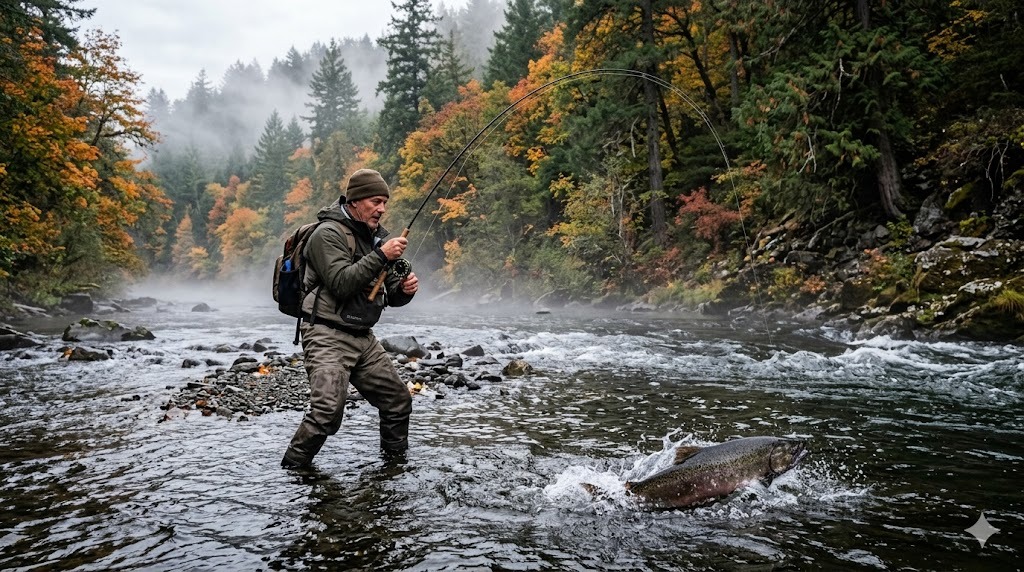
River salmon fishing is one of angling’s most demanding pursuits. You are chasing a fish that has stopped eating, in cold water, on technical drifts that punish bad presentations. The reward is a chrome-bright king, coho, or chinook that fought from saltwater to the headwater you stand in. The fight is unmatched in freshwater.
This guide covers reading water, identifying runs, choosing lures and baits, and the techniques - drift fishing, bobber-and-jig, plug pulling, and back-bouncing - that consistently produce river salmon.
Understanding Salmon in Rivers
Salmon enter rivers as part of their spawning migration. They typically stop actively feeding, but they still strike out of aggression, instinct, and territoriality. Your job is to put a presentation in their lane consistently enough to trigger a reaction.
The Major River Salmon
- King / Chinook - Largest Pacific salmon, 15-50+ lbs. Pacific Northwest and Great Lakes.
- Coho / Silver - 6-15 lbs, aggressive, willing biters. PNW and Great Lakes.
- Sockeye / Red - 4-10 lbs, plankton feeders, hard to provoke into a strike (snagging is illegal; legal fly/lure techniques exist).
- Pink / Humpy - 3-6 lbs, every other year (odd years dominant) in PNW.
- Chum / Dog - 8-15 lbs, late-fall biter; aggressive on chartreuse.
- Atlantic salmon - 5-30+ lbs, North Atlantic rivers and a few US states.
Run Timing
- Spring kings - March-June, depending on river.
- Summer kings/coho - July-September in PNW.
- Fall kings, coho, chum - September-November.
- Great Lakes runs - August-November (kings/coho); steelhead overlap.
- Atlantic salmon - May-September depending on watershed.
Check local fish counts and call shops for current conditions.
Reading River Salmon Water
Salmon hold in specific water types that change with river height.
Resting Lies
Salmon need to rest between hard pushes upstream. Look for:
- Slow pockets along the seam of a fast run.
- Tail-outs of pools where the riffle starts.
- Behind boulders and current breaks.
- Inside bends of the river.
- Soft water along undercut banks.
Travel Lanes
Salmon move along the deeper main channel, often along a specific seam. Watch for boils, rolls, and porpoising - visible signs of salmon moving.
Holding Pools
Deep classic pools hold staging salmon, especially in low water. The head of the pool (where current enters), the seam down the side, and the tail-out are all spots to fish.
Key Indicators
- Boils, splashes, and rolls - salmon present.
- Tail prints in shallow gravel - recent spawning activity.
- Oily slick on the surface - salmon nearby (oil from gill movement).
Drift Fishing
The dominant technique on Pacific rivers and Great Lakes tributaries.
Setup
- Rod: 9-11 ft drift rod, medium-heavy.
- Reel: Casting (level wind) or spinning, 4000-6000 size.
- Line: 15-25 lb mono mainline (Maxima Ultragreen is the standard).
- Leader: 12-20 lb fluorocarbon, 18-30 inches.
- Weight: Slinky (pencil lead in parachute cord) or pencil lead sized to bounce bottom every 1-2 seconds.
Bait/Lure on Drift
- Cured salmon eggs (skein) - Top king bait. Pink, red, orange cures.
- Spawn sacs - Loose eggs tied in mesh sacs.
- Beads - Single or pairs of 8-12mm soft beads pegged above hook.
- Plastic worms / corkies - Buoyant attractors above the hook.
- Spin-N-Glo - Buoyant spinning attractor with a hook below.
- Yarn flies - Color-tied yarn on a hook to imitate egg clusters.
Drift Technique
- Cast upstream at a 45-degree angle.
- Mend slack so the bait drifts naturally with current.
- Let weight bounce bottom every 1-2 seconds - tic-tic-tic feel.
- Follow with rod tip; keep line tight enough to feel strikes but not so tight that you drag.
- Strike on any pause, pull, or change in tension.
Bobber-and-Jig
A simpler technique that excels for coho, chum, and pressured fish.
Setup
- Rod: 9-10 ft medium-light to medium spinning rod.
- Reel: 3000-4000 spinning.
- Line: 30-50 lb braid mainline.
- Bobber: Float (Thill ICE’N FLY, Reedl, Glo-Brite) sized to suspend the jig at the right depth.
- Leader: 12-15 lb fluorocarbon, length adjusted for depth.
- Jig: 1/8 to 3/8 oz marabou or rabbit-strip salmon/steelhead jig. Pink, chartreuse, black, purple.
Bobber Technique
- Set the bobber depth so the jig drifts just above the bottom.
- Cast across and slightly upstream.
- Let the bobber float through the drift naturally - no twitching.
- Watch the bobber. Any twitch, dunk, or unnatural movement - set the hook.
- Strike up and back with authority.
Bobber fishing keeps the bait in the strike zone longer than drift fishing and minimizes snags.
Plug Pulling (Side-Drifting Plugs)
A boat technique. Plugs (Yakima Mag Lip, Hot Shot, Kwikfish) are let downstream from a slow-back-trolled boat. The plug wiggles seductively in front of holding salmon.
- Color: Bright orange, chartreuse, pink in stained water; metallic blue, silver, gold in clear.
- Tuning: Each plug must be tuned to run straight; adjust the screw on the nose.
- Wrap (optional): A sardine or tuna belly wrap on the bottom adds scent.
Back-Bouncing
Used in heavy water or deep pools. From a boat, drop bait (eggs/spawn sac with weight) straight to the bottom, lift, drift downstream a few feet, drop again - keep the bait crawling along the bottom.
Fly Fishing for River Salmon
A complete sport in itself. Two-handed (spey) rods are common for distance and swing.
- Sink-tip line for swing or 10-12 ft polyleader.
- Flies: Egg patterns (Glo-Bug, Otter Soft Eggs), articulated leeches, intruders, classic Atlantic salmon patterns (Green Highlander, Ally’s Shrimp).
- Swing: Cast across, mend, let fly swing on tight line, step downstream, repeat.
Reading Conditions
- Water clarity drives lure choice. Stained: bright orange, chartreuse, pink. Clear: natural colors, smaller offerings.
- Water height changes holding lies. High water pushes fish to softer edges; low water concentrates them in pools.
- Water temperature affects activity. Sub-40°F: slow and lethargic. 45-55°F: peak activity. 60+°F: fish hold deep and stressed.
Etiquette and Conservation
Salmon water is crowded. Practice:
- Hole rotation - Cast 5-10 times, then step downstream.
- No high-holing - Don’t step in upstream of fishing anglers.
- Catch and release of wild fish where regulations require it.
- Quick handling - Salmon are easily stressed.
- Snagging is illegal - Strikes must be in the mouth.
FAQ
Why won’t salmon bite my lure? Salmon in spawning runs often pass dozens of presentations before reacting. Cover water, vary cadence, change colors, return at different times of day.
What size hook for salmon? Drift fishing: size 1 to 2/0 octopus hooks. Bobber jigs: 1/0-3/0 jighooks. Larger for kings, smaller for coho and pinks.
Do I need to cure my own eggs? You can buy cured eggs at salmon-river shops, but experienced anglers swear by their own cure recipes. Procure (Atlas Pro-Cure), borax cures, and Pautzke Fire Cure are all popular kits.
What’s the difference between Atlantic and Pacific salmon fishing? Atlantic salmon are typically fly-only in protected fisheries. Pacific salmon allow drift fishing, lures, and bait depending on regulations.
Are Great Lakes salmon the same as Pacific? Genetically yes - kings and coho were stocked from Pacific stock. Behavior in freshwater rivers is similar; fishing techniques carry over directly.
Conclusion
River salmon fishing rewards anglers who learn the water, read the conditions, and present baits in the lane salmon are holding. Master drift fishing for the technical days and bobber-and-jig for the simpler ones. Watch for boils and rolls, fish soft water along seams, and accept that salmon fishing involves long blank stretches between explosive hookups. When a 25-pound king inhales your spawn sac and runs you into the backing, every cold morning of patience pays off.
🛒 Recommended Gear on Amazon
- Salmon spinners - browse current options and reviews on Amazon.
- Chest waders - browse current options and reviews on Amazon.
- Large salmon landing net - browse current options and reviews on Amazon.
As an Amazon Associate, we earn from qualifying purchases - at no extra cost to you. This helps us keep producing free, in-depth guides.