Bowfishing for Beginners: Bows, Arrows, Regulations
Bowfishing is the bridge between archery and angling - a fast, visual, often nighttime pursuit of carp, gar and other rough fish with a bow.
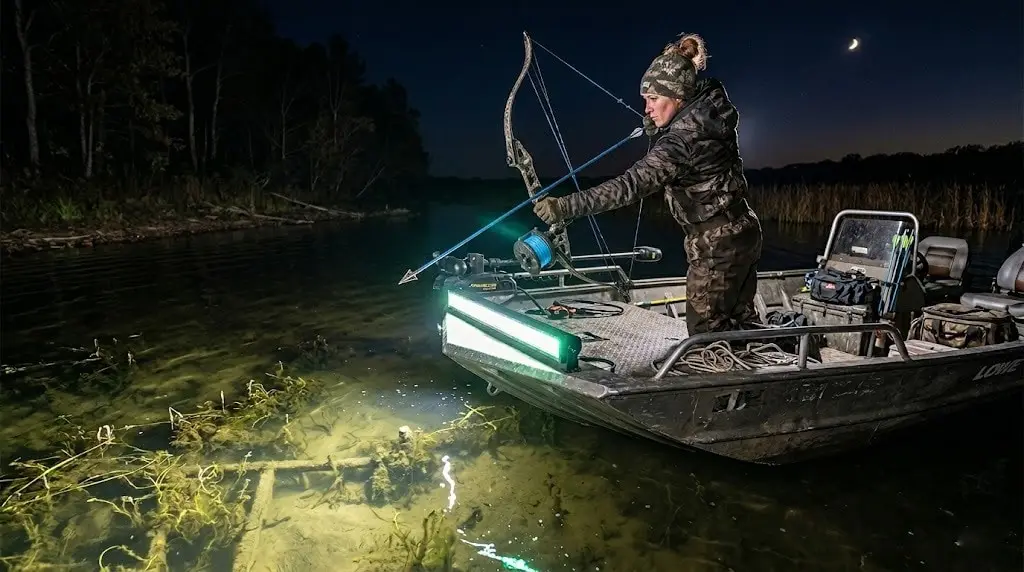
Bowfishing is the bridge between archery and angling - a fast, visual, often nighttime pursuit of carp, gar, suckers, tilapia, and other rough fish with a bow and reel-equipped arrow. It combines stalking, shooting accuracy, and lightning-fast reflexes. A successful bowfisher reads water like a sight angler, shoots like a bowhunter, and processes fish like a chef.
This guide covers what you need to start: bows, arrows, reels, lights, regulations, and the technique that puts arrows on target through water.
What Bowfishing Targets
Where bowfishing is legal, it is generally limited to non-game species - “rough fish” - and each state lists which ones.
Common Targets
- Common carp - The classic bowfishing target. Abundant, large, found everywhere.
- Grass carp / amur - Vegetarians, often in weedy shallows.
- Bighead and silver carp - Asian carp; silvers are the jumping carp.
- Buffalo (smallmouth, bigmouth, black) - Large native rough fish.
- Gar (longnose, shortnose, alligator, spotted) - Top predator targets; alligator gar grow very large.
- Suckers - Various species; common in clear rivers.
- Tilapia - in the southern states where they are established.
- Bowfin (dogfish, mudfish) - Aggressive ancient species.
- Catfish - only where your state’s regulations say so.
Not Targets Unless Your State Says So
- Gamefish: bass, walleye, pike, trout, salmon, panfish, crappie.
- Assume game species are off limits to a bow until you have read otherwise in the regulations.
Check your state regulations carefully. Rules vary dramatically from state to state.
The Bow
You don’t need a hunting bow. Bowfishing-specific or “bowfishing setup” of a youth or beginner compound is ideal.
Compound Bows
- Draw weight: 25-45 lbs is plenty. Heavier is unnecessary and tires you in a long shooting session.
- Let-off: Bowfishing bows often have 0% let-off or shoot-through cams for snap shots; standard hunting bows with 75-80% let-off work fine.
- Makers: several archery companies sell bows built or packaged for bowfishing, usually with a reel and an arrow included. We have not tested them, so we name no models.
Recurve Bows
- Light, simple, traditional. Great for snap shots and shore-side bowfishing.
Crossbows
- Allowed for bowfishing in some states and not in others; check before you rig one.
A 35 lb compound is a great starter setup.
Bowfishing Reels
The reel attaches to the bow and holds the arrow line.
Drum/Hand Reels
- A simple drum that holds the line. The cheapest kind. Line is pulled in by hand. Common on entry-level setups.
Spincast Reels
- A modified spincast (closed-face) reel mounted to the bow. Faster retrieval, less line management.
Bottle Reels
- A reel with line stuffed loose in a bottle. No spool - line peels freely from the bottle and is rewound after the shot. Popular with experienced bowfishers because the line leaves freely.
For a beginner: a spincast reel is the best balance of ease and performance.
Bowfishing Arrows
Bowfishing arrows are heavier, tougher, and shaped differently from hunting arrows.
Arrow Materials
- Fiberglass - Standard, tough, affordable. Most common.
- Carbon-fiber composite - Lighter and faster; for clear water and longer shots. Tend to break on rocks.
- Hybrid fiberglass/carbon - Compromise.
Points
- Carp/general - Reverse barbs deploy after penetration to hold the fish.
- Heavy points - For big buffalo, gar, alligator gar. Mechanical broadhead-style with retractable barbs.
- Gar points - Specialized for the bony, hard-skulled gar. Long, sharp, gripping points.
Nocks
- Lighted nocks help you see your arrow at night.
- Safety nocks prevent dry-fire damage.
Line Attachment
The line attaches to the arrow with a safety slide that prevents the line from snapping back at you on a missed shot (a critical safety feature). Always use a safety slide.
A common starter setup: a fiberglass arrow with a barbed carp point and a safety slide.
Lighting (Night Bowfishing)
Most bowfishing happens at night when fish are more active and easier to spot in shallow water with lights.
Boat-Mounted Lights
- Halogen and HID lights - Older but powerful. Power-hungry.
- LED lights - Modern standard. Dramatically more efficient. Several makers sell light bars built for bowfishing boats.
- Generator - Most boats run an onboard generator to power lights.
Lighting Color
- White - Most common, good color rendition.
- Green - Penetrates water well, attracts fish.
After the boat, lighting is usually the biggest expense of a full bowfishing rig.
The Boat
Bowfishing boats are typically flat-bottomed jon boats or specialized rigs with:
- Elevated shooting deck/platform on the bow.
- Bright lights illuminating the water in front.
- Quiet outboard or trolling motor.
- Generator for lights.
- Storage for harvested fish.
A 16-18 ft jon boat with a shooting platform and an LED light bar is a typical setup. Some boat builders sell dedicated bowfishing models, already rigged.
You can also bowfish from shore, kayaks, or canoes - much cheaper but more limited.
Shooting Technique
The critical lesson: water bends light. A fish you see at apparent depth X is actually at a deeper position. The deeper the fish appears, the more you must compensate.
Aiming Below the Fish
The cardinal rule: Aim below the fish.
- Shallow fish (just under surface): aim a few inches low.
- Fish at 2-3 ft: aim 4-8 inches low.
- Fish at 4+ ft: aim a foot or more low.
The exact amount varies with shooting angle, water clarity, and your distance.
Snap Shots
Bowfishing is fast - you may have 1-2 seconds from spotting fish to shooting. Practice snap shooting: draw, anchor, shoot in one motion. Most bowfishers shoot instinctive (no sight) at close range.
Distance
Most shots are 10-20 ft. Beyond 25 ft, accuracy drops fast.
Don’t Skybow
Never draw the bow above your head pointing up - a slipped arrow can fly hundreds of yards. Always keep the bow level and pointed at the target.
Regulations
Bowfishing regulations are state-specific and often complex.
Common Rules
- Bowfishing license - Often a regular fishing license; some states require a separate bowfishing endorsement.
- Species restrictions - Only specified non-game fish; game fish are illegal targets.
- Night/day restrictions - Some states limit hours.
- Season - Year-round in some states; restricted seasons in others.
- Daily limits - Some species have limits (especially gar in some states).
- Boat lighting - Required navigation lights even with bowfishing lights on.
- Disposal of fish - Some states require fish be utilized; never dump fish back into the water or on shore.
Always read your state regulations before going. Bowfishing-specific rules are often in a separate section.
Disposal and Use
- Eat them - Carp, buffalo, and gar are all edible. Smoking and grinding are popular preparations. Never eat gar eggs: the Missouri Department of Conservation’s field guide says the roe of gar is highly toxic to warm-blooded animals, including humans.
- Garden fertilizer - Old farmer technique; bury a fish under each plant.
- Donate to bait shops or zoos - Some accept rough fish for animal feed.
- Composting - Properly composted at high temp.
Don’t dump fish in the water or on land. It is wasteful, often illegal, and bad for the sport’s reputation.
FAQ
Do I need a hunting license to bowfish? Typically a fishing license, not a hunting license, but rules vary by state.
What draw weight for bowfishing? 30-45 lbs is plenty. Heavier is unnecessary and fatiguing.
Can I bowfish in saltwater? In some coastal states, for certain species - and the list differs from state to state. Do not assume: read the saltwater regulations, which often prohibit taking particular fish, sharks among them, with a bow.
Why does a bottle reel keep the line in a bottle? The bottle stores line loose so it pulls out without tangles when the arrow flies - much faster and more reliable than a spool.
Is bowfishing dangerous? Less dangerous than firearm hunting but real risks exist: snap-back if you don’t use a safety slide, arrows ricocheting off shallow rocks, and night-boat hazards. Use safety equipment and practice.
Conclusion
Bowfishing combines the visual hunting of sight fishing with the precision of archery and the thrill of nighttime action on the water. With a light compound, a reel, sturdy fiberglass arrows on safety slides, and a light, you can start from shore; a fully rigged boat is a much bigger step. Learn the aim-low rule, respect regulations, and use your catches.
Recommended Gear on Amazon
- Bowfishing kit - browse current options and reviews on Amazon.
- Bowfishing arrows - browse current options and reviews on Amazon.
- Bowfishing reel - browse current options and reviews on Amazon.
As an Amazon Associate, we earn from qualifying purchases - at no extra cost to you. This helps us keep producing free, in-depth guides.