How to Fish a Blade Bait
A blade bait is a thin metal lure weighted at the nose or belly that vibrates on a short lift. When cold-water smallmouth anglers use it, the short lift-and-pause, snaps, line and rods, and where to fish it, from Bassmaster and In-Fisherman reporting.
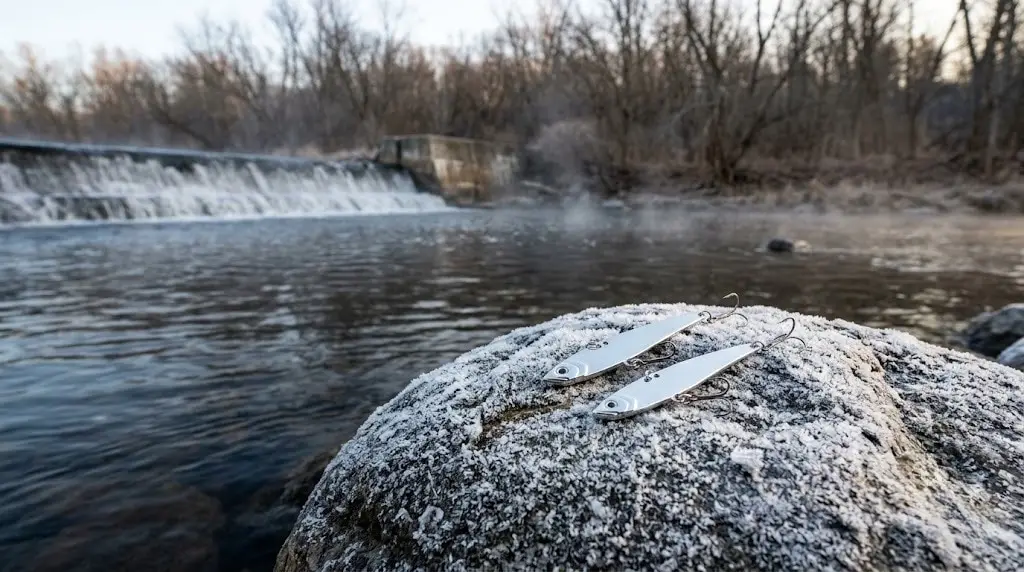
A blade bait is a thin metal body with lead along the bottom or nose. A Bassmaster article on winter smallmouth describes it as a cold-weather lure, fished on the bottom either vertically like a jigging spoon or hopped across the bottom like a jig. This guide collects what the anglers in that article and an In-Fisherman piece on cold-water smallmouth say about when, how and where to fish one. These are experienced anglers’ methods, not rules; we have not tested them ourselves.
When: cold water
- Under about 50 °F: one Lake Erie angler in the Bassmaster article fishes blades in fall once the water drops below 50 °F and again in spring until it warms past 50 °F. Another names the low 50s, when fish group up for winter, as the start, and around 40 °F as the peak on the Great Lakes.
- Into the coldest water: the same article quotes anglers catching smallmouth on blades below 40 °F and right at ice-out in deep water.
- Why vibration: the In-Fisherman anglers believe the vibration of a heavy blade bait, jigging spoon or lipless crankbait is the best way to get sluggish cold-water smallmouth to bite.
How: short lifts and pauses
- Lift just enough to feel it vibrate, about 4 to 6 inches, according to an angler in the Bassmaster article, and leave it on the bottom three or four seconds between lifts for big smallmouth; he says to fish it more like a worm than snap it like a jigging spoon.
- Keep it on the bottom with short hops (In-Fisherman). Both anglers there say fish won’t move more than a few feet to chase it, and that most people work these baits far too aggressively: “less is more”.
- Slow down as it gets colder: as water falls toward 38 °F, the In-Fisherman anglers pause the bait up to 5 seconds.
- When the strike comes: the two articles differ. One angler in Bassmaster says many fish hit it on the fall; the pair in In-Fisherman report that as water cools, strikes come as the bait is lifted off the bottom. Watch and feel for both.
Our guide to fishing a jig covers the hopping retrieve, and the jigging spoon is the vertical cousin.
Rigging
- Use a snap: everyone in the Bassmaster article agrees. Most blades have a simple punched hole for the line tie, and one angler warns it will cut your line “in a heartbeat”.
- Line: one angler uses fluorocarbon for feel, both of the vibration and of fish that just tick the bait, and uses line size to control the fall: thicker line falls slower, so he fishes heavier line in shallow water and lighter line in deep water. Another prefers heavier line partly because you get more snagged blades back. Our fishing line explained covers line types.
- Rods: one angler prefers a 7-foot baitcasting rod for control and leverage on the hookset; another uses a 6-foot-10 fast rod of the kind he uses for spinnerbaits, with some tip and good backbone.
Where
From the Bassmaster anglers:
- Big lakes: fish adjacent to reefs and the edges around them.
- Inland lakes: breaklines with tight bends (inside turns), and the deep water near them; also weedlines and long sloping flats, starting shallow and working deeper until you find the depth.
- Rivers: the deepest water around, often below dams on the channels, as long as heavy flow isn’t putting a big bow in your line.
- Follow the bait: electronics help find baitfish, and the bass will be near them.
Our lake turnover guide explains what happens to a lake as it cools in fall. See our smallmouth bass profile for more on the fish.
Sources
- Bassmaster, Blade baits for winter smallies. Read 28 October 2026.
- In-Fisherman, In cold water, heavy metal reigns supreme. Read 28 October 2026.
Recommended Gear on Amazon
- Blade baits - browse current options and reviews on Amazon.
- Fishing snaps - browse current options and reviews on Amazon.
- Hook sharpener - browse current options and reviews on Amazon.
As an Amazon Associate, we earn from qualifying purchases - at no extra cost to you. This helps us keep producing free, in-depth guides.