How to Fish a Chatterbait
A chatterbait (bladed jig) is a jig with a hex-shaped blade at the nose. Where it shines around the spawn, lead vs. tungsten heads, trailers for baitfish or crawfish, colours by water clarity, retrieves, the rod, and trimming the skirt, from an Outdoor Life guide.
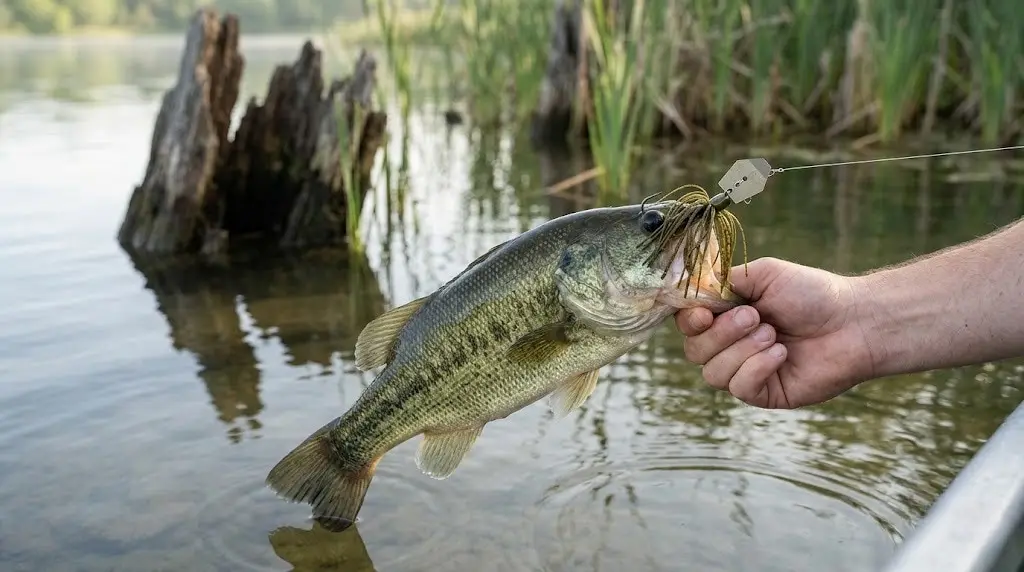
A chatterbait, or bladed jig, is a jig with a hex-shaped blade attached at the nose. An Outdoor Life guide by a tournament angler traces it to 1998, when a lure designer first attached the blade to a jig, and calls it one of the most popular bass baits because it is versatile: any water, any depth, any time of year. This guide summarises that article’s advice. It is one experienced angler’s method, not a rule, and we have not tested it ourselves.
Where and when it shines
The author finds the bladed jig strongest around the spawn:
- Pre-spawn: as bass move to the shallows, burn it through stump fields, around laydowns and over emergent vegetation.
- Just after the spawn: as bass move to the first drop-off or nearest cover, fish it in the thicker grass beds in 5 to 10 feet of water. In milfoil or hydrilla you have to yank it to keep it moving through the stems, which gives an erratic action.
Our largemouth bass profile and fall fishing guide cover where bass are through the year.
Lead or tungsten head
Per the article, tungsten is denser than lead, so a tungsten head of the same size weighs more and falls faster: a head that looks like a 1/4-ounce lead head may be 1/2 ounce in tungsten. That lets you fish the same profile deeper or use a stop-and-start retrieve. The author also hears a higher-pitched ping from tungsten than the dull thud of lead. Lead heads cost less, which matters where you expect to lose baits to snags.
Trailers
- Imitating baitfish: a paddle-tail or straight-tail swimbait, with the lure fished higher in the water and burned over grass beds or laydowns.
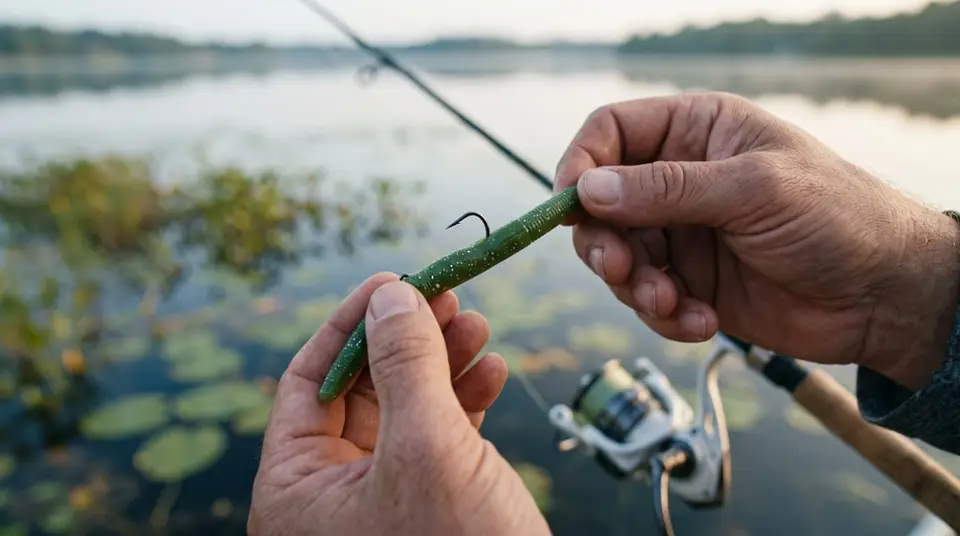
- Imitating crawfish or panfish: a creature bait or crawfish trailer, crawled slowly along a rocky bottom with small, erratic twitches of the reel handle.
- No trailer: just the skirt gives a different action, which the author occasionally uses on heavily fished water.
Colours (from the article)
- Clear water: green pumpkin for a natural look.
- Shad and low visibility: white or white and chartreuse, which help fish find the bait by sight and by the blade’s thump through their lateral line.
- Muddy or tannic water: black and blue, with a trailer that moves water.
- Pre-spawn crawfish: red crawfish colours, as with the spring lipless crankbait bite, when the fish want something more subtle than a lipless crankbait.
- Blades: silver and gold are most common; the author usually picks gold, especially in tannic water.
Retrieve
Most anglers use a straight retrieve, so fish get used to it. The article suggests varying it and adding a few hard cranks to imitate frantic, wounded prey; using a faster retrieve in clear water so fish have less time to inspect the bait; fishing more erratically in warm water and slower in cool water. If you aren’t getting bites, try a different bladed jig, since fish sometimes prefer one model’s vibration over another’s.
Skirt and rod
- Trim or remove the skirt to help it come through grass and to make it “hunt” side to side more, with a slimmer look for clear water and shad.
- Rod: one like a squarebill crankbait rod, with a fast tip and a strong backbone for the hookset; the author uses a 7-foot-3 medium-heavy rod and a lower-gear reel because it makes slow-rolling easier.
A chatterbait and a spinnerbait both use a blade for vibration and flash; our lure selector helps you choose between lures for the conditions.
Sources
- Outdoor Life, How to fish a chatterbait. Read 28 October 2026.
Recommended Gear on Amazon
- Bladed jigs - browse current options and reviews on Amazon.
- Soft plastic trailers - browse current options and reviews on Amazon.
- Fluorocarbon line - browse current options and reviews on Amazon.
As an Amazon Associate, we earn from qualifying purchases - at no extra cost to you. This helps us keep producing free, in-depth guides.