How to Fish a Wacky Rig
A wacky rig is a soft stick worm hooked through the middle so both ends flutter as it sinks. Worms, hooks, O-rings, line and nail or ring weights, where to throw it, how to work it and watch for the bite, following Wikipedia and New York DEC's bass rig table.
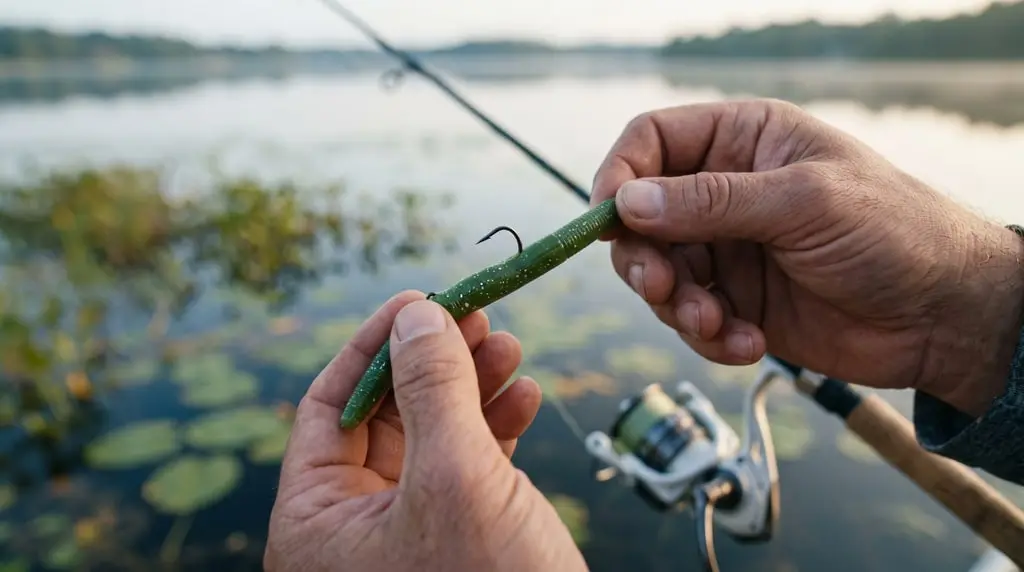
A wacky rig is a soft-plastic worm hooked through the middle instead of at one end, which is where the name comes from. Wikipedia explains that, unlike the Texas rig and Carolina rig, both ends of a wacky-rigged worm flutter, giving a natural action that can tempt finicky fish on hard days. New York DEC lists it among its effective rigs for largemouth and smallmouth bass. This guide covers rigging, weights, where to cast and how to work it.
Rigging
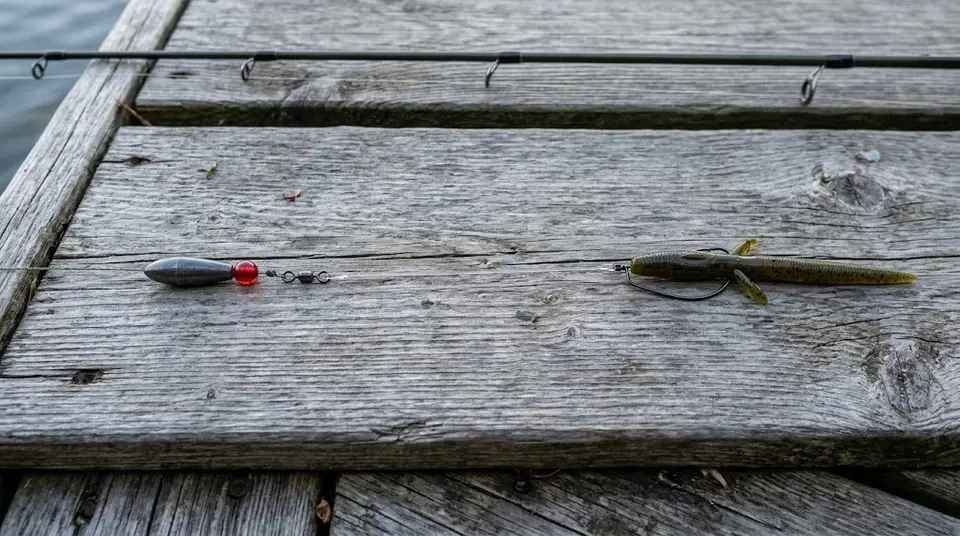
- Worm: 4- to 6-inch worms are usual, most often stick worms, which have the same diameter along their length and a straight tail; they are heavier and give a more erratic action on the fall (Wikipedia). DEC’s version: a 4-inch soft stickworm in natural colours such as green pumpkin or watermelon.
- Hook: through the middle of the worm, with the point exposed. Wikipedia says almost any hook works as long as it is generally smaller than Texas and Carolina rig hooks; DEC uses a size 1/0 circle or octopus hook.
- O-ring: DEC’s rig uses an O-ring around the worm, with the hook through the ring.
- Line: Wikipedia gives lighter line than usual, 6- to 10-pound test, monofilament or fluorocarbon. Our guide to choosing fishing line covers the choice.
Adding weight
Wikipedia describes two weights for fishing deeper, from about 10 to 40 feet:
- Nail weights pushed into the head of the worm, which give an irregular action as it glides to the bottom.
- Ring weights, which let you put the hook through the worm and the ring together.
Where to throw it
Wikipedia says the rig can be used anywhere: around cover, in vegetation, in open water and skipped under docks; see our dock fishing guide. It works year-round but is considered less effective in winter, when bass are sluggish, and clearer water is generally thought better than stained or murky water. DEC lists it for both shallow and deep water.
How to work it
- DEC: let it sink slowly; after it hits bottom, raise it up and let it fall again.
- Wikipedia: let it fall on a slack line, lifting the rod now and then to keep it moving and off the bottom longer. If you get no bite after up to a minute, shake the line to make it look alive, or lift the rod and let it fall again.
- Watch your line: DEC notes you can sometimes see a hit, as a tap or line movement, before you feel it.
Trade-offs
Wikipedia notes the small bait lets bass of all sizes take it, which raises your chance of bites at the expense of very large fish. For a heavier, weedless soft plastic, try the Texas rig; for other light-line methods, see finesse fishing. Our largemouth bass profile covers where bass are.
Sources
- Wikipedia, Wacky rig. Read 28 October 2026.
- New York State DEC, Fishing for largemouth and smallmouth bass. Read 28 October 2026.
Recommended Gear on Amazon
- Soft plastic stick worms - browse current options and reviews on Amazon.
- Wacky rig hooks with weed guard - browse current options and reviews on Amazon.
- Wacky rig tool and O-rings - browse current options and reviews on Amazon.
As an Amazon Associate, we earn from qualifying purchases - at no extra cost to you. This helps us keep producing free, in-depth guides.