How to Fish a Swimbait
Swimbaits imitate swimming baitfish. Hard glide and multi-jointed baits, soft paddle tails, line-through and top-hook baits, rigging a paddle tail on a jig head, the near-bottom retrieve and the mid-cast pause, from Wikipedia and a Wired2Fish technique piece.
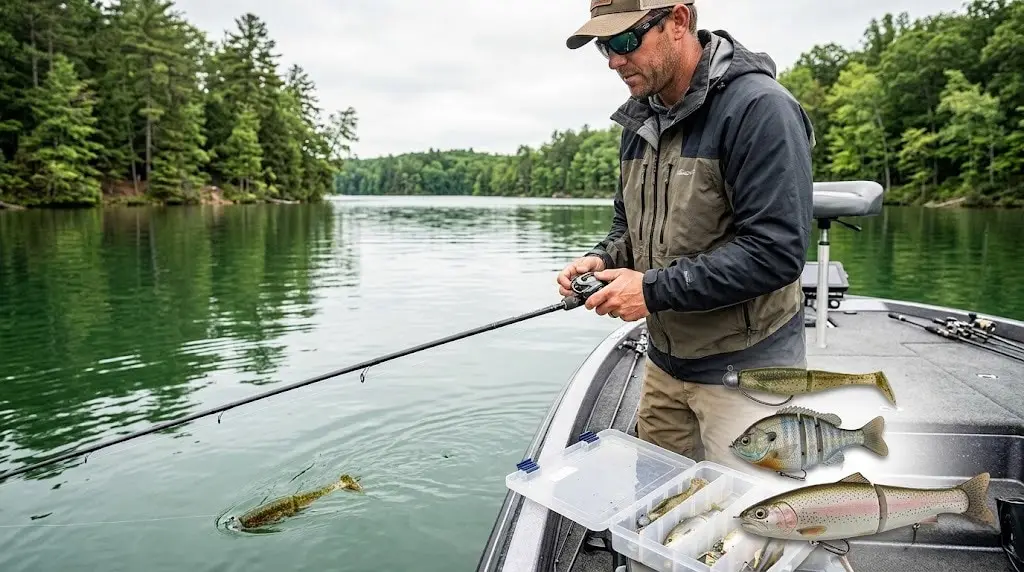
Swimbaits are a loosely defined family of lures designed mainly to imitate the swimming motion of baitfish. Wikipedia traces them to the late 1980s, as larger, more lifelike lures imitating the rainbow trout that largemouth and striped bass fed on in Southern California reservoirs. This guide covers the types, rigging a paddle tail, and the retrieve, following Wikipedia and a Wired2Fish piece on a tournament angler’s paddle-tail technique. The technique is one experienced angler’s method; we have not tested it ourselves.
Types of swimbait (Wikipedia)
Hard-body
Made of wood or plastic and imitating baitfish eaten by bass, pike and trout. The action depends on the number of joints:
- Glide bait: a single joint, which gives a serpentine, gliding movement. Varying speed and technique makes it move erratically like an injured fish.
- Multi-jointed: several segments for a more natural swimming motion.
Soft-body
Made of rubber or soft plastic, like artificial worms:
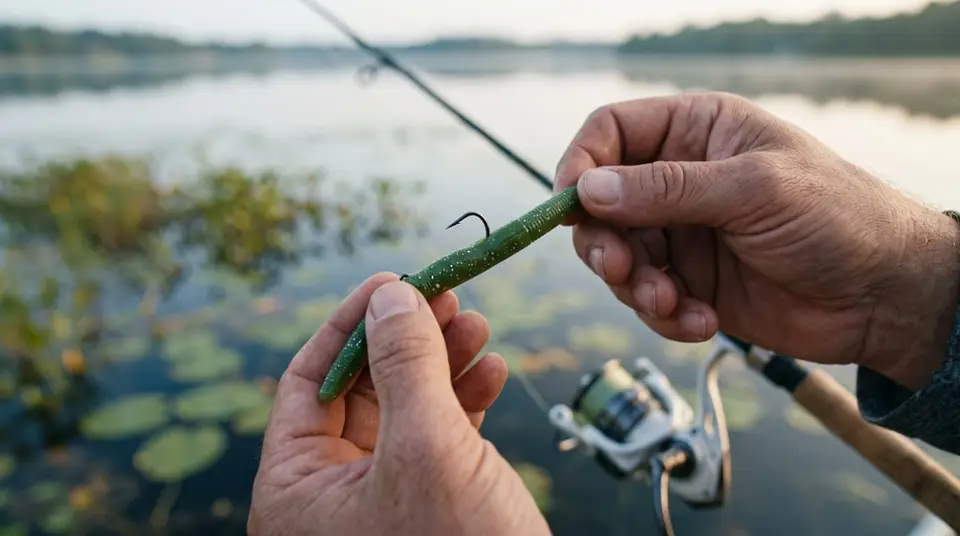
- Paddle tail: the most common type. Small paddle tails are used as trailers on spinnerbaits, chatterbaits and underspins; larger ones go on a swimbait jig head or a weighted extra-wide-gap hook.
- Line-through: the line runs through the body, which keeps a fish from using the bait as leverage to throw the hook.
- Top-hook: a strong jig-style hook through the top, often fished in deep water or rocky places, usually with a wedge tail that gives a subtler action for colder water.
Rigging a paddle tail on a jig head
The Wired2Fish piece focuses on 3- to 4-inch paddle tails for offshore bass:
- A head that locks the bait straight, such as a screw-lock jig head, so the swimbait runs true and survives several fish.
- A bait that swims on the fall and at the slowest retrieve speeds; a constant tail kick imitates shad.
- Lighter line and a heavier head for a deeper running depth and better action: the angler uses 12-pound fluorocarbon. Our guide to choosing fishing line covers line types.
- A slower reel (he uses 6.3:1) to resist reeling too fast, and a rod with a more moderate taper.
The retrieve
- Let it fall to the bottom first, then reel horizontally, just fast enough to keep it a foot or two off the bottom.
- The common mistake, per the article, is fishing it too far off the bottom; keep it low in most situations.
- Pause mid-cast and let it fall back toward the bottom, like a dying shad dropping from a school; the angler says following bass often take it then.
- Hooksets: sweeping, with a slight hesitation, as with a chatterbait.
Our reading water guide helps find the depth and structure to fish, and the largemouth bass and smallmouth bass profiles cover the fish. If you release them, our catch and release guide covers handling.
Sources
- Wikipedia, Swimbait. Read 28 October 2026.
- Wired2Fish, Jacob Wheeler’s tournament paddle tail swimbait technique. Read 28 October 2026.
Recommended Gear on Amazon
- Paddle tail swimbaits - browse current options and reviews on Amazon.
- Swimbait hooks - browse current options and reviews on Amazon.
- Heavy swimbait rod - browse current options and reviews on Amazon.
As an Amazon Associate, we earn from qualifying purchases - at no extra cost to you. This helps us keep producing free, in-depth guides.