Rod and Reel Maintenance Basics
Rinse reels gently after every trip, store them with the drag backed off, lubricate lightly, check rod guides for grooves, fill spools to the right level, and replace line when it frays or fades, following Game & Fish, South Carolina DNR and Wikipedia.
Most tackle care is a few minutes after each trip and a short service once a season. This guide covers rinsing, drag and lubrication, rod guides, spooling and line replacement, and storage, following a Game & Fish guide to reel maintenance, South Carolina DNR’s red drum report and Wikipedia. Your reel’s own manual and parts diagram come first for anything specific to your model.
After every trip
From Game & Fish:
- Rinse with fresh water, gently. Use light pressure straight from the hose, not a spray nozzle: high pressure can force sand, dirt and salt into the reel.
- Tighten the drag before rinsing, especially on spinning reels, to keep water out, and hold spinning reels drag-side down while you rinse.
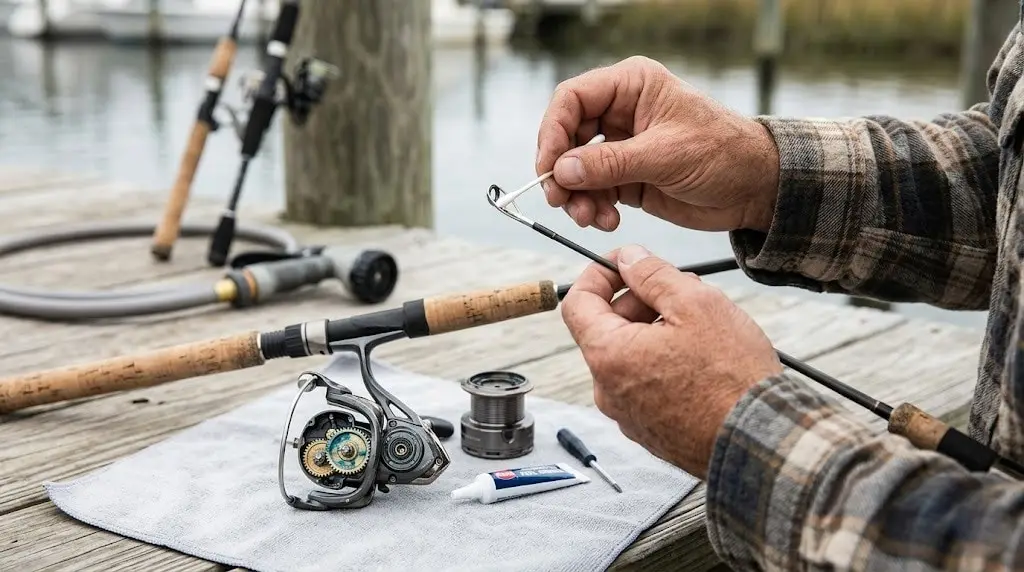
- Let it dry, then lightly lubricate the moving parts you can reach, especially after saltwater or muddy conditions.
- Back the drag off before storing. A drag left tight keeps the washers compressed, which can make it jerky or ineffective; less pressure helps them last.
Lubrication and servicing
- Light lubricant, lightly applied. Game & Fish advises lubricating bearings, spool spindles and gears with a fine, light reel lubricant, not heavy oil or grease that can gum up close-fitting parts, and says not to use general-purpose spray lubricants or petroleum jelly on reels.
- How often: the article says most manufacturers recommend re-lubricating at least monthly, more with heavy use, and at the least once a season. Check your reel’s manual for its schedule.
- Taking a reel apart: clean out old, gummed-up grease with a solvent such as isopropyl alcohol on a cotton swab or soft cloth. Keep the parts in order as you go (an egg carton with numbered cups works), and keep the schematic that came with the reel; it’s the best guide to reassembly.
If a reel needs more than a clean and light lubrication, a reel service shop or the manufacturer is the safer route.
Rod guides
South Carolina DNR’s red drum report warns that line running through chromed stainless-steel guides can wear grooves in them over time, and grooved guides fray and weaken line. It notes newer composite-metal and ceramic guides have reduced the problem, and suggests looking closely at the guides when you buy a rod. Inspect yours from time to time and replace damaged guides before they cost you a fish.
Spooling: how full
- Baitcasting reels: Game & Fish recommends filling to about 90% of capacity; too much line raises the chance of backlash and too little shortens casts.
- Spinning and spincast reels: fill until about 1/8 inch of space remains below the spool lip. Wikipedia notes overfilling a spinning reel is one cause of line springing off in loose loops, while MDC’s casting guide says a well-filled spool helps distance because line doesn’t drag on the spool lip.
- Baitcaster brakes: with the lure tied on, press the free-spool button while lightly thumbing the line; when the brake is set right, the lure drops slowly to the ground and the spool stops without overrunning (Game & Fish).
Our guide to spinning vs. baitcasting reels explains backlash and line twist.
Replacing line
Game & Fish suggests replacing line after a long fight with a hard-fighting fish, after lots of fishing around rocks and snags that nick and abrade it, when the spool is getting low, and whenever it fades, frays or no longer feels supple. South Carolina DNR’s author adds that cheap line is often stiff and tangles easily, and suggests carrying a spare spool already filled. See fishing line explained for line types, and take old line home: Wikipedia notes discarded monofilament can take up to 600 years to break down.
Off-season storage
For a break of a couple of months, Game & Fish suggests stripping the line and leaving it off until just before the first trip of the new season, so you start with fresh line. Store reels with the drag backed off. For travel, see our rod travel cases; for the rest of your kit, our tackle box essentials.
Sources
- Game & Fish, Fishing reel maintenance tips for better performance, longer life. Read 28 October 2026.
- South Carolina DNR, Red drum: natural history and fishing techniques in South Carolina. Read 28 October 2026.
- Wikipedia, Fishing reel and Fishing line. Read 28 October 2026.
- Missouri Department of Conservation, Casting. Read 28 October 2026.
Recommended Gear on Amazon
- Reel grease and oil kit - browse current options and reviews on Amazon.
- Reel cleaning brush set - browse current options and reviews on Amazon.
- Rod socks - browse current options and reviews on Amazon.
As an Amazon Associate, we earn from qualifying purchases - at no extra cost to you. This helps us keep producing free, in-depth guides.