Goliath Grouper
The goliath grouper is the true giant of the reef - a broad, slab-sided grouper that can grow to the size of a small refrigerator and weigh several hundred pounds.
🗓️ Last reviewed: July 2026
Overview
The goliath grouper is the true giant of the reef - a broad, slab-sided grouper that can grow to the size of a small refrigerator and weigh several hundred pounds. Once fished nearly to collapse, it became one of the great conservation stories of the Southeast, protected from harvest for decades so the population could rebuild. Today it is a bucket-list catch-and-release target: an angler hooks a fish that feels like a locomotive, hauls it up from a wreck or bridge piling, snaps a quick photo boatside, and lets it swim back down. The goliath's sheer size, its curious lack of fear, and the drama of stopping a fish that wants to bury itself in structure make it unforgettable. It is not table fare here - it is a living monument to what careful management can restore.
Identification & Appearance
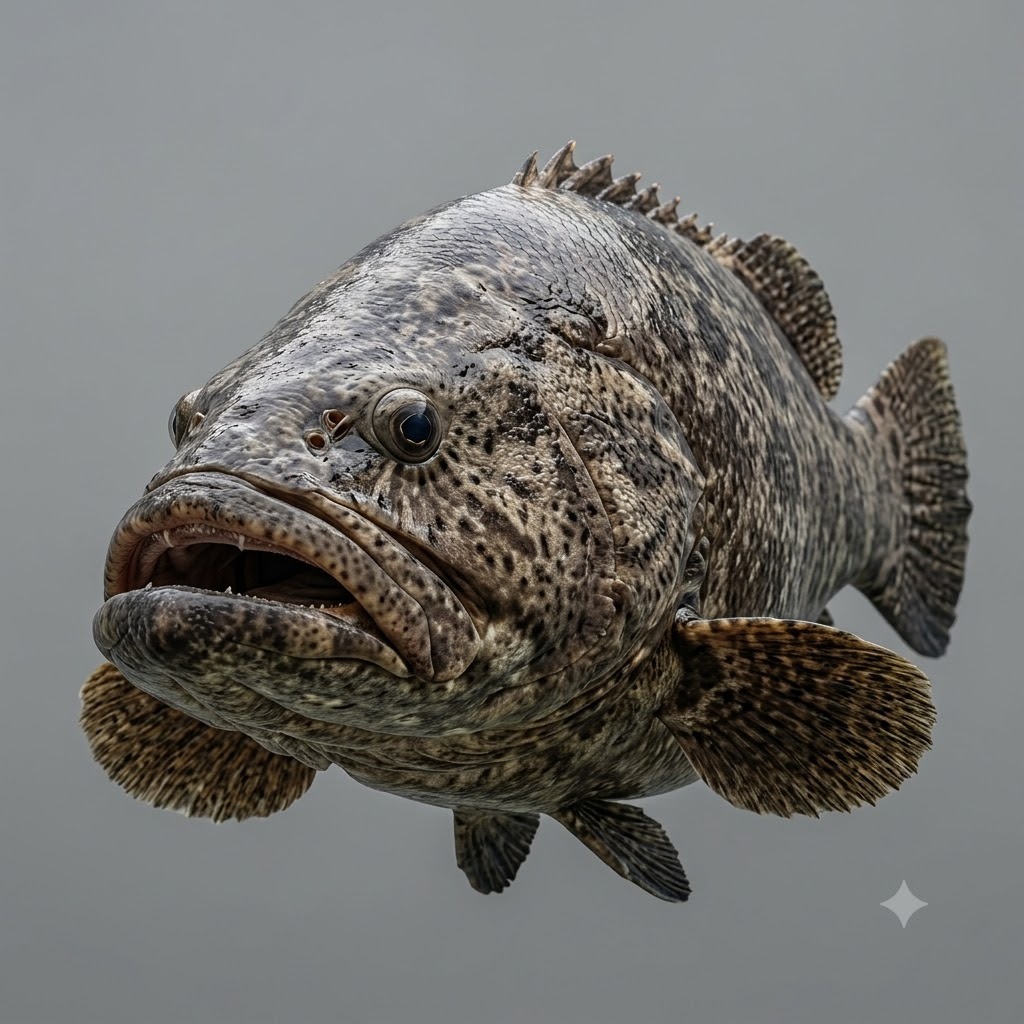
Goliath groupers are unmistakable once they reach any size: a huge, deep, heavily built body, a broad flat head, and a wide mouth that can inhale a whole fish. Coloration is a mottled tawny to greenish-brown or gray, marbled with irregular dark blotches and small dark spots scattered over the head, body, and fins. The eyes are small relative to the massive head, and the tail is rounded rather than forked. Juveniles are more strikingly patterned, with bold dark bars and bright spotting that fade as they grow. Unlike most groupers, the goliath has a broad, rounded profile that looks blocky and tank-like. Its size alone separates it from every other grouper on the reef; a mature adult simply dwarfs everything around it.
Range & Habitat (US waters - inshore / offshore)
In US waters the goliath grouper is centered on Florida, especially the southern half of the state, and ranges into the Gulf of Mexico and along the South Atlantic coast up toward the Carolinas in warmer months. The core population lives in Florida's coastal and offshore waters year-round.
Juveniles are famous residents of mangrove estuaries, using the roots and creeks of red mangrove shorelines as nurseries. As they grow, they move out to structure: bridge pilings, jetties, artificial reefs, shipwrecks, rock ledges, and natural reef holes. Big adults claim a favorite piece of structure and defend it, often the same wreck year after year. Spawning aggregations gather at certain offshore wrecks and reefs in late summer, a spectacle divers travel to witness.
Behavior & Feeding
The goliath grouper is an ambush predator with a vacuum for a mouth. It does not chase prey far; instead it hangs near structure and engulfs whatever passes - crabs, lobster, stingrays, and slower fish - in an explosive gulp that creates an audible "boom" underwater. They are famously bold and territorial, sometimes following divers or trying to steal hooked fish off an angler's line. Once hooked, a goliath's entire game plan is to turn and power straight back into the structure, wedging itself into a hole or wrapping the line on a wreck. They are strong rather than fast, using bulk and leverage. This is why the fight is a short, brutal tug of war rather than a long run.
Best Seasons & Times to Catch
Goliath groupers are catchable year-round in southern Florida, but summer is the classic season. From roughly June through September they gather in spawning aggregations on offshore wrecks, and encounter rates on structure peak. Warm-water months also pull fish onto nearshore reefs, bridges, and jetties where shore and small-boat anglers can reach them. Low-light periods and moving tides tend to fire up feeding around inshore structure like bridges and piers. In cooler months the fish are still present but less concentrated. As a rule: fish structure hard in summer, fish moving tide around bridges and piers, and expect the biggest fish on the most established wrecks.
Where to Find Them - Reading the Water
Think structure, and the bigger and more solid the better. Bridge and pier pilings, rock jetties, deep channel edges, artificial reefs, rock piles, and shipwrecks all hold goliaths. Inshore, look for the deepest, most current-swept pilings on a bridge and the darkest holes under a dock or jetty. Offshore, a wreck marked on the sounder with a big, solid return near the bottom often means a resident giant. A quiet sounder over a wreck can light up the moment a bait drops. Watch for the characteristic hard "thump" and immediate dive when one eats - there is rarely any doubt. Juveniles reveal themselves in mangrove creeks, tucked in the roots and shade.
Tackle & Rigs
This is heavy-tackle fishing by necessity. Stopping a several-hundred-pound fish before it reaches structure demands a short, powerful stand-up rod, a large lever-drag reel, and heavy line - anglers routinely use very heavy braided main line and extremely heavy leaders. Every connection must be strong, because a goliath tests the weakest link instantly.
The standard rig is a simple, strong bottom setup: a heavy circle hook snelled to a short, very heavy monofilament leader, with enough weight to hold the bait near the structure in current. Circle hooks are essential - they lodge in the corner of the jaw and make release far cleaner and safer for the fish. Everything is oversized: big swivels, heavy crimps, and hooks matched to a mouth that can swallow a bait the size of a football.
Best Baits & Lures
Big live baits rule. A live jack, mullet, ladyfish, or other hearty baitfish presented near structure is the classic offering, and large fresh cut baits such as whole fish heads or big chunks work well because goliaths hunt partly by scent and vibration. The bait is meant to be big - this is a fish that eats other predators.
Artificial lures are not the usual approach for goliaths, though large jigs are occasionally taken. The name of the game is a substantial natural bait, alive or freshly cut, fished tight to the structure the fish calls home. Because a goliath commits hard and fast, the bait needs to be pinned on a strong circle hook and ready for an immediate, powerful hookup.
Techniques - How to Fish for It
The core technique is a controlled ambush at close range. Position over or up-current of the structure, drop a big bait down, and be ready - the strike is often immediate and violent. The critical first seconds decide everything: you must turn the fish's head and gain line before it reaches its hole, so anglers lock down heavy drag and use their whole body, braced against the rail, to pull. Let the circle hook do its job; do not swing wildly. Once the fish clears the structure the fight becomes a heavy, grinding lift. At the surface, keep the fish in the water - a goliath is far too heavy to hoist aboard safely and doing so can injure both fish and angler. Photograph it boatside and release it quickly.
Common Mistakes
The number one mistake is undergunned tackle - light gear simply cannot stop a goliath, and the fish breaks off in the structure, leaving hooks and line behind. Hesitating on the hookset lets the fish reach its hole. Trying to lift a giant out of the water for a "hero shot" is both dangerous and harmful to the fish; the correct move is a boatside photo. Fishing away from structure wastes time, since goliaths rarely stray far. And ignoring the regulations is a serious error: this is a protected species with strict rules, and mishandling or harvesting one carries real consequences.
Size, Records & Eating Quality
Goliath groupers are enormous - mature adults commonly run well over 100 pounds, and the largest historically reached several hundred pounds. They are among the biggest bony fish on the reef. Growth is slow and the fish are long-lived, which is exactly why the population was so vulnerable to overharvest. As for eating quality, the point is moot: the goliath grouper is protected and is a catch-and-release fish. Harvest has been prohibited or extremely tightly restricted for many years to allow the stock to recover, and any limited take that exists is governed by special permits and strict rules. Always check current state and federal regulations before targeting one, and treat every goliath as a release.
Pros & Cons (as a target species)
Pros: An unforgettable, arm-testing fight with a truly giant fish; accessible from bridges, piers, and jetties as well as offshore wrecks; a great catch-and-release trophy; a conservation success story you get to be part of. Cons: Requires heavy, specialized tackle; protected status means release only, with strict handling rules; not a table fish; the fight can be hard on gear and angler alike; easy to lose in structure if you are not prepared.
Best Suited For
The goliath grouper suits anglers who want raw power and a genuine trophy experience rather than a fish for the table. It is ideal for those willing to invest in heavy gear and to prioritize the fish's welfare on release. Beginners can hook one from a bridge with a guide's help, while experienced offshore anglers chase the true giants on deep wrecks. Above all, it suits conservation-minded anglers who take pride in a careful catch, a fast photo, and a clean release.
FAQ
Can I keep a goliath grouper? No - in US waters the goliath grouper is protected, and harvest is prohibited or extremely tightly limited under special permit only. Treat it as a strictly catch-and-release fish and check current regulations.
How big do goliath groupers get? They commonly exceed 100 pounds, and the largest historically reached several hundred pounds, making them one of the largest reef fish anywhere.
Why is it illegal to keep them? Decades of overharvest collapsed the population. Protection allowed a slow-growing, long-lived fish to rebound, and it remains a carefully managed conservation success.
How do I handle one for release? Keep the fish in the water. It is far too heavy to lift aboard safely, so photograph it boatside, use circle hooks to make hook removal easier, and release it quickly.
What tackle do I need? Heavy stand-up gear - a short powerful rod, a large lever-drag reel, very heavy braided line and leader, and a strong circle hook - because you must turn a huge fish away from structure fast.