Gray Triggerfish
The gray triggerfish - known to bottom anglers across the US Atlantic and Gulf as simply the "trigger" - is a tough, oval, deep-bodied reef fish that punches well above its size and tastes like a million dollars on the plate.
🗓️ Last reviewed: June 2026
Overview
The gray triggerfish - known to bottom anglers across the US Atlantic and Gulf as simply the "trigger" - is a tough, oval, deep-bodied reef fish that punches well above its size and tastes like a million dollars on the plate. Triggerfish are a structure-bound bottom fishery beloved by reef, wreck, and rig anglers from the Carolinas around through Florida and across the Gulf of Mexico, often caught on the same drops as snapper and grouper. They are armored in thick, leathery skin, armed with small but razor-sharp teeth and a locking dorsal spine - the "trigger" that gives them their name - and they are notorious bait-stealers that can pick a hook clean before you ever feel the bite. The reward is a stubborn, surprisingly strong fight from a small fish and some of the sweetest, whitest fillets in the ocean. For anglers who love bottom fishing over reefs and wrecks and prize a fish that eats as well as anything that swims, the gray triggerfish is a favorite and a true bottom-fishing prize.
Identification & Appearance
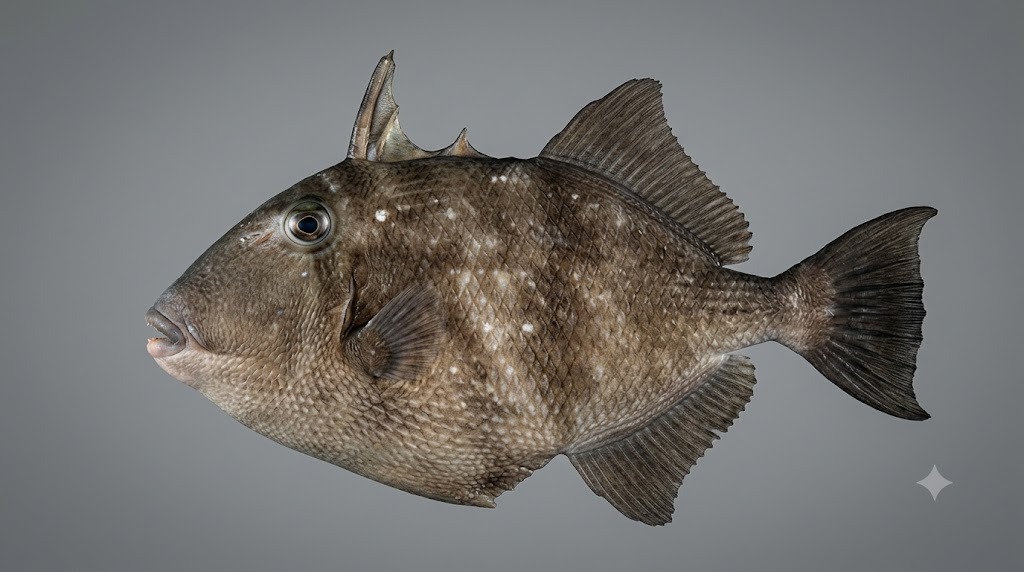
Gray triggerfish are deep, laterally compressed, oval-bodied fish with a tough, leathery, scaleless-looking hide and a small mouth set with strong jaws and tiny, sharp incisor-like teeth. They are typically gray to olive-gray or brownish, often able to shift shade and show faint mottling or pale blotches that help them blend into reef and rubble. The most distinctive feature is the dorsal armament: a stout first dorsal spine that locks upright and can only be released by depressing a smaller second spine behind it - the "trigger" - a mechanism the fish uses to wedge itself immovably into crevices. The soft dorsal and anal fins are long and symmetrical near the rear of the body, and the fish swims with an undulating, almost hovering motion using those fins. The eyes are set high and far back on the head, well away from the small mouth, an adaptation for a fish that pokes into urchins and crusty bottom. The skin is famously tough - so tough that cleaning a trigger takes a sturdy knife - and the overall impression is of a compact, well-armored, oddly graceful little tank.
Range & Habitat (US waters - inshore / offshore)
Gray triggerfish range widely in the western Atlantic, found from roughly Nova Scotia and New England south through the Carolinas, Georgia, and Florida, and all the way around the Gulf of Mexico, with the heart of the US fishery in the warm waters of the South Atlantic and the Gulf. They are an iconic structure fish of the reefs, wrecks, and rigs of the southeastern coast.
Gray triggerfish are firmly structure-oriented. They live on and around hard bottom of every kind - natural rock and limestone reefs, ledges, wrecks, artificial reefs, nearshore and offshore oil and gas platforms ("rigs"), and any rubble or relief that holds life. They favor moderate depths over hard bottom, commonly from a few dozen feet out to well over a hundred, and they relate tightly to the structure, hovering above and around it rather than roaming open water. Smaller fish often hold shallower and around nearshore reefs and even floating debris, while larger fish tend to be taken on deeper offshore reefs, wrecks, and rigs. Wherever there is reef relief and food, triggerfish are usually somewhere in the water column nearby.
Behavior & Feeding
Gray triggerfish are crustacean-and-shellfish specialists with small, powerful jaws and a deliberate, structure-bound lifestyle. They use their tiny sharp teeth and strong bite to nip and crunch crabs, shrimp, barnacles, mollusks, sea urchins, and other hard-shelled invertebrates off the reef, and they are remarkably precise feeders - capable of taking just the soft parts off a bait and leaving the hook bare. They hover and maneuver around structure with their undulating fins, often holding above the reef and dropping down to pick at food, and they are curious and aggressive around a baited drop, frequently swarming a chum slick or a bait sent to the bottom. Their bite is famously subtle and tricky - a series of light taps and tugs as the fish pecks and nibbles the bait - which is exactly why they are such notorious bait-stealers. When alarmed, a trigger will dart into a crevice and lock its dorsal spine to wedge itself in place, making it nearly impossible to extract. They feed by a combination of sight and that precise, probing mouth, and the whole game for the angler is detecting the soft bite and setting the hook fast before the bait is gone.
Best Seasons & Times to Catch
Gray triggerfish are available much of the year over their reefs and wrecks, but warm-water months generally offer the most consistent action, when fish are active and feeding hard around structure. Spring through fall is prime for most of the range, with triggerfish readily mixing into reef and bottom-fishing trips alongside snapper and grouper. Because they are federally managed in the Gulf and South Atlantic with specific open and closed seasons that change from year to year, the practical "best time" to keep them is dictated as much by the regulatory season as by the bite, so always confirm current open dates before a trip. Within a day, triggerfish bite well when bait can be presented cleanly on the structure, and many anglers find that a steady chum slick brings them up and turns on the feed, sometimes drawing fish well off the bottom where they are easier to target. Calm conditions that let you anchor or hold precisely over a piece of reef or wreck make the fishing far more effective, since triggers relate so closely to a specific patch of structure.
Where to Find Them - Reading the Water
Find the reef, find the triggers - and precision pays. Productive spots are natural rock and limestone reefs, ledges and drop-offs, wrecks, artificial reefs, rubble piles, and oil and gas platforms, anywhere with hard bottom and relief that holds invertebrate life. The best triggerfish spots are pieces of structure that concentrate fish, and accurate boat positioning over them matters, because triggers hold tight to the relief and hover around it. A good sounder is the key tool - look for hard, irregular bottom, wreck profiles, and bait and fish marks stacked over the structure, and anchor or spot-lock so your baits land right on the spot. Triggerfish often appear in the water column above the reef rather than glued to the bottom, so watch for marks suspended over the structure and be ready to fish a bait higher than you would for snapper or grouper. From a rig, fish tight to the legs and cross-members where life encrusts the steel. As a rule, the livelier and more food-rich the reef or wreck, the more likely it holds a school of triggerfish.
Tackle & Rigs
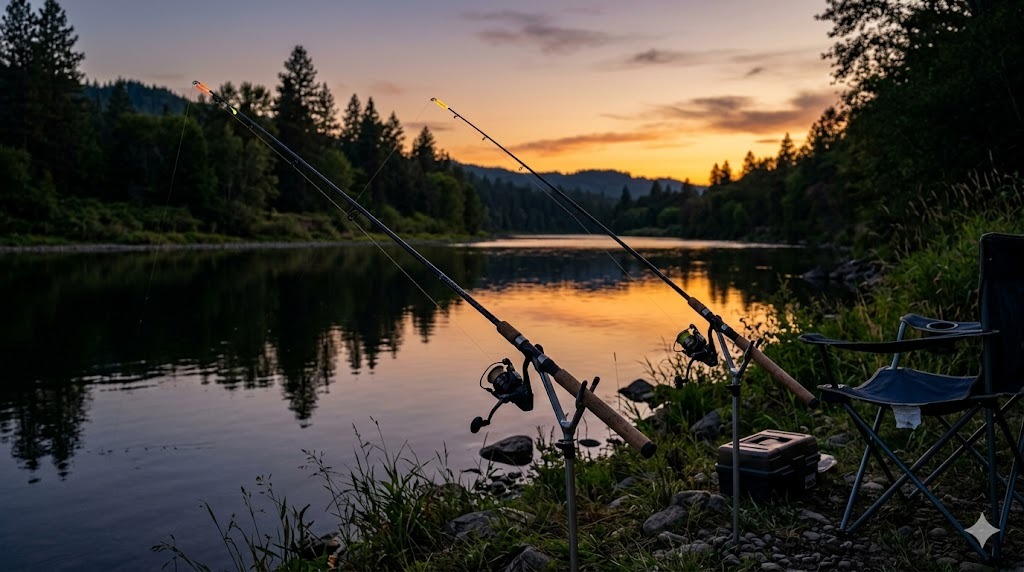
Triggerfish fishing rewards a sensitive but sturdy setup, because you must feel a soft, picky bite, set the hook fast, and pull a strong, structure-loving fish up away from snags. A medium to medium-heavy fast-action conventional or spinning rod with a sensitive tip and a solid backbone is ideal, matched to a quality reel loaded with 20-40 lb braid. Braid is a big advantage here for the sensitivity to detect the light taps and for the no-stretch power to drive a small hook home and turn the fish quickly. A short length of abrasion-resistant fluorocarbon or mono leader, often 20-40 lb, finishes the connection and helps near the structure.
The terminal setup is where triggerfish demand attention: because of their small mouths and bait-stealing skill, small, strong, sharp hooks are essential - a small-but-stout J-hook or a snell of compact hooks in the range that fits a trigger's little mouth, fished on a simple dropper or knocker rig above a bank or egg sinker heavy enough to hold bottom (commonly a couple of ounces up to several, depending on depth and current). Many anglers downsize the hook specifically for triggers and keep the bait small and tight to the hook so the point stays clear. Because the reef and wreck claim terminal tackle, bring plenty of hooks and sinkers. Strong, small, very sharp hooks and a clean, direct rig are the priorities.
Best Baits & Lures
Gray triggerfish are overwhelmingly a bait fishery, and small, tough natural baits are the undisputed top choice. Squid - cut into small strips or chunks - is a everyday standard that stays on the hook through the pecking; fresh or peeled shrimp is excellent and highly attractive; and small pieces of cut fish, crab, and other shellfish all take triggers well. The key with any bait is to keep it small and threaded firmly so the point stays clear and the fish cannot simply nibble the soft parts away - many anglers use just enough bait to cover a small hook and no more, precisely because triggers are such expert thieves. A chum slick of cut bait or commercial chum is a powerful tool that draws triggerfish up off the structure and concentrates them around the boat, often turning a slow bite into a fast one.
Lure fishing for triggerfish is a smaller niche, but they will hit small jigs and bits of artificial tipped with squid or shrimp fished tight to the structure, which can be an engaging way to target them and feel the bottom directly. Still, for most anglers most of the time, a small piece of squid or shrimp on a small strong hook, fished right on the reef or wreck and often over chum, is the reliable producer.
Techniques - How to Fish for It
Triggerfish fishing is precise bottom and near-bottom fishing over structure. Anchor or hold position over a reef, wreck, ledge, or rig, and drop a small-baited rig down to the structure, keeping the sinker on or near the bottom and the bait tight to the relief. Often it pays to start a chum slick to bring the school up, then watch the sounder and your line - triggers frequently rise off the bottom to feed, so be ready to fish a bait higher in the column when they do. The bite is the crux: triggers peck and tap and nibble as they test and pick at the bait, and the art is to feel those light taps, resist the urge to wait too long, and set the hook fast and firmly the instant you sense the fish on the bait - a slow or soft set means a clean-stolen bait every time. Keep the hook small and sharp and the bait minimal so the point comes through on the set. Once hooked, a trigger fights hard and will try to dart back into the structure, so lift and crank steadily to keep it coming up and away from the snags. If you are getting picked clean without hooking up, downsize the bait and hook further and sharpen your timing. Fast, decisive hooksets combined with small clean baits are the whole technique.
Common Mistakes
The classic mistake is using too large a hook and too much bait - a trigger's small mouth and surgical nibbling mean a big hook buried in a big bait gets cleaned off without ever hooking up. The opposite problem is setting too slowly or too softly; triggers steal bait in an instant, so a lazy hookset loses the fish. Failing to keep the point clear, by burying the hook in a wad of bait, is a constant cause of missed fish. Not using chum, or not paying attention when the school rises off the bottom, leaves easy fish uncaught, since triggers often feed best up in the water column over the structure. Poor positioning that puts baits off the relief cuts the bite, because triggers hold tight to specific structure. Many anglers also bring too little terminal tackle and run short of hooks and sinkers after the reef claims its share. Finally, careless handling around the sharp teeth and the locking dorsal spine leads to cuts and pokes, so respect both ends of the fish.
Size, Records & Eating Quality
A typical keeper gray triggerfish runs roughly 12-16 inches and one to a few pounds, with good fish in the 3-5 pound range and trophies reaching into the high single digits; fish over 5 pounds are notable and the largest are exceptional for the species. The IGFA all-tackle world record is a gray triggerfish of about 13 pounds, 9 ounces, caught off Murrells Inlet, South Carolina, in 1989. On the table, gray triggerfish are superb - dense, firm, sweet, snow-white fillets that many bottom anglers rank among the very best eating fish in the ocean, excellent fried, baked, grilled, or in chowder, with a clean mild flavor that wins over almost everyone. The catch is the cleaning: the skin is famously thick and tough and the fish yield modest fillets, so they are a bit of work for the meat you get, but the quality more than rewards the effort. Because triggerfish are slow-growing and heavily targeted on their concentrated structure, they are federally managed in the Gulf and South Atlantic with size limits, bag limits, and open and closed seasons that vary by region and change frequently, so always check current regulations before keeping fish.
Pros & Cons (as a target species)
Pros: Tough, surprisingly strong fighter that punches above its size; some of the sweetest, whitest, best-eating fillets in the ocean; readily mixes into reef and bottom-fishing trips alongside snapper and grouper; available much of the year over reefs, wrecks, and rigs; engaging and rewarding for anglers who enjoy beating a clever, bait-stealing fish at its own game. Cons: Notorious bait-stealer with a tricky, subtle bite that frustrates newcomers and demands small hooks and fast sets; tough thick skin makes them a real chore to clean for modest fillet yield; sharp teeth and a locking dorsal spine require careful handling; relates tightly to structure, so precise positioning is needed; strictly regulated with size limits, bag limits, and frequently changing seasons; largely a bait-only fishery.
Best Suited For
Gray triggerfish are best suited to bottom and reef anglers who enjoy a tactical structure fishery and prize outstanding table fare, and who do not mind a finicky bite and a tough cleaning job in exchange for some of the best eating in the sea. They are a natural addition to any snapper or grouper trip and a favorite of anglers fishing reefs, wrecks, and rigs across the Gulf and South Atlantic. The subtle, bait-stealing bite means there is a genuine learning curve - mastering the small hook, the minimal bait, and the fast set rewards experience and attention. Beginners can certainly catch triggers, especially over an active reef with chum and small squid baits, but learning to convert those light taps into hookups takes practice. In short, the gray triggerfish is a reef angler's prize: a tough, clever, delicious little tank for anglers who enjoy outsmarting a wary bait-thief in its rocky home.
FAQ
Is gray triggerfish good to eat? Yes - triggerfish are among the finest eating fish in the ocean, with dense, sweet, firm, snow-white fillets that are excellent fried, baked, grilled, or in chowder. The skin is very tough to clean, but the meat is worth it.
Why do triggerfish steal my bait? Triggers have small mouths and tiny sharp teeth and nibble the soft parts off a bait with surgical precision. If you keep getting cleaned out, downsize the hook, use a small bait threaded so the point stays clear, and set the hook fast at the first taps.
What is the best bait for gray triggerfish? Small tough baits like squid strips, fresh or peeled shrimp, and small pieces of cut fish or crab are the top choices. Keep the bait small and the hook small and sharp, and a chum slick will bring the school up.
Where do gray triggerfish live? On and around hard structure - reefs, ledges, wrecks, artificial reefs, rubble, and oil and gas rigs - in moderate to deeper water across the US Atlantic and Gulf. They hold tight to structure and often hover above it in the water column.
What is the "trigger" on a triggerfish? It is the stout first dorsal spine, which locks upright and can only be lowered by depressing a smaller second spine behind it. The fish uses it to wedge into crevices, and anglers handling one should mind that spine and the sharp teeth.