Pacific Halibut
The Pacific halibut is the giant of the cold North Pacific bottom - a massive, diamond-shaped flatfish that can top a hundred pounds and pull like a barn door coming off the seafloor.
🗓️ Last reviewed: June 2026
Overview
The Pacific halibut is the giant of the cold North Pacific bottom - a massive, diamond-shaped flatfish that can top a hundred pounds and pull like a barn door coming off the seafloor. Found across the deep, cold waters of Alaska and the Pacific Northwest, halibut are the premier bottom-fishing target of the region, the fish that fills coolers and freezers and anchors countless charter trips out of ports like Homer, Seward, and Sitka. They are right-eyed flatfish that lie on the bottom in deep water, ambushing fish, squid, octopus, and crabs, and they hit a bait hard and then fight with sheer dead weight, slabbing and surging all the way up from a hundred feet or more. Targeting them means heavy rods, stout reels, big baits or jigs, circle hooks, and the patience to grind a big fish off the bottom. The reward is a brutal tug-of-war and some of the finest white table fish in the ocean - firm, mild, snow-white fillets that are prized in kitchens everywhere. Halibut fishing is also among the most tightly regulated saltwater fisheries in the country, with short seasons, strict limits, and serious safety considerations around landing very large fish. For anglers who want a true heavyweight and a freezer full of premium fillets, the Pacific halibut is the trophy of the North.
Identification & Appearance
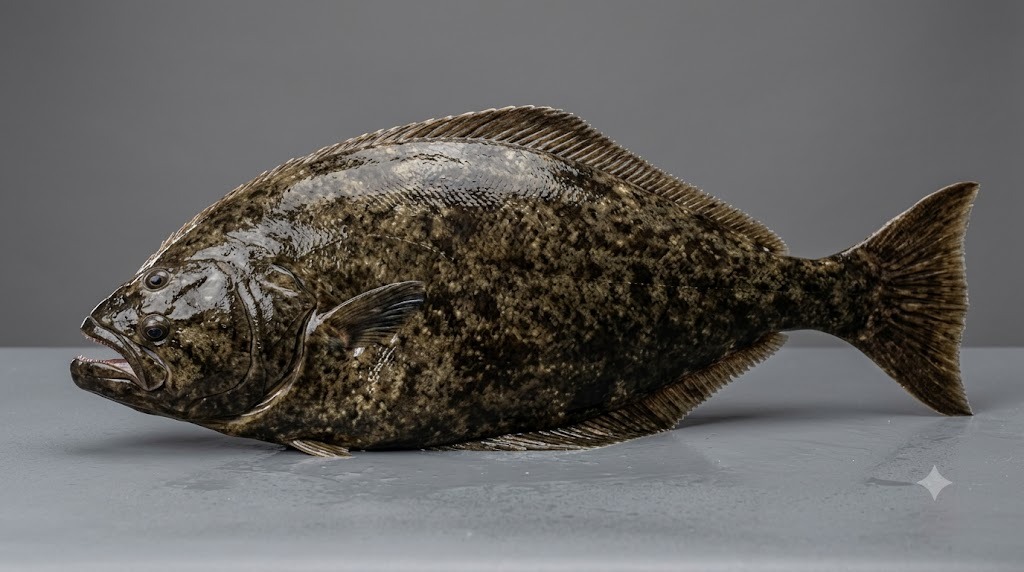
Pacific halibut are large, flat, diamond-shaped fish that lie on their side on the bottom, with both eyes on the upper (right) side of the body - they are a "right-eyed" flatfish, meaning when the dark eyed side faces up the head points to your right. The eyed (top) side is dark gray to greenish brown or nearly black, often mottled and blotchy to match the seafloor, while the blind (bottom) side is pale white. The body is broad and powerful, far thicker and more muscular than the small "doormat" flounders many anglers know, and a big halibut is a genuine slab of dense fish. The mouth is large and the jaws are armed with sharp teeth, fitting a fish that eats other fish whole. The tail is broad and slightly forked, giving real power on the surge. Pacific halibut closely resemble their Atlantic cousins but are the dominant species of the North Pacific. Anglers distinguish them from the smaller arrowtooth flounder and other flatfish by their size, their relatively symmetrical diamond shape, and their lunate (crescent) tail. The overall impression is of an enormous, flat, immensely strong bottom fish built to lie in wait and overpower its prey.
Range & Habitat (US waters - inshore / offshore)
Pacific halibut range across the cold North Pacific, from California north along the coast through Oregon, Washington, and British Columbia, and around the great arc of Alaska - the Gulf of Alaska, the Aleutian Islands, and the Bering Sea - which is the heart of the fishery. The vast majority of the US recreational catch comes from Alaska, with a meaningful fishery also off Washington and Oregon. They are a cold-water, deep-water fish, most abundant in the productive waters of the far North.
Pacific halibut are bottom dwellers that live on and just above the seafloor, favoring sand, gravel, and mud bottoms, often near edges, drop-offs, underwater banks, humps, and channels where currents concentrate baitfish. Depending on season and location they are caught anywhere from relatively shallow water of a few dozen feet to well over a few hundred feet deep, and big fish are often found in deeper water. They move seasonally - generally shallower in the warmer months to feed and deeper in winter to spawn - and they relate to structure and current edges on the bottom where food gathers. Because they live deep and on the bottom, halibut are almost entirely a boat fishery, and locating productive bottom with a good sounder and chart is central to finding them.
Behavior & Feeding
Pacific halibut are powerful, opportunistic ambush predators of the seafloor. They lie flat on the bottom, often partly buried or resting motionless, blended into the substrate, and wait for prey to pass - then they rise off the bottom in a surprisingly quick rush to engulf it. They are aggressive, effective predators that eat a wide range of food: fish such as herring, cod, pollock, sand lance, and smaller flatfish, along with octopus, squid, crabs, and other bottom life, and big halibut will take large prey, including good-sized fish. They feed primarily by sensing movement, vibration, and scent on the bottom, and a fresh, oily, smelly bait or a bait that puts out vibration draws them in. The take is often a heavy thump or a series of taps as the fish mouths the bait, followed by solid weight; with circle hooks the angler resists the urge to swing and instead lets the fish turn and load the rod, which sets the hook in the corner of the jaw. Once hooked, a halibut fights with deep, dogged dead weight, slabbing its broad flat body against the pull and surging powerfully, especially a big fish that uses the current and its sheer mass. They feed actively when current moves food along the bottom, which is why tide and drift matter so much. The whole pattern is of a heavy, ambush-feeding bottom giant that rewards a good scent trail and a patient, powerful fight.
Best Seasons & Times to Catch
Pacific halibut fishing is driven heavily by the regulated season, which is set annually by managers and typically opens in spring and runs through the warmer months into fall, with the exact open dates varying by area and year - so the practical "season" is whatever the current regulations allow. Within the open season, the prime fishing is generally late spring through summer and into early fall, when halibut move onto the feeding grounds, water is more workable, and weather allows boats to reach the grounds. Summer is the marquee time for the Alaska charter fishery, with long days and large numbers of fish on the banks. As fall progresses and winter approaches, halibut move deeper to spawn and the fishery winds down, and winter fishing is limited by both regulation and brutal sea conditions. Within a day, moving water is key - many halibut anglers favor the stronger stages of the tide and the hours around tide changes, because current carries scent and moves baitfish along the bottom and turns the fish on. Slack tide often slows the bite. Calm-enough weather to anchor or drift safely and hold bottom is essential, and the best days combine a good tide with workable seas over productive bottom. Always confirm the current open dates and rules before planning a trip, because the season is short and strictly enforced.
Where to Find Them - Reading the Water
Finding halibut means reading the bottom. Productive water is sand, gravel, and mud seafloor near features that concentrate food: underwater banks and humps, the edges of drop-offs and channels, points and reefs, and the current seams where moving water sweeps baitfish along. A good sounder and chart are essential - look for the right depth for the season, hard-to-soft bottom transitions, structure rising off the floor, and signs of baitfish, and watch for fish marks holding right on the bottom. Halibut relate strongly to current edges, so positioning the boat to drift a bait along a productive edge or anchoring up-current of a hump so your scent washes down to the fish are proven approaches. Depth varies widely with area and season, from a few dozen feet to several hundred, and bigger fish often hold deeper. Local knowledge and charts of known banks and holes are invaluable, and experienced skippers work a milk run of productive spots, moving until they find biting fish. As a rule, find the right depth, the right bottom, and moving water near a feature that gathers bait, and you have found the halibut grounds.
Tackle & Rigs
Halibut fishing demands heavy, powerful gear because you are fighting very large, heavy fish in deep water and current. A stout 6.5- to 7.5-foot heavy or extra-heavy bottom rod with plenty of backbone is standard, matched to a strong conventional reel with a good drag and ample line capacity - a sturdy level-wind or two-speed conventional reel is the workhorse. Heavy braided main line, commonly in the 80- to 130-pound class, is preferred for its thin diameter, low stretch, and the sensitivity and lifting power needed to feel the bottom and move a big fish through deep water and current; a strong leader of similar or heavier monofilament or braid completes the connection. The depth and current demand heavy weight to hold bottom - sinkers commonly run from a half pound to several pounds depending on depth and tide.
The standard terminal setup is a heavy bottom rig built around circle hooks, which are strongly recommended (and in places required) for halibut because they reliably hook the fish in the corner of the jaw, improving landing and the survival of released fish. Common rigs include a sliding-sinker bait rig with a large circle hook, a spreader bar holding a bait and weight apart to reduce tangles, or a heavy leadhead jig fished directly. Hooks are large - often in the heavy circle-hook sizes appropriate to big baits and big fish. Because of the depth, weight, and size of the fish, everything in the system is built stout: strong swivels, heavy leader, sturdy hooks, and enough weight to stay pinned to the bottom. Many anglers also keep a release mechanism, gaff, harpoon, and other heavy-fish gear ready, since landing a large halibut is a serious task.
Best Baits & Lures
Pacific halibut are drawn by scent and movement, and big, oily, smelly natural baits are the top producers. Herring is a classic and widely used bait, fished whole or in chunks; large pieces of octopus are an outstanding and very durable halibut bait that stays on the hook through hard current and pecking; squid, salmon heads and bellies, and chunks of other oily fish all take halibut well. Many anglers combine baits - for example a herring paired with octopus or a salmon belly - to maximize both scent and toughness on the hook. The key is a bait that puts out a strong scent trail in the current and is tough enough to stay presented near the bottom; fresh, oily, bloody baits draw fish from a distance.
On the artificial side, heavy leadhead jigs are very effective and increasingly popular for halibut, especially large leadhead jigs and metal jigs worked near the bottom, often tipped with a piece of bait or a soft-plastic trailer to add scent and action. Jigging lets the angler cover the bottom actively, impart enticing movement, and feel the take directly, and it can be a deadly and engaging way to target halibut, particularly over structure. Large soft-plastic swimbaits on heavy leadheads also produce. Still, for many anglers most of the time, a big chunk of oily bait on a circle hook fished hard on the bottom in good current is the reliable, proven method.
Techniques - How to Fish for It
Halibut fishing is deep, heavy bottom fishing built around getting a scented bait to the seafloor and keeping it there in the current. The two core approaches are anchoring and drifting. Anchoring up-current of a productive hump or edge lets your bait sit on the bottom while the tide washes its scent down to the fish, drawing them to the boat - a deadly method in strong current over a known spot. Drifting carries the bait or jig along productive bottom, covering water and presenting to fish spread along an edge, with the angler keeping the weight ticking the bottom as the boat moves. Either way, the essentials are the same: get to the bottom with enough weight to hold, keep contact with the seafloor, and let the scent and presentation work. When a halibut bites - often a heavy thump or a load of weight - the crucial discipline with circle hooks is to resist the hard swing; instead, let the fish take the bait and turn, then lift steadily into it and let the circle hook find the jaw corner. Once hooked, settle in for a heavy fight: keep steady pressure, pump and reel to gain line, and grind the fish up from the depths, expecting strong surges, especially near the surface. Landing a big halibut is its own challenge and a real safety matter - large fish are extremely powerful and should be subdued and controlled before bringing them aboard, and skippers commonly use a harpoon, gaff, and other gear and never bring a green, thrashing big halibut into the boat. Patience getting to and holding the bottom, discipline on the circle-hook set, and steady power on the fight are the whole technique.
Common Mistakes
The classic mistake with circle hooks is swinging hard to set the hook the way you would with a J-hook - this pulls the bait out of the fish's mouth, whereas a circle hook works by the angler simply coming tight and letting the fish turn. Another common error is not using enough weight, so the bait washes off the bottom in the current and never reaches the fish, or losing contact with the bottom on the drift. Fishing the wrong depth or unproductive bottom, rather than reading the chart and sounder to find the right banks and edges, wastes the day. Undergunning the tackle is a real problem: light gear cannot move a big halibut off the bottom in deep water and current, leading to long, lost battles or pulled hooks. Poor bait choice or stingy, played-out bait that puts out little scent draws fewer fish than fresh, oily, tough baits. Fishing slack water and wondering why the bite died, instead of timing the stronger stages of the tide, is common. And the most serious mistake is mishandling a large fish at the boat - trying to muscle a green, thrashing big halibut aboard is dangerous and has caused real injuries, so failing to subdue and control a big fish before landing it is a mistake with consequences beyond a lost catch.
Size, Records & Eating Quality
Pacific halibut grow enormous and are one of the largest bony fish an angler can target from a small boat. Typical "chicken" halibut run roughly 10-30 pounds, common keepers span into the 30-60 pound range, and big fish - often called "barn doors" or "soakers" - reach well over a hundred pounds, with the largest sport-caught fish exceeding two and three hundred pounds. The IGFA all-tackle world record is a 459-pound Pacific halibut taken off Dutch Harbor, Alaska, in 1996. The very largest fish are almost always females. On the table, Pacific halibut are superb and among the most prized white fish in the world: dense, firm, mild, snow-white fillets that are versatile and excellent grilled, baked, fried, or in fish and chips, with a clean flavor that suits almost any preparation, and the cheeks are a particular delicacy. Many anglers note that mid-sized halibut often eat as well as or better than the giants, and the fish freeze and keep well, filling a freezer with premium fillets. Because halibut grow slowly, mature late, and are heavily targeted by both sport and commercial fisheries, they are intensively managed - the fishery is governed by the International Pacific Halibut Commission (IPHC) and domestic regulators, with annually set seasons, strict bag and possession limits, size limits in some areas, and special charter-boat rules - so always check the current regulations for your area before keeping fish.
Pros & Cons (as a target species)
Pros: A true heavyweight - one of the largest fish reachable from a small boat, capable of topping a hundred pounds; superb, mild, firm white table fare among the most prized eating fish anywhere, and a big fish fills a freezer; a heavy, dogged, satisfying fight that tests gear and stamina; a well-supported, accessible charter fishery across Alaska and the Pacific Northwest; an iconic, bucket-list North Pacific experience. Cons: Almost entirely a deep-water boat fishery that requires getting to the grounds and reaching the bottom; demands heavy, specialized, and not-cheap tackle; tightly regulated with short, annually set seasons and strict bag, possession, size, and charter rules; landing very large fish is physically demanding and a genuine safety hazard; weather and sea conditions in the cold North Pacific can be harsh and limiting; the fight, while powerful, is more dead-weight grind than acrobatic.
Best Suited For
Pacific halibut are best suited to anglers who want a genuine heavyweight bottom fish and a freezer full of premium fillets, and who do not mind heavy gear, deep water, and the realities of a regulated, weather-dependent ocean fishery. They are a favorite of Alaska and Pacific Northwest charter clients and serious bottom fishermen, and because the technique is straightforward - get a scented bait to the bottom in good current and grind the fish up - beginners on a good charter routinely catch them, making halibut very accessible to newcomers even though the fish are enormous. That said, fully understanding the gear, the circle-hook discipline, the tide, and especially the safe handling of large fish rewards experience. In short, the Pacific halibut is the trophy of the North: a huge, delicious, hard-pulling bottom giant for anglers who want a true heavyweight and the best white fish the cold Pacific has to offer.
FAQ
Is Pacific halibut good to eat? Yes - it is among the most prized white fish in the world, with dense, firm, mild, snow-white fillets that are excellent grilled, baked, fried, or in fish and chips, and the cheeks are a special delicacy.
How big do Pacific halibut get? Very big - common keepers run 30-60 pounds, "barn door" fish top a hundred pounds, and the largest sport-caught fish exceed two and three hundred pounds; the all-tackle record is 459 pounds.
What is the best bait for halibut? Big, oily, smelly natural baits - herring, octopus, squid, and salmon bellies or heads - fished on a circle hook on the bottom, often combined for scent and toughness. Heavy leadhead jigs also work well.
Why should I use a circle hook for halibut? Circle hooks reliably hook fish in the corner of the jaw, which improves landing and the survival of released fish, and they are recommended or required in places. Don't swing hard - let the fish turn and the hook will set.
Where and when do I catch Pacific halibut? On sand, gravel, and mud bottom near banks, humps, and current edges across Alaska and the Pacific Northwest, almost entirely from a boat in deep water, during the regulated season - generally spring through fall. Always check current regulations.