Sailfish
The sailfish is the crown jewel of light-tackle offshore fishing - a slender, electric-blue billfish famous for the enormous dorsal "sail" it raises when excited and for acrobatic jumps that can send it cartwheeling across the surface a dozen times on a single run.
🗓️ Last reviewed: July 2026
Overview
The sailfish is the crown jewel of light-tackle offshore fishing - a slender, electric-blue billfish famous for the enormous dorsal "sail" it raises when excited and for acrobatic jumps that can send it cartwheeling across the surface a dozen times on a single run. Reputed to be among the fastest fish in the ocean, a hooked sail streaks off in blistering runs and lights up in glowing neon stripes as it hunts and fights. It is the most attainable billfish for the average angler, roaming warm waters within reach of a day trip from many US ports. Almost universally released, the sailfish today is prized far more as a photograph and a memory than as a meal, and it anchors a passionate catch-and-release community built around the tag-and-release ethic.
Identification & Appearance
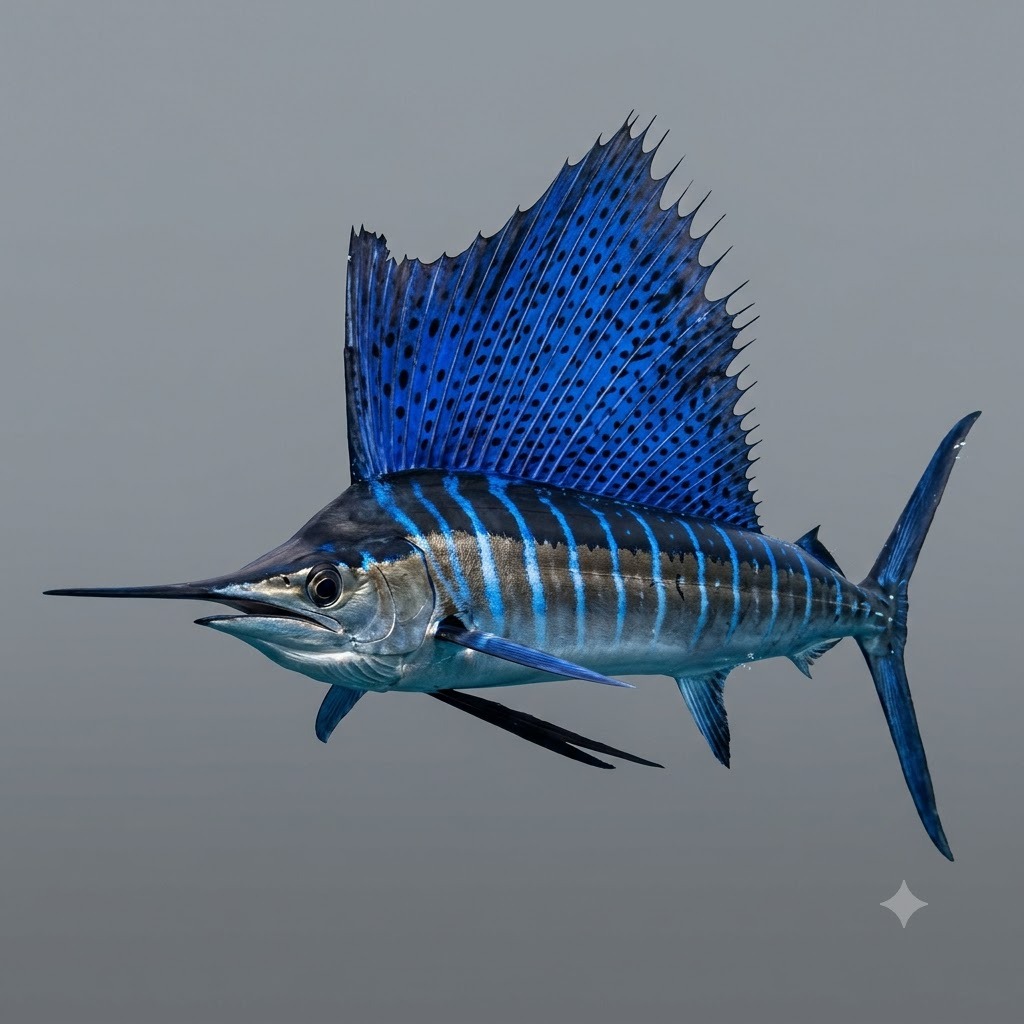
Sailfish are unmistakable. The towering, sail-like first dorsal fin - often taller than the body is deep - is the signature feature, cobalt blue and spotted, folding down into a groove when the fish is cruising and flaring up during feeding or fighting. The body is long, slim, and laterally compressed, deep blue to slate on the back, silvery-white below, and crossed by roughly twenty vertical bars of pale blue dots that flash on and off as the fish changes mood. A long, thin, rounded bill extends from the upper jaw. The pelvic fins are extremely long and narrow. When lit up in a feeding frenzy, a sailfish glows in vivid electric blues and purples - one of the great sights in all of angling.
Range & Habitat (US waters - inshore / offshore)
Sailfish are a pelagic, offshore species of warm and temperate seas. In US waters the classic fishery is off southeast Florida - Stuart, Palm Beach, Miami, and the Keys - where winter cold fronts push migrating sails south along the reef edge in remarkable numbers. They are also caught in the Gulf of Mexico off Louisiana, Texas, and the Florida panhandle, and along the warmer stretches of the Atlantic seaboard in summer.
This is strictly an offshore pursuit. Sailfish roam blue water over the continental shelf and its edge, frequently relating to temperature breaks, current edges, weed lines, and concentrations of baitfish. They often patrol relatively shallow reef edges in 60 to 200 feet during the Florida winter run, which puts them within a short offshore run of the inlets - but a seaworthy boat and open-ocean conditions are always part of the game.
Behavior & Feeding
Sailfish are high-speed pack hunters. They herd schools of small baitfish - ballyhoo, sardines, pilchards, and similar - into tight balls, then slash through with the bill to stun prey before eating it. That bill-slashing behavior is why a hooked sail often comes up "greyhounding," and why anglers frequently drop back to a fish that has swatted a bait before it fully commits. They hunt largely by sight in clear blue water and use their color-changing ability to communicate and coordinate. Under diving frigatebirds you will often find sailfish and other predators working the same bait. They are curious, aggressive, and will readily crash a spread of trolled or kited baits.
Best Seasons & Times to Catch
Timing is everything. Off southeast Florida the peak runs from late fall through winter and into early spring, when cold fronts and north winds stack migrating sailfish along the reef; a hard front followed by building seas can trigger legendary multi-fish days. Elsewhere in the Gulf and along the Atlantic, summer and early fall bring warmer water and scattered sails. Early morning is often prime, and moving current is a strong plus. Serious sailfish anglers watch the weather closely - the days right around a passing front, uncomfortable as they can be, are frequently the best of the season.
Where to Find Them - Reading the Water
Read the blue water. The reef edge and the color change where green inshore water meets clean blue is a highway. Look for tide rips, weed lines, and current edges that concentrate bait, and for temperature breaks where warm and cool water meet. Diving and circling frigatebirds are the single best visual cue - a working frigate often marks a sailfish pushing bait near the surface. Nervous bait, showering pilchards, and free-jumping fish all signal action. Many crews troll or slow-drift along a productive depth contour, watching the sky and the surface as much as the rod tips.
Tackle & Rigs
Sailfish are a light-tackle thrill, not a brute-strength contest. A 15- to 30-pound-class outfit is standard - a 7-foot conventional or spinning rod with a smooth, fast reel holding plenty of 20- to 30-pound line and a long top shot of monofilament. Because sailfish have no cutting teeth but a raspy bill, a wind-on leader of 40- to 60-pound fluorocarbon or mono, several feet long, protects against abrasion while keeping the presentation clean.
The two defining methods each have their rig. Kite fishing suspends live baits at the surface from a fishing kite, so the bait dances enticingly with the leader and hook well away from the mainline. Trolling and drifting use rigged or bridled natural baits on the leader. In all cases, non-offset circle hooks are the standard - and are required for many billfish situations - because they consistently hook the fish in the corner of the jaw and dramatically improve survival on release.
Best Baits & Lures
Natural bait rules the sailfish game. Ballyhoo, either trolled skirted or slow-dragged, is the classic. Live baits - goggle-eyes, threadfin herring, pilchards, and sardines - are deadly, especially fished from kites where they struggle at the surface. Dead baits rigged to swim or skip also produce.
For anglers who prefer to cover water, small to medium trolling lures and skirted ballyhoo combos raise fish, and teasers - hookless baits or plastic squid chains dragged in the spread - are essential for pulling curious sails up close so a pitch bait can be dropped to them. The teaser-and-pitch game, common in tournament fishing, is one of the most exciting ways to hook a sail on light tackle.
Techniques - How to Fish for It
Kite fishing is the marquee technique off Florida: a kite lifts one or more lines so live baits splash at the surface, drawing crushing strikes in full view. When a sail rises on a trolled or teased bait, the drop-back is key - free-spool line so the fish can turn and eat before the circle hook comes tight on a smooth, steady pull rather than a hard swing. With circle hooks you do not set the hook; you let the fish load the rod, then keep pressure on through the jumps. During the fight, follow the fish with the boat to recover line, bow to the jumps, and keep the drag sensible. Because these fish are almost always released, plan the release before you hook up: keep the fish in the water, control the bill with a gloved hand, revive it swimming boatside, and let it kick off strong.
Common Mistakes
The most common error is trying to muscle a sailfish on gear that is too heavy or a drag that is too tight - broken leaders and pulled hooks follow. Swinging hard to set a circle hook is another classic mistake; it pulls the bait from the fish's mouth. Anglers also mishandle the drop-back, coming tight too soon so the fish never fully eats. On the release side, dragging a green fish over the gunwale for a "hero shot," or failing to revive it before letting go, needlessly harms a fish meant to swim away. Finally, ignoring the birds and running past working frigatebirds costs more shots than any tackle choice.
Size, Records & Eating Quality
Atlantic sailfish commonly run 5 to 7 feet and roughly 30 to 60 pounds, with larger individuals possible; Pacific sailfish grow bigger on average. They are among the fastest-accelerating fish in the sea and put on a jumping display out of proportion to their weight. Eating quality is beside the point here: sailfish are not a food fish in US sportfishing culture and are overwhelmingly released. The entire billfish ethic centers on tag-and-release conservation, and many jurisdictions require circle hooks and prohibit harvest or impose strict permits and size limits. Always follow current federal Highly Migratory Species regulations, which govern billfish and change periodically.
Pros & Cons (as a target species)
Pros: Spectacular aerial fighter with blistering runs; the most accessible billfish for everyday anglers; stunning color show; strong catch-and-release culture and healthy conservation ethic; achievable on a day trip from many warm-water ports. Cons: Strictly an offshore fish requiring a capable boat and open-ocean conditions; highly weather- and season-dependent; not a table fish; demands the right circle-hook technique and careful release; specialized methods like kite fishing have a learning curve.
Best Suited For
Sailfish suit anglers ready to graduate from inshore fishing to their first billfish, as well as seasoned offshore crews chasing tournament releases. They reward patience, teamwork, and clean technique over raw strength, making them ideal for anglers who value the thrill of the jump and the pride of a healthy release over filling a cooler. A first sailfish, tagged and swimming away, is a milestone many anglers never forget.
FAQ
Do people eat sailfish? Almost never in US sportfishing. Sailfish are prized as a catch-and-release trophy, and the culture strongly favors releasing them alive.
Why do circle hooks matter for sailfish? Non-offset circle hooks hook the fish in the jaw corner rather than the gut, greatly improving survival on release. They are required in many billfish situations - never swing to set them; let the fish load the rod.
What is kite fishing? A technique where a fishing kite suspends live baits at the surface so they splash enticingly, with the line and hook held away from the mainline. It is the signature sailfish method off southeast Florida.
When is the best time to catch a sailfish in Florida? The winter run, roughly late fall through early spring, is prime - especially right around cold fronts that push migrating sails along the reef edge.
Do I need a big boat to catch sailfish? You need a seaworthy offshore boat and safe conditions, but off Florida sailfish often hold over the reef edge within a short run of the inlets, so a well-equipped center console can reach them.