White Seabass
The white seabass is one of the most prized inshore gamefish on the US West Coast, a sleek, hard-pulling silver fish that prowls the kelp beds, reefs, and squid grounds of Southern and Central California.
🗓️ Last reviewed: June 2026
Overview
The white seabass is one of the most prized inshore gamefish on the US West Coast, a sleek, hard-pulling silver fish that prowls the kelp beds, reefs, and squid grounds of Southern and Central California. Despite the name, it is not a true bass at all - it is the largest member of the croaker family in California waters, a relative of the corvina and the white croaker, and big fish make the deep, drumming croak that gives the family its name. White seabass fishing is a patient, timing-driven pursuit built around the squid spawn, the gray light of dawn, and the edges of the kelp, where these fish move in to ambush bait. They grow big - good fish run 20 to 40 pounds and trophies push past 50 and even 60 - and they fight with strong, dogged runs and a tendency to bury into the kelp. Add some of the finest white table fare in the Pacific, and the white seabass becomes a true California classic: a fish that rewards local knowledge, early mornings, and a well-presented live bait.
Identification & Appearance
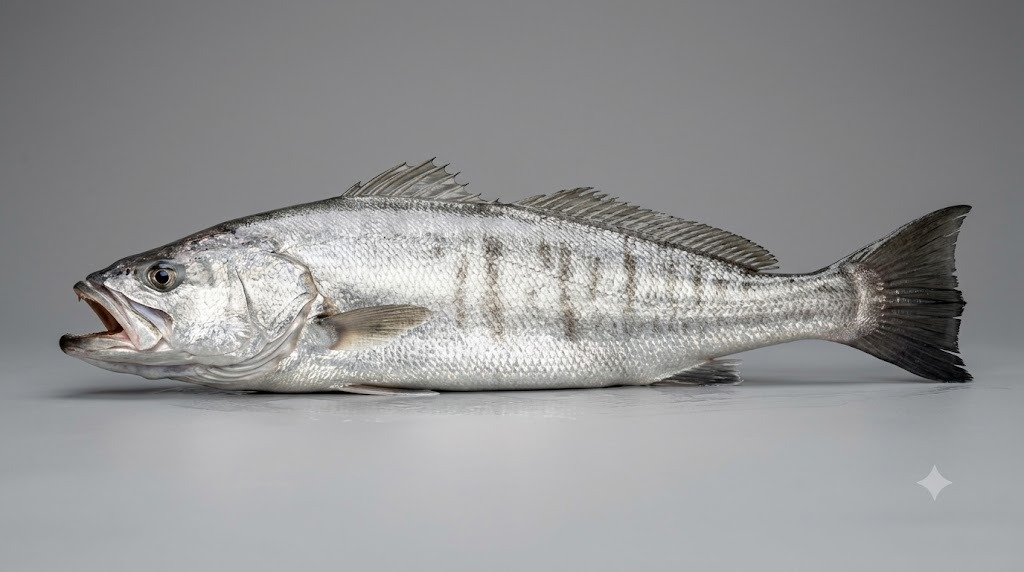
White seabass are long, streamlined, silvery fish with an elongated body, a slightly humped back, and a large mouth set in a pointed head. The back is bluish to gray, fading to bright silver on the sides and a white belly, and the body is marked with faint dusky vertical bars that are most visible on younger fish and fade with age. A distinctive feature is a raised ridge running lengthwise along the belly. The fins are dusky to yellowish, and the tail is broad and slightly forked for strong swimming. Inside the mouth, white seabass lack the heavy crushing teeth of structure feeders; instead they have a large gape suited to engulfing whole squid and baitfish. Like other croakers, they have a lateral line that extends onto the tail and otoliths (ear stones) that, combined with their swim bladder, let big fish produce a low croaking or drumming sound. Juveniles, called sea trout by some, are more strongly barred and can be confused with other croakers, but the size, silver sheen, and belly ridge mark the adult fish. The overall impression is of a powerful, clean-lined silver predator.
Range & Habitat (US waters - inshore / offshore)
White seabass are an eastern Pacific species, ranging from roughly Alaska in the north down through California and Baja California to the Gulf of California, but the heart of the US fishery is Southern and Central California - from San Diego and the Coronado Islands up through the Channel Islands, the Los Angeles and Orange County coast, Santa Barbara, and the Central Coast around Monterey. They are a signature fish of the Southern California kelp-bed and island fishery.
White seabass relate strongly to structure and bait. They hold around kelp beds and the edges of kelp forests, over rocky reefs and pinnacles, along drop-offs and current lines, and around the offshore islands where kelp, reef, and cold upwelling water concentrate squid and baitfish. They move inshore and shallow to feed, often in 20 to 100 feet of water along the kelp, and they follow the bait - especially spawning squid - onto sandy flats and reef edges adjacent to the kelp. They are largely a coastal and island species rather than a deep offshore fish, and they range from near the surface down to the bottom depending on where the bait is holding. The classic white seabass water is a kelp edge at dawn over a squid spawn.
Behavior & Feeding
White seabass are pelagic ambush predators that feed heavily on squid, sardines, anchovies, mackerel, and other baitfish, and squid is the keystone of the fishery. When market squid move inshore to spawn on the sandy bottoms near the kelp and reefs, white seabass gather to gorge, and these squid spawns trigger the best fishing of the year. The fish are strongly tied to low-light periods - they feed most aggressively in the gray light of dawn and dusk, through the night, and under overcast skies or moving water, and they often go quiet in bright midday sun. They roam the kelp edges and current lines hunting bait, using their large mouths to engulf whole squid and baitfish, and they can be there one tide and gone the next, which makes them a famously moody and timing-dependent target. They are sensitive to current and tide, often biting best on a moving tide that gets the bait active. When hooked, a white seabass makes strong, dogged runs and will dive for the kelp to break off, so the fight is a tug-of-war to keep the fish out of the cover.
Best Seasons & Times to Catch
White seabass are most strongly tied to the spring and early summer squid spawns, and that is the marquee season - roughly March through June or July is prime along Southern and Central California, when market squid move inshore to spawn and white seabass gather to feed. Good fishing can extend into late summer and fall, and there is often a secondary push, but the spring squid run is the classic window that produces the most and biggest fish. Within that, timing the day is everything: dawn is the golden period, with the gray light before and just after sunrise often producing the best bite, and dusk and night fishing are also highly productive. Overcast days and moving water extend the bite, while bright, calm midday conditions are typically slow. Tide matters - many anglers favor a moving tide and fish the dawn around a good tidal stage. In short, the formula is squid plus low light plus moving water, and the angler who is on the kelp edge at first light during a spring spawn is fishing the heart of the white seabass game.
Where to Find Them - Reading the Water
Find the kelp, the reef, and especially the squid, and you find white seabass. The most productive water is the edges of kelp beds and kelp forests, rocky reefs and pinnacles, drop-offs and hard-bottom structure, and the sandy flats adjacent to reefs and kelp where squid spawn. The offshore islands - the Channel Islands and the Coronados - are legendary white seabass grounds because they combine kelp, reef, cold water, and bait. The single biggest tell is squid: spawning squid on the bottom, squid on the surface, diving birds and bait activity, or a fish finder lit up with bait and marks over a reef or kelp edge all point to feeding white seabass. Look for current lines and color changes along the kelp, and fish the up-current edge where bait stacks. A good sounder to mark bait, squid, and fish over structure is a major advantage, and local knowledge of which kelp beds and reefs are holding squid is often the difference. As a rule, the combination of kelp or reef structure plus concentrated squid or baitfish in low light is the place to be.
Tackle & Rigs
White seabass fishing calls for a stout but balanced setup that can cast or fly-line a live bait, set the hook on a big fish, and turn it away from the kelp. A 7- to 8-foot medium-heavy to heavy fast-action conventional or spinning rod is standard, matched to a quality conventional reel (or a strong saltwater spinner) with a smooth, strong drag, loaded with 25-50 lb line. Many anglers run braid for casting distance and sensitivity with a fluorocarbon leader, while others fish straight monofilament for its forgiving stretch around the kelp; both work, and the leader is typically 20-40 lb fluorocarbon to handle the fish's sharp gill plates and the kelp.
The classic terminal setup for white seabass is a simple live-bait rig. Fly-lining - a live squid or live sardine on a bare hook with no weight, allowed to swim naturally near the surface or down the kelp edge - is the signature presentation, using a live-bait hook (commonly 1/0 to 4/0) sized to the bait. When current or depth requires getting the bait down, a sliding egg sinker or a rubber-core sinker ahead of the leader, or a dropper-loop bottom rig with a torpedo sinker, puts a live or dead squid near the bottom over the reef. For slow-trolling, a live bait or a squid is pulled slowly along the kelp on a similar leader. Sharp hooks, a quality drag, and abrasion-resistant leader to survive the kelp are the priorities.
Best Baits & Lures
Live squid is the undisputed top bait for white seabass - a lively market squid fly-lined or fished on the bottom near a spawn is the single most effective offering, and when the squid are in, little else compares. Live sardines and live mackerel are also excellent, fly-lined along the kelp edges, and live anchovies will produce as well. Fresh dead squid, fished on the bottom over reefs, is a reliable producer when live bait is scarce and is a mainstay of night fishing. Strip baits and whole dead baitfish also take fish.
On the artificial side, white seabass will hit lures that imitate squid and baitfish, and lure fishing has a strong following. Surface iron and heavy jigs - the classic West Coast metal jigs - retrieved along the kelp and reef edges can be deadly, especially at dawn, and squid-imitating swimbaits, soft plastics, and glow lures fished near the bottom or along the kelp catch fish, particularly at night and in low light. Trolled and cast plugs that mimic squid or sardines round out the artificial options. Still, for most anglers most of the time, a lively live squid is the bait that defines white seabass fishing.
Techniques - How to Fish for It
White seabass fishing is a low-light, bait-driven game built around the kelp and the squid. The signature technique is fly-lining a live bait: hook a lively squid or sardine on a bare hook, cast it to the up-current edge of the kelp or over a squid spawn, and let it swim naturally with the reel in free-spool or light drag, watching the line for the take. When the fish picks up the bait, let it eat for a moment, come tight, and set the hook firmly - then immediately apply pressure to steer the fish away from the kelp before it can dive in and break off. Slow-trolling a live bait or squid along the kelp edge at dawn is another classic method, covering water until you find feeding fish. When the bite is deeper or on the bottom, fish a live or dead squid on a sliding-sinker or dropper rig over the reef, keeping contact with the bottom and watching for the strong, dogged pull. Throughout, the keys are timing and stealth: be on the spot in the gray dawn light or at night, fish a moving tide, keep noise and shadows down in the often-clear water, and keep your bait fresh and lively. The fight is a controlled battle to keep a strong fish out of the kelp - smooth, firm drag pressure rather than panic. Patience to fish the right window and discipline to keep the fish clear of cover are the whole technique.
Common Mistakes
The most common mistake is fishing the wrong time of day - showing up in bright midday sun instead of the dawn, dusk, or night low-light windows when white seabass actually feed. Another is ignoring the squid: anglers who do not key on the squid spawn, or who fish tired, dead-looking bait, miss the entire point of the fishery, since fresh lively squid is the difference-maker. Letting a hooked fish reach the kelp by fishing too light a drag or reacting too slowly is a frequent heartbreak, as is using a leader too light to survive the kelp and the fish's sharp gill plates. Setting the hook too early, before the fish has the bait, pulls it away; setting too late lets a deeply hooked fish bury into cover. Many anglers also fish without paying attention to tide and current, missing the moving-water bite. Finally, being noisy or casting shadows in the clear, calm water near the kelp spooks these wary fish, and failing to check current size and bag regulations before keeping fish is both a legal and a conservation error.
Size, Records & Eating Quality
White seabass grow large. A typical keeper-class fish runs 15 to 30 pounds, good fish reach the 30s and 40s, and trophies push past 50 and even into the 60-pound range; the largest fish exceed five feet and decades of age. The IGFA all-tackle world record is an 83-pound, 12-ounce white seabass caught off San Felipe, Baja California, Mexico, in 1953. On the table, white seabass are superb - mild, slightly sweet, firm white fillets with a clean flavor that ranks among the most prized eating fish on the West Coast, excellent grilled, baked, pan-seared, or as sashimi and ceviche when impeccably fresh. The meat is versatile and holds up well to a variety of preparations, and the large fillets feed a crowd. Because white seabass were heavily depleted by past commercial fishing and have recovered under management and hatchery efforts, they are regulated in California with a minimum size limit (28 inches total length), a daily bag limit, and rules that can vary by season and area, so always check current California regulations before keeping fish.
Pros & Cons (as a target species)
Pros: A large, hard-pulling inshore gamefish that reaches trophy size past 50 and 60 pounds; among the finest mild white table fare on the West Coast, excellent grilled, baked, or as sashimi; a thrilling timing-and-stealth pursuit around kelp, reefs, and squid spawns; accessible from boats, kayaks, and even some shore and pier spots in Southern and Central California; deeply rewarding for anglers who enjoy reading bait, tide, and low light. Cons: Famously moody and timing-dependent - they can be there one tide and gone the next; the best fishing demands early dawns, night sessions, and being on the squid; hooked fish dive for the kelp and break off without firm drag and stout leader; strongly dependent on live squid availability, which varies; strictly regulated with size and bag limits and a recovery history; largely a regional Southern/Central California fishery rather than a coast-wide one.
Best Suited For
White seabass are best suited to patient, opportunistic anglers who are willing to fish the dawn and the night, key on the squid spawn, and learn the kelp beds and reefs of the California coast. They reward local knowledge, good live bait, and the discipline to keep a strong fish out of the kelp, and they are a favorite of Southern California boat and kayak anglers who relish a big, prized, hard-fighting fish that also happens to be outstanding eating. Beginners can certainly catch white seabass, especially fishing live squid on a party boat during a good spring run, but the moody, timing-driven nature of the fish means there is a real element of being in the right place at the right time. In short, the white seabass is a California classic: a big, sleek, delicious croaker that rewards anglers who fish the gray light, follow the squid, and respect the kelp.
FAQ
Is white seabass a true bass? No - despite the name, white seabass is the largest member of the croaker (drum) family in California, related to corvina and white croaker, not a true bass. Big fish make the deep croaking sound typical of the family.
Is white seabass good to eat? Yes - it is one of the most prized eating fish on the West Coast, with mild, slightly sweet, firm white fillets that are excellent grilled, baked, pan-seared, or as sashimi and ceviche when very fresh.
What is the best bait for white seabass? Live squid is the top bait by far, especially during the spring squid spawn. Live sardines and mackerel are also excellent, and fresh dead squid works well on the bottom and at night.
When and where do I catch white seabass? Fish the kelp edges, reefs, and squid grounds of Southern and Central California - including the Channel Islands and Coronados - in spring and early summer, focusing on dawn, dusk, and night in low light on a moving tide.
How big do white seabass get? Good fish run 20 to 40 pounds, trophies exceed 50 and even 60 pounds, and the largest are over five feet long. The all-tackle world record is an 83-pound, 12-ounce fish from Baja.